

The Meerab III National Convention presents a decisive sovereignty-focused agenda, calling for accountability, state restoration, legal measures, and institutional authority.
Reclaiming the State and its compromised sovereignty
Reclaiming the State and its compromised sovereignty
By The Beiruter | March 31, 2026

Reading time: 5 min
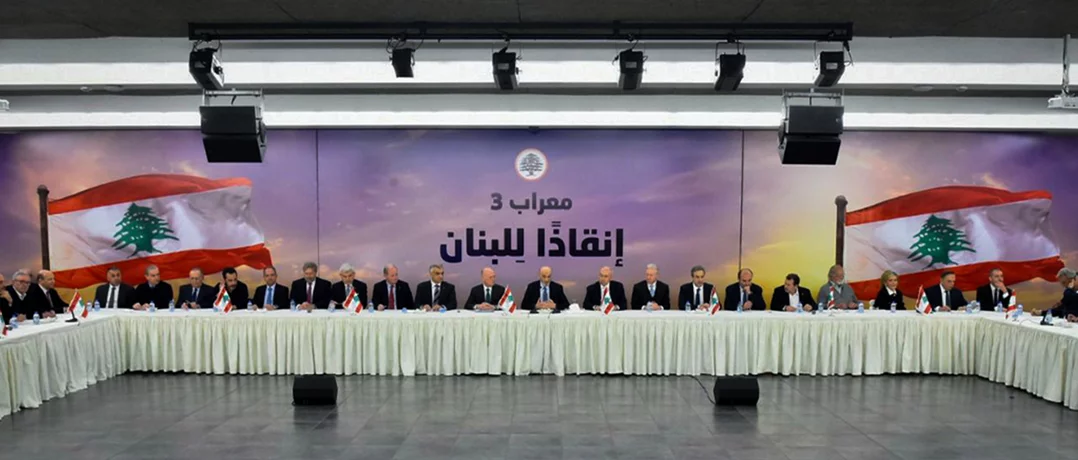
Amidst the ongoing armed conflict between Israel and Hezbollah, as well as persistent Iranian interference in Lebanon, various Lebanese actors and figures have embarked on an extensive and determined process of reclaiming the country’s long-compromised sovereignty and territorial integrity.
This process is not confined to a certain sect or political party, but rather encompasses a wide range of actors that share the same beliefs and vision for a prosperous, secure, and viable Lebanese State, capable of retaining exclusivity of arms and enforcing its authority across its territories as well as resist any kind of foreign intervention.
In this context, the third Maarab National Convention, convened on 28 March 2026 at the Lebanese Forces Party (LF) Headquarters (HQ) in Maarab, and was headed by LF leader Samir Geagea, joining distinct, yet likeminded, influential figures and parties to voice one message: Save Lebanon.
Parallels with the road leading up to 14 March 2005
The Maarab III convention bears notable similarities to the sequence of events and initiatives that culminated in the Cedar Revolution of 14 March 2005. While the contexts differ, the structural parallels are striking.
First, both moments are characterized by a gradual accumulation of political pressure. In the years leading up to 2005, calls for Syrian withdrawal gained momentum through initiatives such as the Maronite Bishops’ Call of 2000, the 2001 Qornet Shehwan Gathering, and the Bristol meetings of 2004. Similarly, the Maarab conventions represent a cumulative process, moving from warnings to demands and from political critique to institutional proposals, providing the necessary foundations for the aspired change in the future.
Second, both periods reflect the convergence of diverse actors around a shared objective. The March 14 movement was notable for bridging sectarian and political divides, bringing together Christian, Sunni, Shiite, and Druze constituencies under the slogan of sovereignty and independence. Maarab III offers strike resemblance by convening various political parties, independent figures, and civil society representatives who share a common stance on state authority and the rejection of external influence.
Therefore, today’s efforts might not yield immediate outcomes, as one might expect. However, based on previous experiences during the Syrian occupation of Lebanon (1990-2005), sustained determination and cumulative efforts ultimately result in attaining the aspired objectives.
The Maarab III National Convention and its significance
The Maarab III National Convention must be understood within the broader trajectory of similar initiatives held since 2024. The first 2 conferences had already warned against the risks of entangling Lebanon in regional conflicts, particularly following Hezbollah’s unilateral decision to engage in a “support front for Gaza.” Those warnings, reiterated on 27 April and 12 October 2024, stressed the adherence to all United Nations Security Council (UNSC) resolutions, most notably 1559 (2004), 1680 (2006), and 1701 (2006).
However, by 2026, the tone had fundamentally shifted. The convention’s significance lies in its transition from preventive diplomacy to subsequent political positioning and assertiveness, calling for effective and decisive measures to be taken. The participants argued that Lebanon has been dragged into a devastating conflict, one that was neither permitted by its constitutional institutions nor reflective of national consensus. The war was described as a “collective suicide,” imposed by force and serving external agendas rather than Lebanese interests.
This framing is crucial. It elevates the debate from a partisan disagreement to a question of sovereignty and state survival. The assertion that “the continued existence of weapons outside state control is no longer a political issue but an existential threat” summarizes the convention’s central argument. By doing so, participants positioned themselves as part of a broader effort to redefine the national discourse around legitimacy, authority, and accountability.
In this context, key and decisive decisions were taken during the convention. This included the establishment of a special court to prosecute those responsible for dragging Lebanon into war, holding Iran and Hezbollah responsibility for the war and the destruction and losses incurred, demanding that reconstruction costs should not fall on the Lebanese State or taxpayers but rather on those who initiated and participated in the conflict, and fully enforcing government decisions (issued on 5 and 7 August 2025 as well as on 2 March 2026) alongside immediately deploying the Lebanese Armed Forces (LAF) across all territories.
Furthermore, Geagea stated to The Beiruter that the matter of Iran’s ambassador-designate to Lebanon, Mohammad Reza Sheibani, who was recently declared persona non grata , rests squarely with the country’s security apparatus. “This falls within the responsibilities of the relevant security agencies, particularly General Security,” he said, adding that the agency should approach the ambassador and “send him from the airport to Iran with full respect.” Should the envoy refuse to leave, Geagea warned, the terms are clear: “He remains within the embassy’s compound, while the relevant authorities wait until he comes out.“
It is worth noting that this is not the first time that Lebanese-Iranian relations witnessed heightened tensions, as similar measures were also taken in 1983 during President Amine Gemayel’s term, whereby a decision was taken to severe diplomatic relations with Iran and close its embassy in Beirut, asking the chargé d'affaires and embassy staff to leave Lebanon. In light of the 1979 Iranian Revolution and the establishment of the Islamic Republic, Tehran’s Islamic Revolutionary Guard Corps (IRGC) latter embarked on a project to export its revolution in the region, thus establishing Hezbollah in 1982. Persistent interference in domestic affairs led Gemayel, as well as today’s engaging figures, to confront Iran’s ambitions by taking various decisive measures.
Hence, by articulating a comprehensive framework that combines accountability, state restoration, and legal recourse, cross-sectarian and political factions seem determined to redefine the parameters of political debate in a country long marked by ambiguity and compromise. Its stress on sovereignty, the monopoly of arms, and the rule of law echoes earlier moments in Lebanese history, particularly the prelude to 14 March 2005.
-
-

-
The Beiruter
-
