



An exhibition at Palais Debbané brings together rare restored Melkite icons from Saida’s Church of St. Nicholas, revealing layered Orthodox and Greek Catholic identities and centuries of Lebanon’s religious and artistic heritage.
Restored Melkite icons shine again in Palais Debbané
Restored Melkite icons shine again in Palais Debbané
By Patricia Khoder | February 19, 2026

Reading time: 3 min
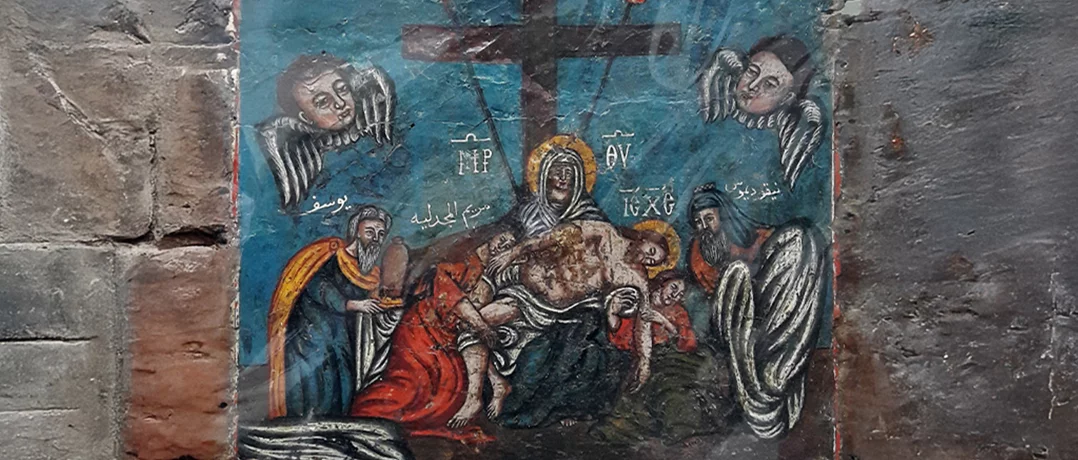
An exhibition of rare Melkite icons is on display at Palais Debbané until June, offering visitors a rare glimpse into Lebanon’s religious and artistic heritage. Organized by the Greek Catholic bishopric of Saida, the show brings together around 50 icons that were damaged by time, humidity, and years of poor storage during and after the country’s 1975-1990 war. After an extensive restoration led by artist Lena Kelekian, the works are once again on display.
The icons once adorned the historic Church of St. Nicholas in Saida’s old city, a place long shared by Greek Orthodox and Greek Catholic communities. During the Ottoman era, a wall was erected inside the church to divide the space and quell disputes between the two groups. The structure remains a symbol of the city’s complex religious history.
According to Greek Catholic Bishop Elie Haddad of Saida, the significance of the icons lies in their layered identity.
“Some of these icons were initially written in the Orthodox iconographic tradition,” he says.
When we entered into communion with the Catholic Church in 1724, the same icons were rewritten, sometimes on a second or third layer, in the Melkite style.
The 1724 schism formalized the establishment of the Melkite Greek Catholic Church when a part of the Orthodox community entered into communion with Rome while retaining the Byzantine rites.
As a result, some icons in the collection contain multiple artistic and theological layers. In certain cases, Kelekian chose to preserve both the original Orthodox imagery and the later Melkite reinterpretation on the same wooden panel, allowing viewers to see the evolution of identity expressed through art.
The project was first discussed around 2000, during the tenure of Bishop Georges Kwaiter, Haddad’s predecessor. However, it took years to materialize. Financial support was provided by the Hariri family, allowing the conservation effort to proceed.
Father Nicolas Riachi, an expert in iconography, describes the collection as a rare and compelling testament to the region’s artistic and religious heritage. “The oldest icon in the collection dates to 1708, followed by another from 1711,” he says.
There are works by local artists, particularly from Saida and Deir el-Qamar, including one known as Boutros el-Ajami. Other icons belong to the schools of Aleppo and Jerusalem. The collection represents many of the major feasts of the Church.
Although most of the icons are now displayed, some of the larger pieces are still undergoing restoration. By the completion of the project, Kelekian will have restored 59 icons in total.
Kelekian said the effort was both technically demanding and emotionally meaningful. The icons varied greatly in size and condition, from large panels to extremely small and fragile works requiring careful stabilization.
“Technically, each icon was a case on its own,” she says. Some required reinforcement and a month-long drying period before cleaning and retouching could begin. In certain cases, she had to remove earlier incorrect repainting before restoring missing sections and applying protective varnish. The process often involved reinforcing the wood panel, allowing it to stabilize, completing the restoration and then reinforcing it again to ensure long-term preservation.

The pigments used in the original works were primarily natural materials, consistent with pre-18th century techniques. Kelekian says she continues “to use similar natural pigments in her own conservation practice. One of the most striking features of the collection, she adds, is that all inscriptions are in Arabic: Usually, the icons I restore are in Greek, Russian or Romanian”.
“Discovering the details during restoration was extraordinary,” she says. “These icons came from Saida. There was an emotional layer history, material, country, city. Layer upon layer.”
Some icons remain purely Greek Orthodox in style, while others reflect Melkite influences ranging from simple and naïve to more refined and sophisticated compositions. Together, they illustrate the artistic exchanges that shaped Christian communities in the eastern Mediterranean.
To host the exhibition, the bishopric partnered with Raphaël Debbané, president of the Debbané Foundation. In 1990, Debbané restored his family’s historic residence in Saida and transformed it into a museum now known as Palais Debbané. The exhibition layout was organized by architect Jean-Louis Mainguy shortly before his death. The Debbané Foundation also produced a trilingual catalog in Arabic, French and English.
“We are part of the community and only steps away from the church,” Debbané says. “We are honored to host these icons. They have both historical and economic value, and preserving them is a priority.”
Debbané said the museum had originally planned a virtual exhibition on the sarcophagi of the kings of Sidon, housed at the Archaeological Museum of Istanbul, but postponed it to accommodate the icons. The exhibition occupies the entire second floor of the palace.
Beyond preservation, organizers hope the show will help revive cultural tourism in Saida.
A few years ago, Palais Debbané welcomed 35,000 visitors annually, but that number has declined since 2024 following the outbreak of the war in Gaza and Israeli bombardments in southern Lebanon.
For Debbané, safeguarding Saida’s heritage goes hand in hand with encouraging visitors to return. Bishop Haddad and Kelekian share that hope, viewing the exhibition as both a cultural and spiritual milestone.
For at least the next six months, the restored icons will remain at Palais Debbané, just steps from the Church of St. Nicholas in Saida’s historic district. The palace, a 19th-century mansion converted into a museum, stands near other cultural landmarks, including the Soap Museum of the Audi Foundation and Khan Sacy.
-
-
-
Patricia KhoderJournalistFocusing on culture and entertainment.
-
