



Marking the launch of a new LLWB-AUB partnership, former U.S. Special Advisor on International Disability Rights Sara Minkara challenged institutions to move disability beyond accessibility and into leadership, diplomacy, technology and public policy.
Rethinking disability in the halls of power

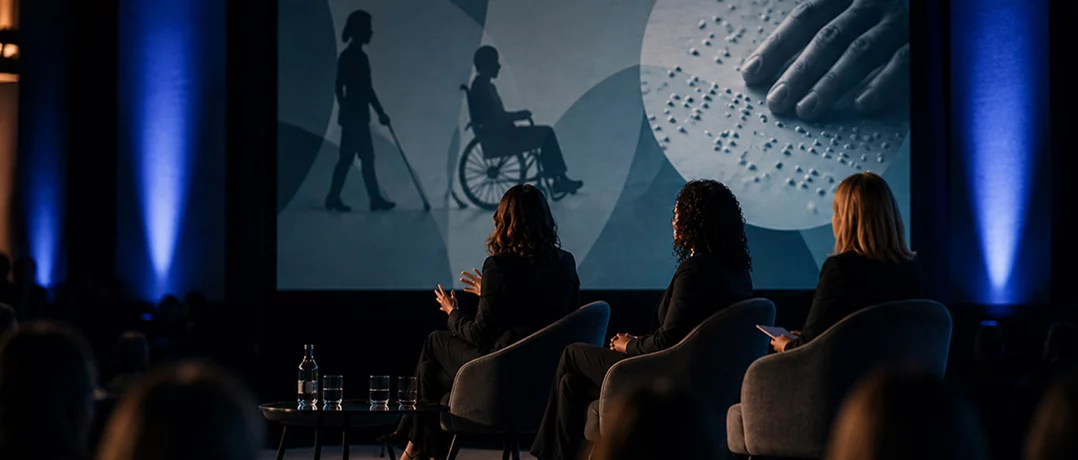
What if disability were no longer treated as a social issue, but as a question of diplomacy, economic policy, and leadership?
Around 1.3 billion people, or one in six globally, live with a significant disability, according to the World Health Organization. Yet discussions about disability continue to center largely on accessibility and social policy rather than the institutions where decisions on trade, technology, foreign policy and economic development are made.
Those questions took center stage this week at the American University of Beirut during a conversation hosted by the Lebanese League for Women in Business and AUB's Center for Women in Business. The event also marked the launch of a new partnership between the two organizations and the introduction of the Women Shaping Business Fellowship, an Executive MBA initiative designed to support women pursuing leadership roles.
Throughout the discussion, former U.S. Special Advisor on International Disability Rights Sara Minkara challenged the tendency to treat disability as a standalone issue, arguing it should instead be integrated into leadership, diplomacy, artificial intelligence and public policy.
"Inclusion is hard work. It's adaptive work. It requires leaders to roll up their sleeves," Minkara said.
"Real inclusion is recognizing talent, creating opportunity and removing barriers, not checking a box."
Disability as diplomacy
Disability has long been discussed through the lens of accessibility, social protection and human rights. Minkara argued that this approach overlooks its relevance to many of the decisions that drive governments and economies.
During her time in government, Minkara pushed to integrate disability into foreign policy, arguing it should inform discussions ranging from trade and security to diplomacy and economic development.
Rather than asking government officials what they were doing on disability inclusion, she began by asking about their top priorities before demonstrating how disability could support those objectives.
"I wanted them to rethink disability as something that advanced their own agenda," she said.
"I wanted people to care about disability because it strengthened their work, not because they were doing us a favor."
Her own background also became an asset. As a blind, hijab-wearing Muslim Arab-American woman, Minkara said her “visible and invisible identities” often disrupted assumptions about who could represent the United States, while creating connections across the Arab world, Central Asia and Southeast Asia.
“My identities became one of my greatest sources of soft power in diplomacy,” she told The Beiruter.
"Disability is an amazing diplomatic tool because most countries are willing to engage on these issues. It opens doors that otherwise remain closed."
Accessibility as innovation
The next arena of that approach may be artificial intelligence.
Artificial intelligence has become one of the defining policy debates of the decade. Governments are developing regulatory frameworks while companies invest billions of dollars in more capable systems. McKinsey estimates that generative AI could contribute between $2.6 trillion and $4.4 trillion annually to the global economy.
As governments and companies develop AI, disability remains largely absent from decisions about how these systems are designed and governed. Minkara argued that the conversation should begin not with how AI can help people with disabilities, but with whether people with disabilities are helping build it.
“If people with disabilities aren’t involved in designing these technologies, AI will leave us behind,” she said.
“AI won’t simply introduce bias. It will make many technologies inaccessible from the outset.”
Responding to a question from The Beiruter, she cited autonomous vehicles, biometric identity systems and ChatGPT as examples of technologies that may create new opportunities while also producing barriers for users whose needs were not considered during development. A tool that saves time for one employee, for example, may place another at a professional disadvantage if its interface is difficult to navigate with assistive technology.
Accessibility must therefore be considered throughout design, testing, deployment and governance.
Rights, budgets and accountability
Lebanon ratified the U.N. Convention on the Rights of Persons with Disabilities in 2022, years after civil society groups had begun pressing Parliament to adopt it.
Minkara supported the campaign through her earlier work in Lebanon before raising the convention with senior Lebanese officials while serving as a U.S. diplomat. Parliament ultimately ratified the convention, but she said members of the disability community expressed frustration that progress came only after sustained international engagement.
But ratification alone does not determine whether people can access transport, education, employment, technology or public services. Minkara argued that responsibility must extend beyond ministries traditionally associated with disability and into every part of government, including infrastructure, economic planning and reconstruction.
That responsibility becomes most visible in public spending.
“A budget reflects what a country truly values,” she said.
“If disability isn't reflected in government budgets, then it cannot be considered a national priority."
She applied the same principle to international assistance, arguing that disability should be embedded in donor-funded programs rather than addressed through separate accessibility initiatives.
Separate disability initiatives cannot compensate for inaccessible public systems. Governments and donors should be judged by whether schools, transport, employment programs and digital services serve the full population.
Women, work , and sponsorship
Disability affects women's economic participation in multiple ways. Women with disabilities continue to face barriers to employment, while women without disabilities often shoulder unpaid caregiving responsibilities for relatives, limiting their own participation in the workforce.
Speaking with The Beiruter, LLWB President Abir Chebaro said women are disproportionately affected by disability because they often assume primary caregiving responsibilities for family members, making disability inclusion inseparable from women's economic participation.
Chebaro described investment in women as producing benefits that extend far beyond individual careers.
“We both believe in the ripple effect,” she said.
“An empowered girl or woman contributes to her family, her workplace, her community and the wider economy.”
Access alone is not enough. Leadership also depends on those already in positions of influence creating opportunities for the next generation.
“How do we intentionally sponsor younger women?” Minkara asked.
"How do we deliberately open doors, advocate for younger women and create opportunities for them?"
The same principle applies to disability inclusion. Representation alone cannot replace access to authority, opportunity and decision-making. Institutions become more inclusive only when leaders use their power to remove barriers and ensure that talent is not overlooked because someone was never considered when the system was designed.
-
-

-
The Beiruter
-
