



The 1983 U.S. Embassy bombing in Beirut marked a turning point in modern terrorism, reshaping U.S. foreign policy, particularly with regards to Lebanon.
Revisiting the 1983 suicide attack on the US embassy in Lebanon
Revisiting the 1983 suicide attack on the US embassy in Lebanon
By The Beiruter | April 18, 2026

Reading time: 4 min
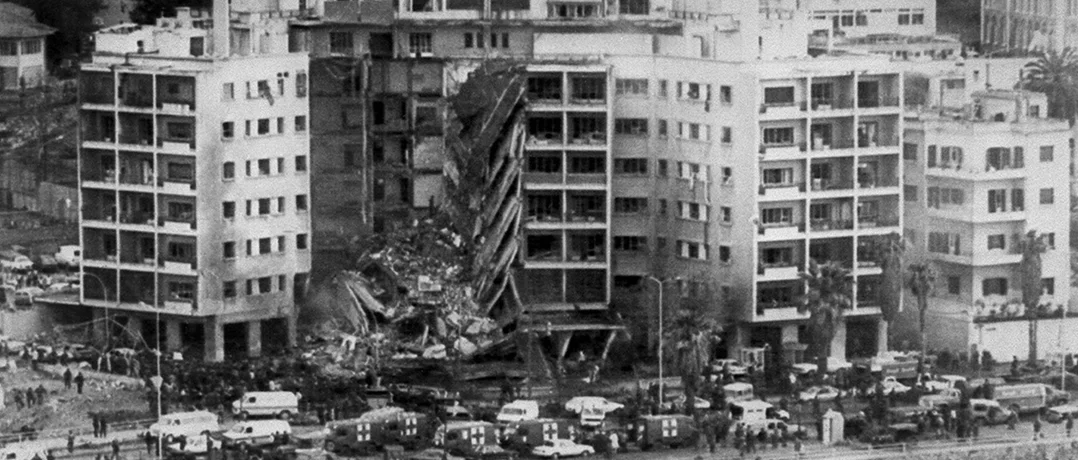
On 18 April 1983, a devastating suicide bombing targeted the United States (U.S.) Embassy in Beirut, marking a turning point in both the Lebanese War (1975-1990) and the global trajectory of modern terrorism.
The attack, which killed 63 people, including 17 Americans, was among the earliest large-scale suicide bombings against a diplomatic mission. It was followed months later by the October 1983 bombings of the U.S. Marine barracks and French paratrooper headquarters, which together claimed nearly 300 lives.
These coordinated acts of violence not only reshaped U.S. foreign policy in the Middle East but also redefined the nature of asymmetric warfare, embedding suicide attacks into the strategic playbook of militant groups.
Historical context: Lebanon in turmoil
To understand the 1983 embassy bombing, it is essential to situate it within the broader context of the Lebanese War. Lebanon, once known as the “Jewel of the Mediterranean,” had descended into a brutal armed conflict in 1975 involving a complex web of non-state armed groups, foreign interventions, and ideological struggles.
At the onset, the conflict had drawn in regional and international actors, including Syria and Israel. Following Israel’s invasion of Lebanon that year, a Multinational Force (MNF) comprising American, French, and other Western troops, was deployed to Beirut to oversee the withdrawal of the Palestine Liberation Organization (PLO) and to stabilize the capital. Initially framed as a peacekeeping mission, the presence of foreign troops quickly became controversial.
Militant groups, particularly those aligned with Iran’s revolutionary ideology, viewed the MNF as an occupying force and allied to Israel. Emerging groups such as Hezbollah and the Islamic Jihad Organization began to adopt increasingly sophisticated and deadly tactics, setting the stage for the attacks of 1983.
The April 1983 embassy bombing
At approximately 1:00 p.m. on 18 April 1983, a suicide bomber drove a truck packed with around 2,000 pounds of explosives into the U.S. Embassy in Beirut. The explosion devastated the building, collapsing its central section and killing dozens instantly. Among the dead were 8 Central Intelligence Agency (CIA) officers, making it the deadliest day in the agency’s history.
The attack was claimed by the Islamic Jihad Organization, a shadowy group widely believed by U.S. intelligence to be linked to Hezbollah and backed by Iran. The choice of target was deliberate: the embassy symbolized American political and intelligence presence in Lebanon. By striking it, the perpetrators aimed to send a clear message that foreign involvement would be met with force.
The bombing introduced a new level of lethality and precision in terrorist operations. Unlike previous attacks that relied on smaller explosives or targeted individuals, this operation demonstrated the destructive potential of suicide vehicle-borne improvised explosive devices (SVBIEDs). It marked a tactical evolution that would later be replicated in conflicts across the globe.
The October 1983 attacks
The April embassy bombing was not an isolated incident but rather the beginning of a broader campaign. On 23 October 1983, 2 nearly simultaneous suicide attacks targeted the U.S. Marine barracks and a French military installation in Beirut. A truck bomb demolished the Marine barracks, killing 241 American servicemen, while a separate explosion killed 58 French paratroopers.
These attacks represented the deadliest single-day loss for the U.S. Marine Corps since World War II (1939-1942). They underscored the vulnerability of even heavily guarded military installations to unconventional tactics. The psychological impact was immense, both within the U.S. and among its allies.
Implications for U.S. foreign policy, particularly in Lebanon
The 1983 attacks had a profound and lasting impact on U.S. foreign policy. In the immediate aftermath, the administration of Ronald Reagan faced mounting domestic pressure to reassess American involvement in Lebanon. The perception that U.S. forces were entangled in a complex and unwinnable conflict led to a strategic withdrawal. By February 1984, U.S. Marines had been pulled out of Beirut, effectively ending the American role in the MNF.
More broadly, the attacks forced a reevaluation of how the U.S. approached peacekeeping and military deployments in volatile regions. The notion of neutrality in such environments was called into question, as U.S. forces were increasingly seen as partisan actors rather than impartial peacekeepers.
In Lebanon specifically, the attacks marked a turning point in U.S. engagement. The withdrawal of American forces signaled a shift from direct military involvement to a more cautious, indirect approach. Washington increasingly relied on regional allies and diplomatic channels rather than deploying troops on the ground.
The events also contributed to the rise of Hezbollah as a significant political and military force in Lebanon. By targeting Western powers and forcing their withdrawal, the group garnered support and notable influence among certain segments of the population. This development would have long-term implications for Lebanon’s internal dynamics and its relations with the U.S. The latter has sought to severely erode Hezbollah’s military and political position, enlisting it as a terrorist organization. Indeed, the memory 1983 attacks still lingers in U.S. decision-makers’ mindset. For instance, as soon as the war between Israel and Hezbollah erupted on 2 March 2026, the White House issued a statement reminding of the “partial record of the Iranian regime’s blood-soaked war on Americans, “including the aforementioned group’s attacks.
Ultimately, for the U.S., these events prompted a fundamental reassessment of foreign policy, particularly in conflict zones like Lebanon. They led to the withdrawal of troops, the overhaul of diplomatic security, and a more cautious approach to international interventions. More than 4 decades later, the legacy of the 1983 attacks continues to shape U.S. strategy and serves as a stark reminder of the enduring complexities of Middle Eastern geopolitics.
-
-

-
The Beiruter
-
