



Beirut’s Le Monnot Theatre has re-emerged under Josyane Boulos, blending community-driven programming with renewed international attention a symbol of Lebanon’s cultural resilience.
Reviving Beirut’s stage: Le Monnot theater’s journey to life
Reviving Beirut’s stage: Le Monnot theater’s journey to life
By Angie Mrad | February 02, 2026

Reading time: 4 min
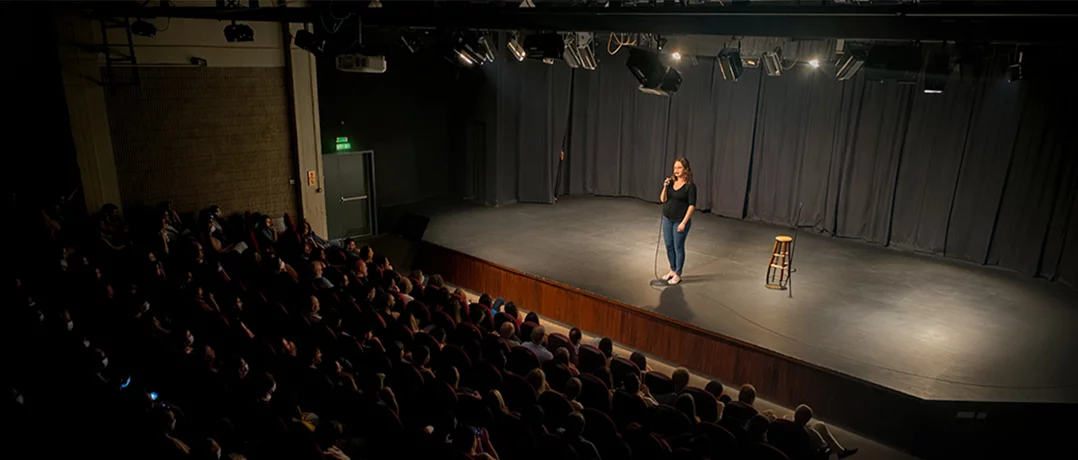
In a city where cultural spaces struggle to survive amid political, economic, and security crises, Le Monnot Theatre continues to stand as one of Beirut’s most active artistic places. Founded in 1997 in collaboration with IESAV at Saint Joseph University, the theatre has long been a home for live performance and creative exchange. But in recent years, its future had grown uncertain, reflecting the broader fragility of Lebanon’s cultural sector.
That journey shifted in April 2022, when Josyane Boulos took over the management of the theatre. This April marks four years since she took on the role, a time in which Le Monnot has been visibly transformed. The transformation was not dramatic or sudden, but built gradually through persistence, structure, and belief in the power of culture.
“I want to bring peace through theatre,” Boulos says. For her, theatre is not a luxury or an escape from reality, but a space where people can pause, breathe, and reconnect. In a country shaped by constant tension, she sees art as a way to restore calm and humanity, even if only for a few hours.
Reviving Le Monnot also meant confronting financial reality. With no real state support for culture in Lebanon, Boulos relied on limited funds, private sponsors, and partnerships to stabilize the theatre and allow it to function again. These resources made it possible to sustain programming, and rebuild confidence among artists and audiences.
For Boulos, managing Le Monnot is the realization of a long-held dream. “I always dreamed of having a theatre,” she says. “Now this dream is coming true.” But her vision went beyond simply running a venue. She wanted to create a space that lives beyond performance hours.
Today, Le Monnot is always open, not just when there is a show. It hosts workshops, provides areas for reading and quiet work, and includes a bar where people can have coffee or drinks. The theatre has become a cultural hub rather than a closed institution, a place where people can gather, meet, and spend time even without buying a ticket. In a city where public and cultural spaces are shrinking, this openness has given Le Monnot a new social role.
The programming remains central. The theatre operates across two spaces: the Grand Hall, with 260 seats, and the more intimate ACT Hall, with 60 seats. It hosts Lebanese and international productions, experimental theatre, emerging artists, and performances for younger audiences. But what distinguishes Le Monnot today is the environment surrounding the stage: one of warmth, accessibility, and continuity.
Attention to detail has reshaped the experience. Sound quality, lighting, cleanliness, and hospitality are treated as essential, not secondary. “Respect builds trust,” Boulos says. “When people feel respected and welcomed, they return.” The atmosphere of the theatre has shifted from institutional to intimate, making it a place people feel comfortable inhabiting, not just visiting.
Le Monnot has also strengthened its role as a platform for young and independent artists. At a time when creative opportunities in Lebanon are increasingly limited, it offers a rare space for experimentation and visibility. It continues to serve as a bridge between Lebanese, Arab, and international productions, keeping Beirut connected to broader cultural networks.
That renewed standing will be reflected at the beginning of April, when renowned French actor François Cluzet is set to perform on its stage. His presence signals not only a major cultural event, but also the theatre’s regained international visibility, challenging the idea that Lebanon has fallen out of global artistic circulation.
Asked what advice she would give to young artists, Boulos does not hesitate: “Do what your heart wants. Follow your heart.” It is a philosophy that reflects both her personal journey and the way she has rebuilt Le Monnot - not through calculation alone, but through intuition, courage, and trust in what feels right.
For Boulos, theatre remains one of the last spaces of direct human encounter. “It is the only art form where there is no screen between people,” she says. “Everything today is mediated. Theatre is where we still meet face to face.”
Four years into this chapter, Le Monnot Theatre stands as an example of how culture in Lebanon survives through individual initiative and collective belief. Revived through vision, and community engagement, it is no longer only a place to watch a play. It is a living space for dialogue, rest, creativity, and connection. A space where, as Boulos hopes, peace can still be created—one performance, one conversation, and one gathering at a time.
