

How a fifteenth-century mountain community turned faith, verse, and a distant papal alliance into one of Lebanon's oldest symbols of freedom.
Roses between the thorns

High in the limestone folds of Lebanon's Qadisha Valley, weathered stone tablets still carry the carved crosses of a community that has spent fifteen centuries proving one point: a faith rooted in these mountains does not move.
The Maronites of Mount Lebanon built their history out of monasteries burned and rebuilt, patriarchs captured and killed, and alliances struck with distant powers whenever no local one could be trusted. Few episodes tell that story more vividly than the closing decades of the fifteenth century, when a Franciscan friar, a Lebanese poet-bishop, and a mountain chieftain's ambition collided, leaving behind a phrase that has outlived all three of them: a rose among the thorns.
It is a small story carrying a much larger question: whether a minority community, wedged into one of history's most contested regions, could insist on governing its own faith and still survive.
By the 1430s, the Maronite Church was already a survivor. Mamluk campaigns in 1268,1283 and 1305 had razed the strongholds of Ehden, Jubbat Bsharri and Kesrawan; a Patriarch from Hadshit was captured and put to death, and in 1367 another, Gabriel of Hjoula, was burned alive outside Tripoli.
Then, in 1439, Rome extended a hand: Pope Eugene IV summoned the churches of the East to the Council of Florence, and Patriarch John al-Jajji answered, pledging in advance to accept its decisions. The governor of Mamluk Tripoli, suspicious of any tie between his Christian subjects and the West, burned the Patriarchal monastery of Mayfouq in response. The Patriarch withdrew to a narrower, safer refuge - the Monastery of Our Lady of Qannoubine, cut into the cliffs of the Wadi Qadisha - which would remain the seat of the Maronite Church for the next three hundred years.
Into that fragile opening, Rome sent its missionaries. Franciscan friars based in Beirut and Jerusalem took charge of Maronite affairs, and the most consequential of them was a friar remembered simply as Gryphon. Fluent in Arabic and Syriac, he spent a quarter-century - from 1450 until his death around 1475 - walking the mountain villages, building churches, and earning the trust of Patriarch Peter al-Hadathi. Around 1470, Gryphon chose three young Maronites from the village of Lehfed to train as Franciscans in Italy. They would not see Mount Lebanon again for more than two decades.
Of the three, it was Gabriel, later known to history as Gabriel Ibn al-Qila'i, who left the deepest mark. He studied theology and Latin letters in Venice and Rome, was ordained a priest. When he finally sailed home in 1493, after twenty-three years away, Mount Lebanon was not the country he remembered. It was, at that moment, dangerously divided against itself.
The trouble centered on Bsharri, whose muqaddam - a hereditary local chieftain - was a headstrong young man named Abd al-Mun'im Ayyub. For years he had contested the Patriarch's growing authority, an authority that had expanded as the Patriarchate leaned further into its Roman alliance. To build a rival power base, Abd al-Mun'im extended his protection to a community of Jacobites, Syriac Christians who had settled in Jubbat Bsharri under earlier muqaddams, and used them to needle the Patriarch at every turn. Favoring these newcomers over his own Rome-aligned flock cost him dearly: the people of the Jubbah turned against him and rallied around their Church instead.
The rupture turned violent in 1488. Abd al-Mun'im called on Muslim fighters from the neighboring district of Dinniyeh to march on Ehden and discipline its people for defying him. It was a miscalculation. Forewarned, the men of Ehden set an ambush outside the town and destroyed the approaching force. The defeat broke Abd al-Mun'im's standing beyond repair: he could no longer protect his Jacobite allies, who scattered from the Jubbah in fear, and his authority never recovered before his death in 1495.
Into that vacuum stepped Ibn al-Qila'i. Settling at Tannourine, he threw his energy behind the Patriarchate, wielding the one weapon he had sharpened in Italy: verse. He composed zajal - sung, colloquial poetry - praising the Maronite Church's constancy and rebuking Abd al-Mun'im and any Maronite drifting toward rival loyalties. His most ambitious composition, a long panegyric on Mount Lebanon, cast the Maronite people as a community chosen by God, led to the safety of the mountain, and entrusted with guarding the true faith and the dignity of Christianity in the East.
Historians still cite it as the moment a scattered mountain people first described itself in the language of nationhood. Ibn al-Qila'i's argument was blunt: every calamity the Maronites had suffered traced back to disunity. Only a people standing together - muqaddams and peasants, clergy and laity - behind their Patriarch and in communion with Rome, could hope to keep the mountain free.
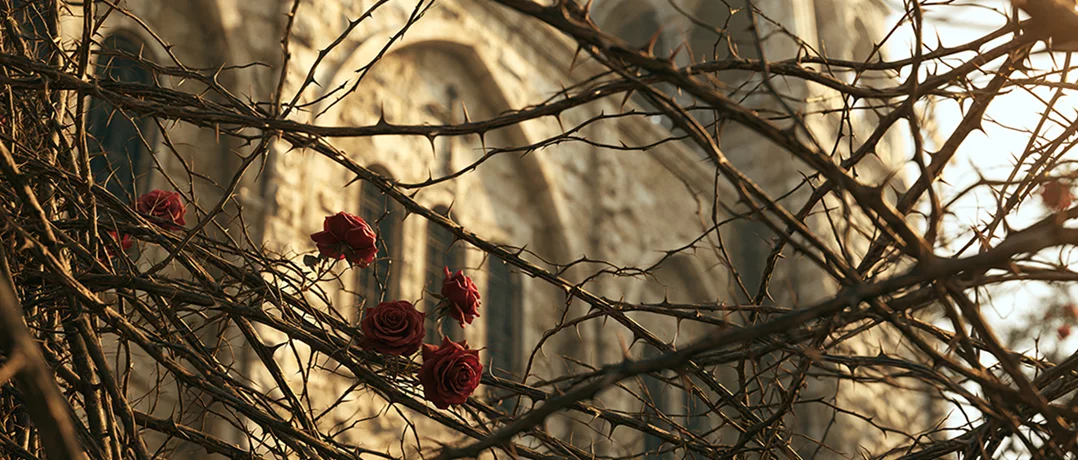
It worked. By 1495, with Abd al-Mun'im dead, Bsharri's chieftains returned to the Patriarchal fold, and the internal argument over union with Rome effectively ended. Two decades later, with Mamluk rule collapsing into decay, Patriarch Simon al-Hadathi - elected in 1492 - wrote directly to Pope Leo X in March 1514, pleading that his people be freed from rulers who, he wrote, "devour us, crush us" with taxes and persecution. Leo X answered the following year, in 1515, the final year of Mamluk rule in Syria, with words Maronites would repeat for the next five centuries. He gave thanks, he wrote, that among the embattled churches of the East, this one had endured amid unbelief and heresy "like a rose among the thorns" - an image of fragile, deliberate, stubborn beauty, growing exactly where it had no right to survive.
Ibn al-Qila'i did not stay in Tannourine to enjoy the peace he had helped negotiate. In 1507 he was consecrated bishop over a community of Maronites who had fled Mamluk oppression years before and resettled on Cyprus - shepherding, in effect, Lebanon's first diaspora. There he kept fighting for his people's institutions: in 1514 he petitioned Rome after Latin bishops on the island moved against the Maronite monastery of Saint John Khuzbandu, and Leo X sided with the Maronites the following year. Ibn al-Qila'i died on Cyprus in 1516 - the same year Ottoman armies under Selim I ended Mamluk rule in Syria and redrew the map he had spent his life trying to protect.
None of this reads like a simple story of light overcoming darkness. It is messier than that, and more human: a small Christian community, wedged between empires that rarely asked its permission, choosing again and again not to disappear. It found protection in inaccessible mountains, leverage in a distant papacy, and - however bruising the process - discipline through its own internal reckonings. Each of those choices was a bet that a distinct faith and a measure of self-rule were worth defending, even at the price of executed patriarchs, burned monasteries, and neighbors turned against neighbors.
That is the thread running from the ruins of Mayfouq to Ibn al-Qila'i's verses to Leo X's letter, and it is why the phrase has outlasted the century that produced it. Centuries later, a Maronite Patriarch would put the same idea more plainly: "This is the freedom, without which, we have no life." In a region that has rarely made room for minorities to govern their own affairs, the Christians of Mount Lebanon spent five hundred years insisting on exactly that room - mountain village by mountain village, verse by verse, letter by letter - and, against long odds, kept insisting still.
-
-
-
Dr. Elie EliasUniversity Lecturer & Political Historian
-
