



Behind closed doors in Washington, Marco Rubio and JD Vance are competing to define America's foreign policy and position themselves for the post-Trump era.
Rubio vs. Vance: Two visions of America, one ambition
Rubio vs. Vance: Two visions of America, one ambition
By Christiane Gemayel | July 14, 2026

Reading time: 3 min
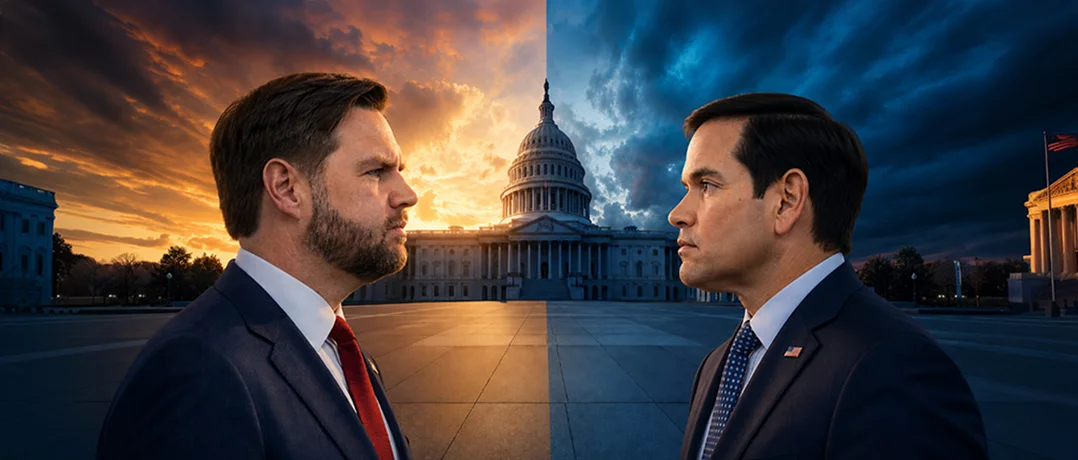
In Washington, the most important rivalries do not always play out in public. They often unfold behind closed doors, shaped by international crises and presidential decisions.
For several weeks, a quiet duel has emerged within the Trump administration. On one side is Secretary of State Marco Rubio, the embodiment of traditional diplomacy, committed to the United States’ longstanding alliances. On the other side is Vice President JD Vance, a figure of the America First movement, advocating a more transactional foreign policy and a cautious approach to U.S. military commitments abroad.
The Iran dossier has served as a revealing test. More than a mere difference in method, it highlighted two conceptions of the United States’ role in the world. In the background, another battle is already taking shape: the succession of Donald Trump in 2028.
Two opposing approaches
Marco Rubio is a man of dossiers. Drawing on his Senate experience, he favors institutional negotiations and methodical diplomacy.
JD Vance represents a new political generation. More instinctive, he believes each foreign engagement must be judged primarily by the direct interests of the United States. He prioritizes power dynamics and rejects prolonged interventions.
This difference became visible in the Iran file.
Iran: The first battlefield
After the Islamabad talks in April 2026 produced no breakthrough, JD Vance became the main defender of the June agreement protocol with Tehran, arguing it could prevent another war in the Middle East.
However, this approach quickly drew criticism within the Republican Party and from several U.S. allies, who deemed the guarantees given to Iran insufficient.
While Vance publicly defended his position, Marco Rubio worked to reassure Israel and Washington’s Arab partners, emphasizing that any détente with Tehran should accompany a durable weakening of Iran’s regional influence.
Lebanon: another point of divergence
The differences also appear in Lebanon. Rubio favors strengthening the Lebanese state, supporting the army, and gradually reducing Hezbollah’s military weight.
Vance, without challenging these objectives, seemed to consider that a sustainable solution also required indirect dialogue with Iran, a stance that raised questions among several Washington partners.
Trump arbitrates… without sidelining
The White House continues to deny any rivalry between the two, and no official decision confirms that JD Vance has been removed from key dossiers.
However, according to multiple diplomatic analyses, the mixed results of the first phase of Iran talks led Donald Trump to give Marco Rubio greater visibility on the most sensitive Middle East issues to reassure traditional U.S. allies.
A rivalry already looking toward 2028
This confrontation goes far beyond the Iran file.
Marco Rubio seeks to establish himself as the guarantor of a strong America, respected by its allies and faithful to its diplomatic leadership.
JD Vance aims to show that the America First doctrine can deliver results without dragging the U.S. back into past wars.
At this stage, one observation is clear: without any official decision confirming a lasting setback for Vance, Rubio appears to be securing more convincing diplomatic results and emerging as the figure Donald Trump relies on for sensitive issues that require reassuring traditional U.S. allies.
This dynamic may evolve, but for now, it clearly favors the Secretary of State, whose political weight within the administration appears strengthened.
