

Israeli Foreign Minister Gideon Sa’ar outlines Israel’s strategic dilemma over Iran’s nuclear threat and U.S.-blocked West Bank annexation plans.
Sa’ar reveals dual challenge: Iran and annexation
Sa’ar reveals dual challenge: Iran and annexation
By The Beiruter | May 02, 2026

Reading time: 4 min
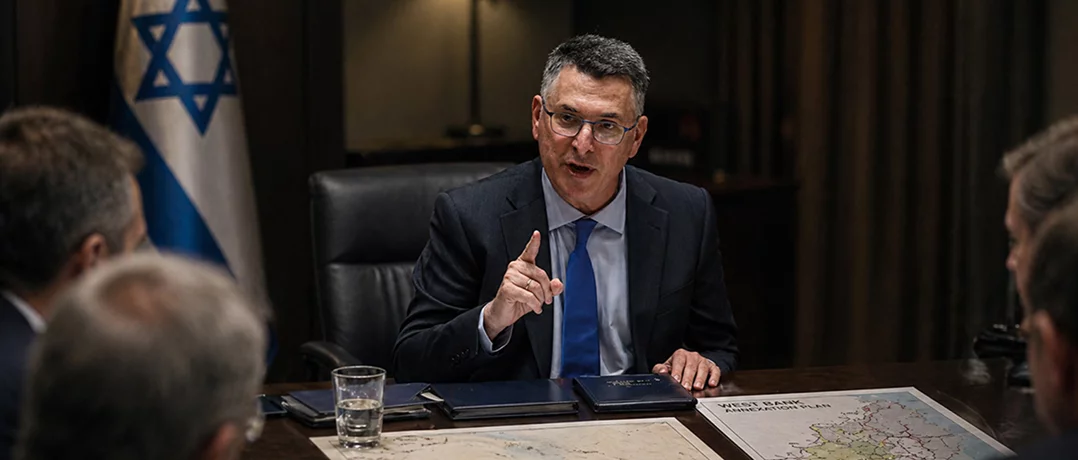
Israeli Minister of Foreign Affairs Gideon Sa’ar has offered one of the clearest insights yet into the strategic calculations shaping Israel’s current regional policy. In remarks delivered during a closed-door meeting with members of the “American Friends of Likud” (a nonprofit organization dedicated to fostering connections between American supporters and Israeli political leaders, primarily associated with the Likud Party), Sa’ar addressed 2 of the most sensitive issues confronting the government of Prime Minister (PM) Benjamin Netanyahu: the confrontation with Iran and the future of the occupied West Bank.
Iran and the logic behind the war
Sa’ar’s most consequential revelation concerned Israel’s decision to engage in a second war against Iran alongside the U.S. on 28 February 2026. According to the foreign minister, Israeli leaders concluded that Iran’s nuclear program was approaching a point at which it would become effectively immune to aerial attack. He explained that
Before this war, we saw that they intended to move their nuclear program deep underground. There, the program was protected against any attack by the American or Israeli air forces, so we had to make decisions, and we didn't have better options.
In Sa’ar’s account, this left Israel with what he portrayed as an unavoidable strategic dilemma.
The comments are particularly significant because they contrast with public statements previously made by Trump, who had suggested that Iran had already halted uranium enrichment after the American strikes of June 2025. Sa’ar acknowledged that enrichment had not resumed since those attacks, yet he maintained that Israel still considered military action necessary because of the broader long-term threat posed by Iran’s nuclear ambitions.
His remarks suggest that Israeli policymakers’ fear was not merely enrichment itself, but the possibility that Iran could secure a permanently protected nuclear infrastructure that would deter future military intervention.
At the same time, Sa’ar clarified that regime change in Tehran was never formally declared as a war objective. Instead, Israel’s goal was to weaken what he described as “existential threats” for as long as possible while creating conditions that might eventually destabilize the Iranian leadership internally.
In this context, the foreign minister openly acknowledged the limits of Israeli power. He noted that Iran is vastly larger than Israel geographically and demographically, highlighting that Israel had neither the intention nor the capacity to invade and occupy the country in pursuit of regime change. Nevertheless, he indicated that Israel would support any realistic opportunity that could contribute to political transformation inside Iran.
Economic pressure and internal instability in Iran
A major element of Sa’ar’s analysis focused on Iran’s deteriorating economic situation. He argued that mounting financial hardship could eventually intensify domestic unrest against the Iranian leadership.
Referring to earlier demonstrations inside Iran in late 2025 and early 2026, Sa’ar suggested that economic pressure remains one of the regime’s greatest vulnerabilities. According to his assessment, Iranian authorities are attempting to avoid another direct military confrontation while simultaneously refusing to compromise substantially on their nuclear program.
Sa’ar’s comments also reflected a broader Israeli concern regarding the sustainability of long-term confrontation. He made clear that Israel does not want to fight recurring wars against Iran every year. Yet his remarks implied that Israeli leaders believe temporary military operations may still be preferable to allowing Iran to achieve irreversible nuclear protection.
Trump’s opposition to west bank annexation
If Sa’ar’s comments on Iran revealed Israel’s military thinking, his statements regarding the occupied West Bank exposed the diplomatic constraints shaping Israeli territorial policy.
In a striking admission, the foreign minister acknowledged that the primary obstacle preventing Israel from annexing parts of the West Bank is opposition from Trump. Sa’ar stated that any move toward imposing Israeli sovereignty would require coordination with Washington and confirmed that the current American administration does not support such a step.
The remarks amount to one of the clearest official acknowledgments by a senior Israeli minister that domestic political considerations are not the principal factor delaying annexation. Rather, it is the position of Israel’s most important and staunch ally.
Sa’ar indicated that the Netanyahu government has no intention of advancing annexation in the near future because doing so would contradict Trump’s regional approach and risk alienating important international partners. His comments highlight the extent to which even a strongly pro-Israel American administration can still impose boundaries on Israeli policy when broader regional calculations are involved.
At the same time, Sa’ar reiterated Israel’s continued opposition to the establishment of a Palestinian state. He also confirmed that settlement expansion and other measures in the West Bank remain ongoing, despite international criticism and rising tensions with European governments.
Growing diplomatic and regional pressures
Beyond Iran and the Palestinian issue, Sa’ar’s remarks reflected Israel’s increasingly complicated international environment. He acknowledged worsening relations with several Western European governments while noting that Israel continues to enjoy stronger support from Central and Eastern European states.
He also addressed tensions with Turkey under President Recep Tayyip Erdoğan, portraying Ankara as an increasingly assertive regional actor pursuing influence across the Middle East, the Balkans, Africa, and Asia. According to Sa’ar, part of Israel’s military activity in southern Syria has been motivated by concerns over growing Turkish influence near Israel’s borders.
The foreign minister further stressed what he described as Israel’s worsening “public opinion problem” internationally. While diplomatic alliances remain intact in many areas, he admitted that the prolonged regional conflicts have damaged Israel’s global image and intensified criticism abroad.
Hence, these positions reveal the broader reality shaping Israeli policy today: a regional power seeking to preserve military dominance and territorial leverage while remaining dependent on American political support in an increasingly volatile and polarized international landscape.
-
-

-
The Beiruter
-
