



Lebanese table tennis champion Saadeddine El Habash discusses his fourth national title, the rivalry with his twin brother and his goal of qualifying for the 2028 Los Angeles Olympics.
Saadeddine El Habash: Lebanese table tennis’ proven talent and still on the rise
Saadeddine El Habash: Lebanese table tennis’ proven talent and still on the rise
By Khalil Hatem | October 16, 2026

Reading time: 8 min
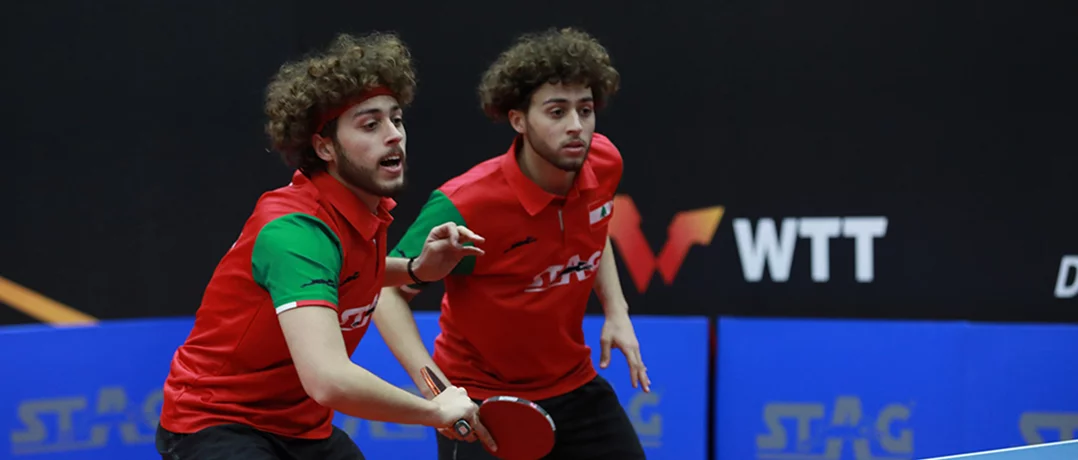
Saadeddine El Habash claimed his fourth (after 2021, 2023 and 2025, with the 2024 edition cancelled due to the war) Lebanese national table tennis title on October 4. The champion from Saida has further cemented his dominance on the domestic scene, fulfilling the promise he showed through his numerous titles at junior level.
In an exclusive interview with “The Beiruter” Habash explains that to win this year “I played in the semifinal against Ghaleb Fahes and won 4-1. It was definitely a challenging match because at this stage of the Lebanese Championship, every opponent is there for a reason. You have to stay focused from the first point until the last and never take anything for granted.
The final was something completely different and very special for me because I faced my twin brother, Mohamad.”
The emulation with his twin brother Hamoudi, key to Saadeddine’s success
Out of the 4 titles won by Saadeddine, it was the second time he meets with his brother in the final knowing that the emulation between both of them have been key for both of them succeeding. It’s worth noting that the twin brothers have won 4 Lebanese Championships doubles titles together. In the singles Lebanese rankings the 2 champions have trusted the 2 first places for the majority of the time since 2023.
Saadeddine confirms that for him “The fact that my twin brother and I both reached the final is a victory for both of us. We have grown up together, trained together, supported each other and pushed each other to become better players. Of course, once we stepped onto the table, we both wanted to win, and it was a serious and competitive match. But when the final point was over, I felt that we had both achieved something special.
Competing against my twin brother for the Lebanese Championship is something I will always remember. I may have lifted the trophy, but in my eyes, reaching that final together was our victory.”
Steady progression in the World Ranking
Saadeddine, who is a centimeter or two shorter than his twin brother, has also registered regional successes with a 2nd place in the Arab championships in 2024 and 3rd place in West Asia in 2024. Worldwide, this week (of the 12th October 2026), Saadeddine is ranked 475th. He has registered a good progression over the last years knowing the fact that he was ranked 664th in April 2024. A significant progression of 189 places in around 2 years and a half for a player known for his relaxed character while playing and his hate of defeat.
The Olympics qualification, a difficult but reachable objective
The main focus of the champion is now the qualification to the Olympic Games in 2028 in Los Angeles. With less than two years to go until the event, qualification seems a reachable target for the player technically renowned for his effective attacking style and his build-up and varied serve. Achieving that feat would make him the first Lebanese table tennis man player to do so, following in the footsteps of three women who have already represented Lebanon on the sport’s biggest stage: Larissa Chouaib (1996), Tvin Moumjoghlian (2012) and Mariana Sahakian (2016 and 2024).
The level to reach the 2028 Olympics is yet to have been reached by the champion. Asked by “The Beiruter” on his chances to qualify for the most important event worldwide in table tennis, the native of Saida explains that “The Olympics are a major goal for me, and I understand how difficult qualification is. I believe I am moving in the right direction, but I also know that there is still a lot of work ahead. Winning in Lebanon is important and gives me confidence, but Olympic qualification requires performing consistently at the international level. That means
playing more international tournaments, facing different styles of players, improving my ranking and gaining as much experience as possible.
I do not want to put unnecessary pressure on myself by thinking only about the final destination. I prefer to focus on the process: becoming better physically, technically and mentally, competing internationally and learning from every match. Being part of the Olympic Committee and what I have achieved so far are definitely positive signs for me. I believe they show that, to a certain extent, I am ready to take the next step toward the Olympic qualification process. But at the same time, I know that this alone is not enough.
To seriously compete for Olympic qualification, I need much more international exposure. I need to travel, participate in training camps, train with high-level international players and coaches, compete in more tournaments, and take advantage of as much professional support as I can receive. Every training camp, every international match and every opportunity to work with experienced people can help bring me closer to the level required.
The dream is definitely to represent Lebanon at the Olympic Games. I believe in what I have achieved so far, but I also know how much work is still ahead of me. I am ready to put in that work and hopefully receive the support and opportunities needed to give myself the best possible chance of qualifying.”
A family that has ping-pong in its blood
A natural talent, Saad and his twin brother Hamoudi come from a family steeped in table tennis tradition. His paternal uncle Mohammad has won around ten Lebanese national titles, while another paternal uncle, Moustapha, was also among the country’s finest players in his prime and is now regarded as one of Lebanon’s leading coaches.
The 23-year-old rising star reflects on his development both on and off the table, discussing his personal growth as well as his tactical, technical and professional evolution. He explains that “I believe I have improved in all of each area of the game, but more importantly, I have become a more complete player. Fitness has been a major focus because modern table tennis is extremely physical. I have worked on my endurance, speed, footwork and recovery so that I can maintain the same intensity throughout an entire match or tournament.
In terms of power, I have become stronger without wanting to sacrifice control. For me, power is not simply about hitting the ball harder; it is about being able to generate quality and speed while maintaining placement and consistency. My serve has become more varied. I have worked on changing the spin, placement, speed and rhythm so that my opponent cannot become comfortable receiving. My return has also improved significantly. At a high level, the serve and receive can decide the direction of the entire point, so I have worked on reading spin earlier and giving myself more options on the receive.
With my forehand, I have worked on making it more explosive and consistent, particularly when I have the opportunity to attack. Concerning my backhand, I have tried to make it a bigger weapon in my game rather than simply using it to maintain the rally. I want to be comfortable attacking and applying pressure from both sides. Overall, compared with the player I was 2 or 3 years ago, I feel more complete, more physically prepared and more confident in adapting my game depending on the opponent.”
Asked by The Beiruter about what should be improved in Lebanese Table Tennis, Habash also puts forward several interesting proposals aimed at developing this sport in Lebanon. Indeed he insists on the fact that “Lebanon has a lot of talented table tennis players, but talent alone is not enough.
If we want Lebanese table tennis to reach another level internationally, we need to invest more in the development of the players with quality coaching, proper training programs and competitive opportunities that will make a huge difference. Lebanese players need opportunities to compete regularly outside Lebanon against different styles and higher-ranked opponents. You can train extremely hard, but international competition gives you experience that is very difficult to reproduce in training.
There should also be more attention given to physical preparation, sports psychology and professional training environments. Table tennis has developed enormously around the world, and preparation today goes far beyond simply spending hours at the table. I think that players need also more support to participate in international training camps and tournaments. For me personally, I want to keep improving, represent Lebanon in the best possible way, and hopefully contribute to pushing Lebanese table tennis forward.”
A domination on Lebanese Table Tennis since 2021
His first Lebanese champion title came in 2021 at the age of 18 years old. Asked by Cedars sports to speak about each of the 4 tiles that progressively marked his domination on the Lebanese table tennis scene, he explains that “every title has a different story behind it. My first title in 2021 will always have a special place in my heart. The first championship is different because it is the moment when you prove to yourself that you are capable of becoming Lebanese champion. There is a huge amount of emotion because all the training, sacrifices and pressure finally lead to that moment. It gave me confidence and made me hungry to achieve more. Then came 2023. That title was important because I wanted to prove that 2021 was not just one great tournament.
Winning again showed me that I could maintain a high level and continue competing at the top of Lebanese table tennis. I was more experienced, more mature and understood my game much better. The 2025 title represented another stage in my development. By then, expectations were higher. People knew my level and wanted to beat me, so mentally the challenge became different. I learned that staying at the top can sometimes be even harder than reaching it. And now, 2026, my fourth title, feels like the continuation of everything I have worked for over the years.
At the same time, this championship will always be unique because I shared the final with Hamoudi as in 2023. Winning four titles is something I am extremely proud of, but I do not want to stop here. Every championship motivates me to work harder and continue improving.”
With fewer than 640 days to go until the 2028 Olympic Games, the champion must sustain and accelerate his upward trajectory to become the first Lebanese man to qualify for the Olympics in table tennis.
