



A small church in Ghbaline, north of Byblos, dedicated to Saint Challita, the protection of animals and the land, was built by several families, including the Rizk family. This family, is considered one of the village's most prominent families and have taken care of thos small church ever since.
Saint Challita Church and the history of Ghbaline's families
Saint Challita Church and the history of Ghbaline's families
By Yara Saliba | November 29, 2026

Reading time: 5 min
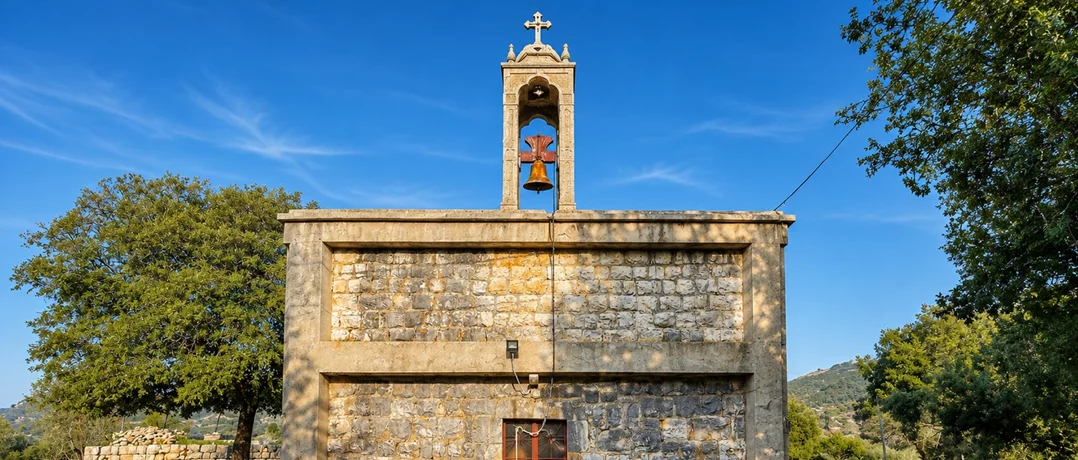
Located in the village of Ghbaline, north of Byblos, Saint Challita Church has stood as a testament to generations of faith, family ties, and local heritage. Dating back to the 19th century, the church is the smallest parish in the Diocese of Byblos, but its history carries the legacy of several families who came together to build it and have continued to preserve it over the years.
Among them is the Rizk family, whose connection to the church dates back to its establishment. Alongside many families, the Rizks took part in bringing the church to life and played a central role in its construction. Their involvement did not end with the completion of the building. Across generations, the family has been committed and dedicated its own resources to maintain the church and ensure that it continues to serve the village.
Why the villagers chose Saint Chalita?
The story of Saint Challita Church dates back to 1864, when the idea of building a church in the area was first raised. According to Mazen Rizk, one of the youngest members of the Rizk family, there was initially a proposal to construct a church dedicated to Saint Maroun. But the Rizk family had a different vision. They wanted to establish a church that they could take responsibility for maintaining while opening it to the entire village and its parish.
The initiative brought several families together, including the Rizks, the Barakats, the Basbous, and the Chahines. Among those involved were Father Abdallah Rizk and Father Gerious Abi Chedid Basbous, who helped gather the families around the project.
“They initially thought of choosing a female saint, but eventually decided on Saint Challita.”, Mazen told The Beiruter. They chose a saint associated with the protection of animals and the land, given the village's agricultural traditions and its reliance on livestock and cultivation.
According to Mazen, the records preserved in the Bkerke archives document the beginning of the construction in 1884. As the historical account states, "The people of Ghbaline started building a church dedicated to Saint Chalita." The church has since remained under the care of the families who contributed to its establishment, with the Rizks continuing to dedicate their own resources to its preservation.
The origins of the Rizk Family
The Rizk family's roots in Maad can be traced back to Yanouh, in Aqoura. Mazen stated that the family has long-standing ties to Maad, where its earliest family records are numbered one, two, and three. He recounted that one of their ancestors, a man named Rizk, left Yanouh and made his way toward Maad through what is known as the Madfoun road.
At the time, Maad had been devastated by the Mamluk campaigns, leaving much of the village deserted. Rizk therefore settled in an area below Maad, where he lived with his family for several years. Once conditions improved and Maad became habitable again, Rizk returned to the village around 1361.
In the 16th century, a man named Basbous was traveling toward the coast when he encountered Rizk. He stopped to stay with him, and the two gradually grew close. This is where the two main families of the village originated. This encounter marked the beginning of the more recent history of Maad and the families who form the village today. Then, the Rizk family gradually spread across all the Lebanese areas.
A new generation, the same commitments
As the Rizk family grew, some of its members moved from Maad to Ghbaline, where economic conditions were more favorable. The family had traditionally relied on sericulture, cultivating mulberry trees and raising silkworms to produce silk. Ghbaline's less humid climate offered better conditions for this activity and helped them increase their production and expand their trade.
Among the family's most remembered figures was Najibeh Rizk, who played an important role during one of Lebanon's most difficult periods. She became known for her generosity and kindness, especially for helping feed children who were suffering from hunger during the Great Famine. She also earned the respect and admiration of people in the surrounding villages. "Whenever Najibeh did something, everyone in the village followed her example," Mazen shared.
After their father's death in 1931, Najibeh took responsibility for raising her nephews, Najib and Elias Hafez Rizk. With her support and guidance, the two brothers established themselves and became important people in the region. Najib was the manager of Saint George Hotel in Beirut. The two brothers introduced the first electric olive press in the region and helped advance olive production and processing. They were also involved in the Green Plan project, and brought the first bulldozers to the mountainous areas to help farmers reclaim and improve their agricultural land. “They had a very good reputation in our village,” Mazen explained.
Mazen considers himself among the descendants responsible for carrying this family history forward. "I am one of those grandchildren continuing the journey after Najib and Elias," he said. That sense of continuity is also reflected in the family's relationship with Saint Challita Church. Even though it is a very small church, Mazen described it as one of the most active, with regular gatherings, conferences, celebrations, and community events.
This small church in Ghbaline stands as an example of how a new generation can follow in the footsteps of its ancestors. The Rizk family is a reflection of how Lebanese families lived in villages throughout history, where family ties, traditions, and shared responsibilities played an important role in village life. Today, the Rizks continue to look after the church and try to keep their village traditions alive.
-
-

-
Yara SalibaJunior Writer/Translator
-
