



Lebanese sculptor Randa Nehmé, whose four-decade devotion to stone explores discipline, silence, craftsmanship, and the philosophy of sculpture.
Sculpture, stone, and the life of Randa Nehmé

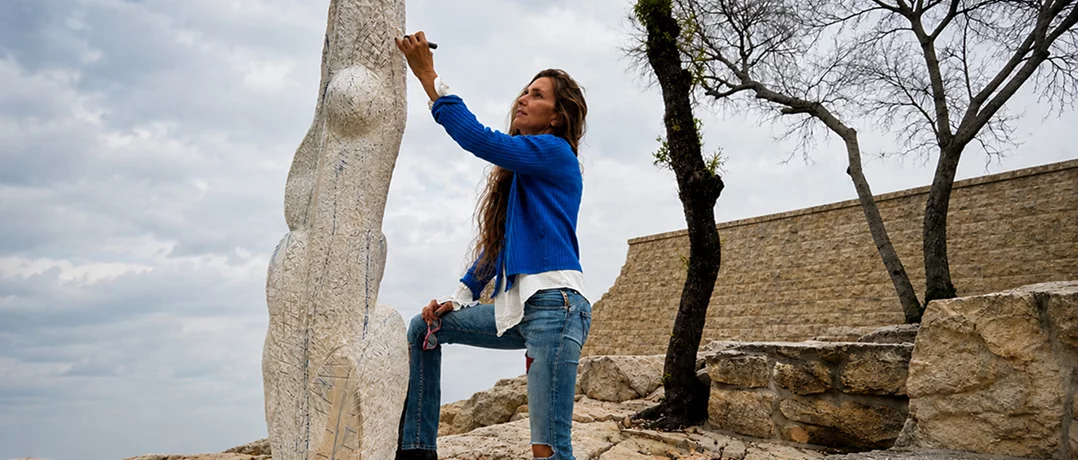
Randa Nehmé is a Lebanese sculptor who moved to Paris in 1988, where she worked closely with French and Japanese masters and became a member of the National Sculptors' Syndicate in France in 1989. Nehmé has spent 37 years in conversation with stone. She has no interest in legacy, only in the work in front of her. Over four decades, she has built a body of work rooted in direct carving, rigorous craftsmanship, and an absolute devotion to her material. She is not easy to categorize, and she would not want to be.
Stone before everything
Nehmé did not grow up in an artistic household. As a child, she simply liked looking at stones on walks through nature. The real turning point came during her Fine Arts studies at ALBA in Beirut, where modeling classes introduced her to clay. While her classmates worked with small pieces assembled together, Nehmé went in the opposite direction: she took one large block and carved into it with a knife. She even brought a hairdryer to harden the clay so she could cut more sharply.
"That's when I understood that I loved sculpture," she says simply. What followed was a rigorous, almost monastic apprenticeship in Paris. She joined city-run workshops where she was often the youngest person in the room by decades, surrounded by stone craftsmen who had spent their entire lives at the material. "These were serious, grounded people," she recalls. "This was real sculpture and real volume. Not experiments. Not people just trying things for fun." She absorbed that seriousness and made it her own.
The discipline of stillness
Much of what defines Nehmé's practice is what she refuses to do. She does not enter the studio in emotional chaos. She does not subscribe to the idea that art is best made in the grip of raw feeling.
"Many people say: go to the studio, let your emotions out, it'll make you feel better," she says. "For me, it's not like that at all." She comes to the stone centered, balanced, ready.
I think the stone gives back what you give it.
This philosophy was shaped in part by years of practicing Aikido and Iaido, Japanese martial disciplines built around the philosophy of emptiness and fullness, presence and restraint. The Japanese masters she worked with in Paris deepened this further. One exchange she has never forgotten: presenting her first sculpture to a renowned Japanese sculptor named Otani, she apologized by saying it was her first piece. He stopped her immediately. "Never say that," he told her. "It will always be your first sculpture." He also told her something that became foundational to her practice: "You must bring out the energy of the stone. Otherwise, don't even try to make sculpture." Nehmé took both instructions seriously.
Grief, silence, and stone
For all her insistence on emotional discipline, Nehmé does not deny that life finds its way into the work, sometimes without the sculptor's knowledge.
After losing a brother at a young age, she returned quickly to Paris, to her children and her studio. She said little. She simply worked. It was only months later that her colleagues pointed out that for nine months, she had arrived each morning, said hello, and spent the entire day in silence. She hadn't noticed.
"I think I lived my grief through that sculpture," she says. When she finally finished it, she had a feeling she still can't fully explain: "Life is fair." She doesn't know exactly what it meant. But something had moved through her, mediated by stone, without her consciously choosing it.
"I remain very attached to professionalism, to working the volumes and the curves properly," she adds. "I don't let myself be completely consumed by emotion." But the stone, it seems, holds what the sculptor doesn't always intend to give it.
On rights, rigor, and what makes an artist
Beyond her studio practice, Nehmé spent years working with UNESCO on artists' rights, helping develop a charter that pushed back against the casual inflation of the word "artist." For her, the title carries obligation. Five years of consistent studio practice, regular exhibitions, continuous commitment, these were the standards she helped advocate for. "Art is continuous work," she says. "Perseverance. And when you persevere, your work begins to say something."
She works directly with stones on-site, shaping the surrounding space and creating what she describes as a true symbiosis between the stone and its environment. The material is never incidental. "I believe the tool is the hand," she has said, meaning confidence in the gesture, and knowing when to put it down, matter as much as any technique.
No legacy, no fear
Ask Nehmé what she wants her work to say about her after she's gone, and she laughs. "What is eternity? How would I know?" She thinks only in the present moment. Once a sculpture is finished, or rather, once she decides it is finished, because abstract sculpture, she notes, never truly ends, she becomes a spectator of it, like anyone else.
"If someone wants to say something about my work now, while I'm here, then wonderful, we can discuss it," she says. "But what comes after no longer belongs to me."
Thirty-seven years of stone. She has no regrets, no grand statement, no interest in monuments to herself. Just the next block, and whatever it asks of her.
-
-

-
The Beiruter
-
