From the ancient mystery cults of Byblos and the Essenes to the medieval Assassins and modern Freemasonry, the Levant has served as a crossroads for secret societies that shaped the region's religious, political and cultural history.




From the ancient mystery cults of Byblos and the Essenes to the medieval Assassins and modern Freemasonry, the Levant has served as a crossroads for secret societies that shaped the region's religious, political and cultural history.

For three thousand years, the Levant has been fertile ground for countless secret societies. Sitting at the junction of Europe, Africa, and Asia, it has been home to cults, and mystics, often fleeing persecution and hoping to hide out in the region’s rugged mountains, forests, or deserts. There, they have imparted forbidden knowledge to followers, passing down ancient wisdom to new generations.
It’s a story that takes us from the Bronze Age through the biblical era to the medieval period, the Crusades, and on to the emergence of Arab nationalism and Freemasonry. Long before the advent of Christianity and Islam, cities like Byblos, Ugarit, and Tyre hosted cults dedicated to dying-and-rising gods whose journeys into the underworld were mimicked by devoted believers. Historians see these stories as allegories for the changing seasons with winter being the time when deity is down below and summer when they emerge above ground again.
The secret rites involved in venerating Adonis were practised at Byblos and the nearby spring-sanctuary at Aphaca on Mount Lebanon. The origins of this cult go back to Tammuz, the Babylonian god of fertility and lover of Ishtar. In Syria, priests known as Galli would lead frenzied prayers to another guardian of fertility, the goddess Atargatis. As things reached fever pitch, they castrated themselves as a supreme sacrifice.
It’s thanks to a 2nd century CE Hellenised Syrian writer of the Roman period, Lucian of Samosata, that we know about these secret practices. In the following century, a young Roman Syrian, Varius Avitus Bassianus, from modern Homs, became the Roman emperor and imported a Levantine cult into the heart of the empire. He elevated a Syrian god, Elagabal, above Jupiter and transported a sacred stone from Emesa (Homs), most likely a sacred meteorite, then adopted the name Elagabalus. The Roman historian Cassius Dio claimed he offered an enormous reward to any surgeon who could give him female genitalia. Having offended most of Rome, he was assassinated, aged 18.
One of the most popular ancient Greek mystery cults was the Eleusinian Mysteries, which centered on the search by Demeter for her abducted daughter, Persephone. She had been kidnapped by Hades, king of the underworld – a familiar theme as we have seen. That cult was based at Eleusis in Greece where totally secret rituals were performed in the Telesterion, a special temple.
In 1978, three respected academics (one of them had synthesised LSD in a laboratory in the 1930s) wrote a book claiming that many ancient cults used hallucinogenic drugs behind closed doors. A few years earlier, in 1970, a scholar who had worked on the Dead Sea Scrolls, John Marco Allegro, claimed that Christianity began as a drug-fuelled secret society. That earned him a mountain of derision.
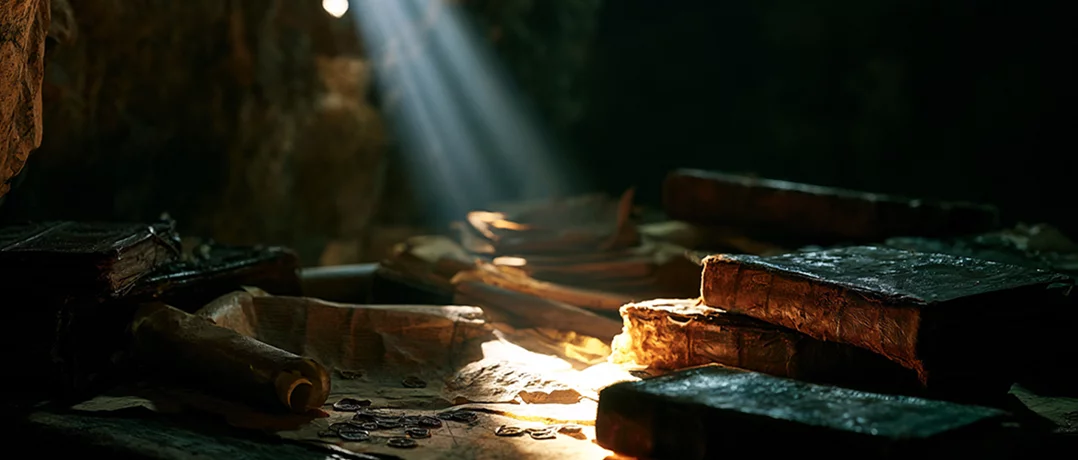
Allegro was the only British scholar in a team, operating under Jordanian and Vatican oversight, that studied the Dead Sea Scrolls, ancient fragments of writing from the ultra-secretive Essenes. He was particularly interested in one scroll made of copper that listed dozens of items of buried treasure and their locations. Many have argued that this was wealth taken out of the temple in Jerusalem before the Romans destroyed it in 70CE.
The Essenes were described by a contemporary historian, Josephus. This was a group that jealously guarded its interpretation of biblical scripture influencing later gnostic groups. Like the gnostics, the Essenes believed that the world was a cosmic battle between Sons of Light and Sons of Darkness. The Levant embraced these ideas with gusto. But the church also condemned them over the centuries.
So, we have the Ophites who argued that the serpent in the Garden of Eden was a bringer of enlightenment. To them, the church was lying about the need for salvation through the sacraments. Needless to say, the church thought otherwise and hunted them down. In fact, Christianity had to compete in the early centuries with various Levantine cults including the Manicheans, followers of the Persian prophet Mani, who also preached about the struggle between light and darkness.
His teachings inspired a string of heresies brutally suppressed by the Byzantine Empire and the Roman Catholic church. There were Paulicians, Bogomils, and Cathars, all conducting their own condemned version of Christianity away from public view.
The most notorious secret society in the medieval Levant were the Assassins. These were Nizari Ismailis, a branch of Shia Islam, who split from the Fatimid Ismaili establishment in Cairo, Egypt, to form their strange death cult at the end of the 11th century.
Establishing themselves in modern Iran, they eventually set up bases in Lebanon and Syria where they struck terror into the population. Their preferred modus operandi was to send out lone suicide killers, armed with daggers, to murder their political opponents, Muslim and Christian. Their demise came largely at the hands of invading Mongolian armies in the 13th century.
Fast forward to the 19th century and we see the emergence of Freemasonry and Arab nationalism. It was often in the secretive masonic lodges that Arab intellectuals discussed a political future that did not involve the decaying Ottoman empire. Interestingly within the lodges, Muslims, Christians, and Jews might rub shoulders whereas they might choose not to do so on the street.
Throughout history, minority strands of opinion, religious and political, have often been forced into secrecy. But there are also those who relished being part of a clandestine society with exclusive rules and membership. In this fascinating region, having a double life has clearly been appealing to many.