

In an exclusive interview with The Beiruter, Archimandrite Agapios Abu Saada sheds light on the recent Silwan incident, examining its broader significance for the Christian presence in Jerusalem and the ongoing challenges surrounding Church-owned properties in the Holy City.
Silwan and the question of presence

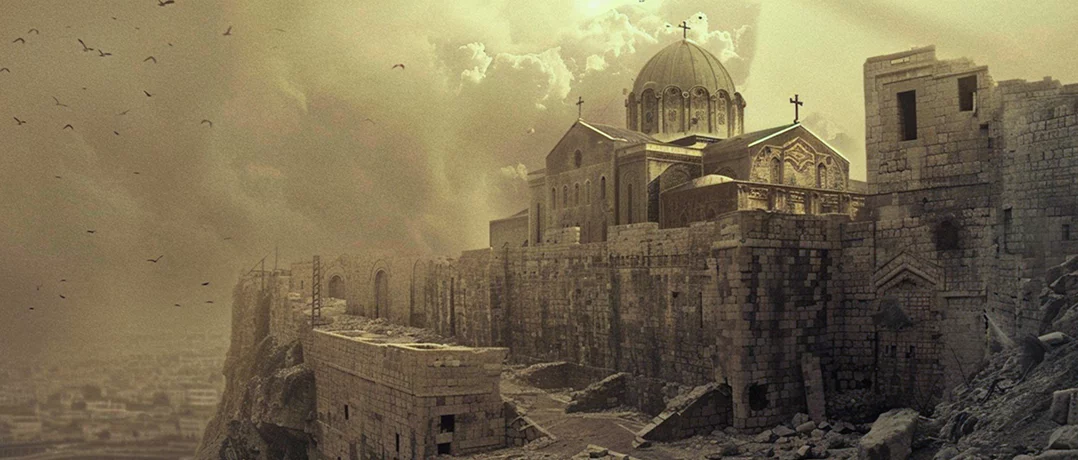
Silwan has once again become a focal point of tension in Jerusalem after the Greek Orthodox Patriarchate described an intervention on Church-owned land as an unlawful seizure, involving the removal of its caretaker, confiscation of equipment, uprooting of trees, and the fencing off of a property it says is officially registered under its name. In a city where land is inseparable from memory, sovereignty, and symbolism, the incident immediately extends beyond the boundaries of a single parcel, touching a deeper sensitivity around the status of ecclesiastical property in Jerusalem’s contested urban fabric. The Patriarchate says the event took place on June 15, 2026.
At the center of the dispute lies Parcel 6 of Block 29985, a plot the Church affirms is legally registered under its ownership. The land sits adjacent to an ancient monastery and contains historical, archaeological, and religious features that deepen its significance beyond cadastral records. The Church argues that the intervention cannot be justified by reference to a municipal gardening order issued in 2019, which it says expired in April 2024, and therefore rejects any legal basis for uprooting trees, removing the caretaker, or restricting access to its property.
Beyond the legal argument, the statement frames the incident as a structural concern, less an isolated dispute than a moment that raises broader questions about how ecclesiastical property is being treated in Jerusalem today, where Church land is understood not only as real estate but as part of a long-standing institutional presence that includes monasteries, schools, charitable institutions, and pastoral centers, making any disruption a question of precedent and continuity rather than a single localized intervention.
“A question of memory, not only law”
The Beiruter reached out to Archimandrite Agapios Abu Saada, General Assistant of the Basilian Salvatorian Order, for contextual reading.
From his perspective, the Silwan incident cannot be reduced to a property dispute. It is, instead, part of a deeper tension between legal frameworks and historical memory in Jerusalem.
Silwan, he notes, is not an ordinary neighborhood. Situated south of the Old City near the City of David and the Kidron Valley, it carries layers of biblical, archaeological, and ecclesiastical meaning. This accumulated geography, he argues, is precisely what transforms land into something more than territory.
“For the Church, land is part of its mission and historical witness in the Holy Land,” he says. “It is not merely property. It is part of a living presence that has existed since the apostolic era.”
Infrastructure of presence
Abu Saada emphasizes that Church property in Jerusalem is not symbolic alone, but functional. “Monasteries, schools, and charitable institutions form an interconnected infrastructure that sustains Christian life in the city.”
When such spaces are restricted or redefined, the impact is not limited to ownership. It affects the Church’s ability to maintain its social, educational, and pastoral role within Jerusalem’s fragile balance of communities.
In this reading, the Holy Land is not a space of competition, but a space of witness, where continuity of presence carries theological meaning.
A wider climate of fragility
Without framing Silwan as an isolated case, Abu Saada situates it within a broader environment of pressure affecting Christian communities across the region. Economic strain, demographic change, political instability, and recurring tensions around religious sites have collectively contributed to a sense of growing vulnerability.
The concern, he suggests, is not only about individual incidents, but about accumulation: a gradual narrowing of space, physical, institutional, and symbolic, for an indigenous Christian presence in the Holy Land.
Yet despite this, he stresses that the Church’s role remains one of persistence, not withdrawal: a commitment to remain a “witness to hope and reconciliation” in a region marked by recurring fracture.
Between Jerusalem and Gaza: an expanding geography of vulnerability
The Patriarchate also situates Silwan within a wider chronology of recent violence affecting Christian sites, recalling the strike on the Saint Porphyrius Church compound in Gaza in October 2023, which killed civilians, and the strike on Holy Family Church in July 2025, which also resulted in casualties and injuries.
These references extend the geography of concern beyond Jerusalem, linking sacred sites across different frontlines into a single narrative of exposure.
A city negotiating its boundaries
At its core, the Silwan incident reflects a recurring tension in Jerusalem’s modern condition: how to govern a city where sacred geography, legal ownership, and political authority constantly overlap without fully aligning.
The Patriarchate concludes its statement with a theological reminder “Blessed are the peacemakers”, but grounds it in a concrete demand: respect for law, protection of holy sites, and preservation of the Christian presence as an integral part of Jerusalem’s identity.
What remains in Silwan is not only a fenced parcel of land, but a broader question that Jerusalem has never fully resolved: how presence endures when the ground it stands on is quietly redefined.
-
-

-
Michella RizkContent Manager/WriterFocusing on social affairs.
-
