



Lebanon’s six billionaires added $500 million in 2025, reaching $12.3 billion. As poverty and unemployment soar, the gap between private wealth and national crisis widens.
Six Lebanese billionaires made Forbes’ 2025 list
Six Lebanese billionaires made Forbes’ 2025 list
By The Beiruter | January 26, 2026

Reading time: 3 min
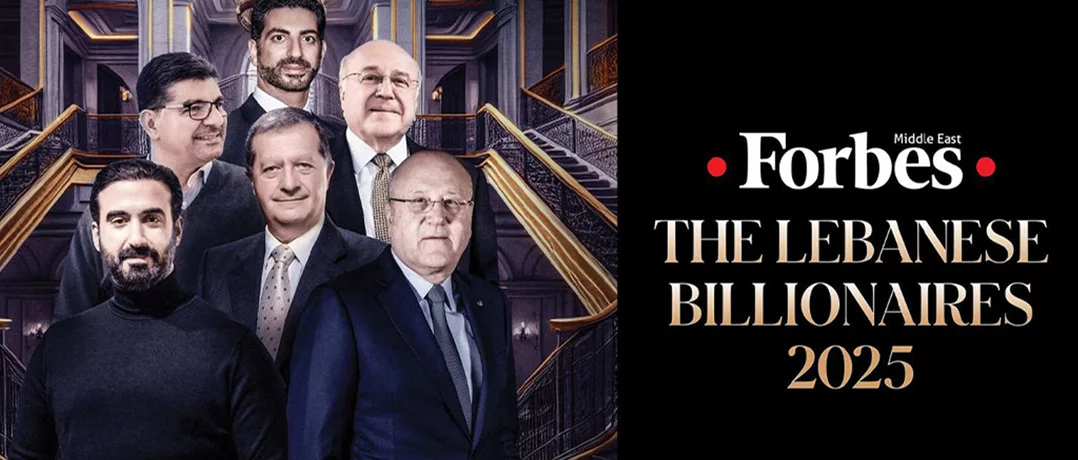
Six Lebanese nationals once again appear on Forbes’ 2025 World’s Billionaires list, unchanged in number for the third consecutive year. What has changed, however, is the scale of their wealth. Collectively, Lebanon’s six billionaires now hold an estimated $12.3 billion, an increase of $500 million compared to last year.
At the top of the list are Najib and Taha Mikati, each with a net worth of $3.1 billion, after adding roughly $300 million apiece over the past year. Their fortunes, built largely through telecommunications investments spanning Lebanon, Africa, and global markets, continue to anchor Lebanon’s billionaire class.
They are followed by members of the Hariri family: Bahaa Hariri ($2 billion), Ayman Hariri ($1.4 billion), and Fahed Hariri ($1.2 billion), as well as Robert Mouawad, the Beirut-born heir to the luxury jewelry house, with a net worth of $1.5 billion.
The names remain the same. The fortunes grow.
Wealth beyond borders
What distinguishes Lebanon’s billionaires from the country’s broader economic reality is not only scale, but geography. Much of this wealth is generated through foreign markets, global portfolios, and diversified investments largely insulated from Lebanon’s domestic financial collapse.
The Mikati brothers’ rise illustrates this trajectory clearly. Starting from Tripoli, one of Lebanon’s most economically marginalized cities, they built telecom empires that expanded into Africa during periods when Lebanon itself was defined by war, instability, and weak state capacity. Today, their wealth growth reflects the resilience of global capital rather than the recovery of the Lebanese economy.
This pattern is not unique to the Mikatis. Across the list, fortunes are tied to real estate abroad, international logistics, luxury goods, technology startups, and offshore investments, while Lebanon continues to struggle with unemployment, poverty, and a paralyzed productive sector.
A widening economic divide
That contrast is stark against Lebanon’s broader socioeconomic landscape. According to the World Bank, poverty in Lebanon has more than tripled over the past decade, rising from about 12% in 2012 to roughly 44% by 2022, even as regional disparities persist. In Beirut itself, poverty remains relatively low by comparison, estimated at about 2%, but in the North (including Tripoli) it reaches around 52%, and in other underserved regions it climbs even higher.
The numbers paint a stark picture of inequality: the very cities that gave rise to some of the country’s wealthiest individuals, such as Tripoli and Saida, are among those most affected by endemic poverty and limited opportunity.
Unemployment figures further underscore Lebanon’s structural economic challenges. Most recent World Bank data place national unemployment around 11.5% in 2024, reflecting persistent joblessness linked to economic contraction, business closures, and labor market shocks since 2019. Youth unemployment remains disproportionately high, with estimates indicating rates well above the national average, a trend echoed in independent labour market analyses.
A widening gap
The contrast is stark. While billionaire wealth rose by half a billion dollars in one year, more than half of Lebanon’s population lives below the poverty line, unemployment remains structurally high, and entire regions, particularly Tripoli and Saida, the very cities from which some of these fortunes originate, continue to experience chronic underdevelopment.
This is not a question of legality or success. But it raises a broader economic question: what happens when private capital grows independently of the country that produced it?
In most emerging economies, large domestic fortunes often play a role, directly or indirectly, in job creation, industrial investment, infrastructure, and social mobility. In Lebanon’s case, that link has weakened over time, as instability pushed capital outward and incentives for local investment eroded.
Beyond philanthropy
The debate, then, is not about charity, but about productive reinvestment. Lebanon’s crisis is not short of capital in absolute terms, it is short of capital willing to engage locally. Strategic investments in energy, agriculture, technology, manufacturing, and urban renewal could generate employment and reduce dependency on remittances and aid.
For figures like the Mikati brothers, whose personal trajectories are inseparable from cities like Tripoli, the question of reinvestment carries symbolic as well as economic weight. Not as an obligation imposed from outside, but as a reflection of long-term national interest.
A test of belonging
Lebanon’s presence on Forbes’ list remains, on the surface, a marker of individual achievement and global integration. Yet set against a country enduring prolonged economic collapse, it also reflects a deeper disconnect, one in which wealth, opportunity, and risk increasingly operate beyond the boundaries of place.
Whether this moment signals the possibility of renewed economic belonging or simply documents parallel trajectories will depend not only on political reform, but on whether private capital comes to view Lebanon not as a liability of the past, but as a viable investment in the future.
Six billionaires.
$12.3 billion.
And an economy still searching for growth that reaches beyond balance sheets and into lived reality.
-
-

-
The Beiruter
-
