

As the government considers whether to extend SOLIDERE's mandate until 2069, new research into the company's legal, financial and planning history examines what SOLIDERE has delivered, what public value remains to be recovered and what should happen after 2029.
SOLIDERE after 2029, a second extension?

Item 15 on the Council of Ministers' agenda, published June 23 ahead of its June 25 meeting, occupied just a few lines among twenty-one agenda items:
Request by the Lebanese Company for the Development and Reconstruction of Beirut Central District (SOLIDERE) to reconsider the Council of Ministers' decision of December 1, 2005, and to ratify the resolution of the company's Extraordinary General Assembly of shareholders concerning the amendment of the company's duration
Behind the bureaucratic language lies one of the most consequential decisions concerning downtown Beirut in decades.
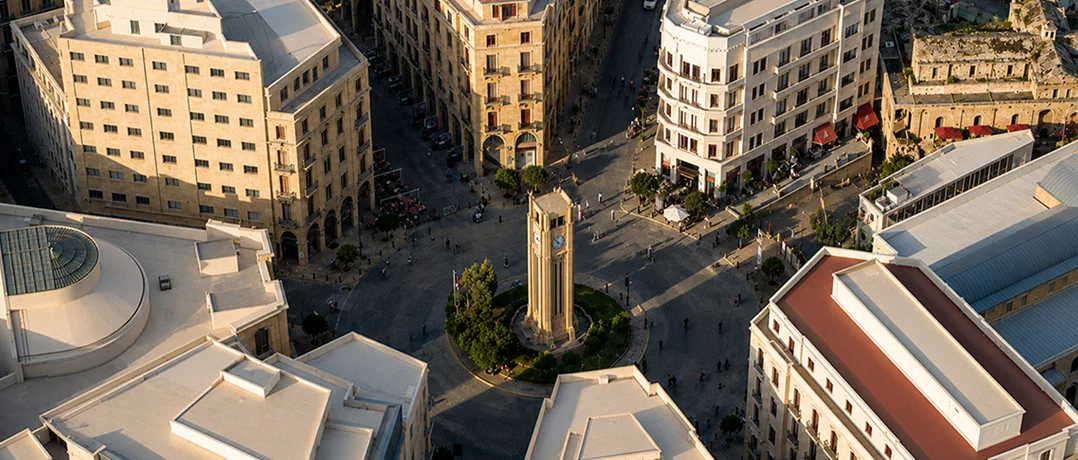
Thirty-two years after it was established to rebuild Beirut's historic center following the civil war, SOLIDERE is seeking to extend its mandate by another forty years. Already extended once in 2005, the company's license is currently set to expire in 2029. Whether ministers approve another extension until 2069 will determine far more than the future of a single real estate company. It will shape who controls Beirut's historic core, whether Lebanon's post-war reconstruction model still serves the country's economic priorities and how much public value should be recovered from one of its largest redevelopment projects.
The debate coincides with one of the most comprehensive examinations of SOLIDERE in years. Over the past year, Beirut Urban Lab researcher and AUB urban planning master's candidate Ahmad Sabra reconstructed the company's legal, financial and planning history through company filings, audited financial statements, planning decrees, government records and interviews.
“This is one of the few moments when the state can redefine its relationship with SOLIDERE,” Sabra told The Beiruter.
For the first time in decades, the government has real leverage. The question is how it chooses to use it.
A company built for reconstruction, not permanence
When Parliament established SOLIDERE in 1994, the company was conceived as an extraordinary solution to an extraordinary moment. Downtown Beirut lay devastated after fifteen years of civil war. Tens of thousands of individual property claims overlapped across the city center, making reconstruction through conventional planning mechanisms almost impossible.
Law 117 created a private joint-stock company with powers unlike those of an ordinary real estate developer. Property owners exchanged land for shares while outside investors provided capital, giving SOLIDERE responsibility for rebuilding downtown Beirut. The company also acquired development rights over approximately 780,000 square meters of reclaimed waterfront in addition to its original 340,000 square meters, an asset Sabra estimates represented roughly US$2 billion in public value.
The arrangement was never intended to be permanent. SOLIDERE was granted a 25-year mandate before entering liquidation and distributing its remaining assets. That timetable shifted in December 2005, when the Council of Ministers approved Decree No. 15909 extending the company's duration by ten years, moving its expiry from 2019 to 2029.
That approaching deadline has now returned to the government. A four-member committee comprising the ministers of economy, public works, culture and finance is examining the proposal before the Cabinet makes a final decision.
What three decades of development produced
Thirty-two years after its creation, SOLIDERE has completed much of the reconstruction that justified its establishment. Yet it also remains one of Lebanon's largest landowners.
According to Sabra's reconstruction of the company's financial statements, SOLIDERE has sold approximately 2.66 million square meters of land and development rights since 1994, generating roughly US$4 billion in sales revenue. It has distributed approximately US$1.2 billion in dividends to shareholders while retaining an estimated 1.35 million square meters of undeveloped land, concentrated around BIEL, Beirut's waterfront and other strategic sites across the city center.
The value of that remaining land has become one of the report's most striking findings. SOLIDERE's 2023 financial statements and shareholder report, the last the company has publicly released, record shareholder equity of approximately US$1.6 billion, while a separate report prepared for investors values the company at roughly US$4 billion. Sabra argues the roughly US$2.6 billion difference represents what he calls the company's "monopoly gain": the additional value created by retaining control over its remaining land rather than liquidating it.
“The company isn't pricing development,” he said. "It's pricing patience."
The distinction carries particular significance as the government considers whether to extend SOLIDERE's mandate beyond 2029. By comparing what the state contributed to SOLIDERE with what the public ultimately received in return, Sabra estimates roughly US$1.7 billion in public value remains unrecovered. He argues policymakers should determine how that value will be recovered before approving any extension.
Reconnecting downtown to Beirut
The debate over renewal also concerns how downtown functions within the rest of Beirut.
Although SOLIDERE rebuilt streets and commercial districts within its boundaries, the area remains physically separated from neighboring communities by high-speed roads separating the city center from Gemmayze, Saifi and Bashoura. Whether intentional or not, Sabra argues, using highways to define the district created an urban core designed around vehicle access rather than pedestrian connectivity.
“If you walk from Gemmayze to Downtown, you have to cross all of these high-speed roads,” Sabra said.
Using highways as the boundary automatically means envisioning the area as disconnected.
Any conditional renewal, he argues, could require SOLIDERE to finance studies and infrastructure reconnecting downtown with adjacent neighborhoods through pedestrian links or road tunneling.
“If SOLIDERE were to bear the cost of reconnecting these areas, it would be redistributing the value it created back to the rest of the city,” Sabra said.
Once downtown functions as part of a single neighborhood again, some of SOLIDERE's value would flow back into the surrounding areas.
Were Lebanon's crises really the obstacle?
For years, SOLIDERE's annual reports have pointed to Lebanon's recurring political instability and security crises to explain the slower-than-expected pace of development.
“One aspect that's really striking about SOLIDERE is how much they talk about security shocks,” Sabra said.
In their annual reports, SOLIDERE constantly argues that the security shocks Lebanon experienced over the past thirty years are the main reason they couldn't perform the way they wanted.
Sabra's reconstruction of the company's financial history, however, tells a more nuanced story.
Since its establishment in 1994, SOLIDERE has generated approximately US$1.2 billion in cumulative profits, a figure Sabra argues is modest given the scale of the project. Yet nearly US$1 billion, roughly 90 percent of those profits, was earned between 2005 and 2010.
Those years were hardly a period of stability. They encompassed the assassination of former Prime Minister Rafik Hariri, the 2006 war between Israel and Hezbollah, the May 2008 clashes in Beirut and months of political paralysis that culminated in the Doha Agreement.
"They always say security was the problem," Sabra said. "But ninety percent of the profits came during exactly those years."
The apparent contradiction, he argues, illustrates that regional capital flows often mattered more than security conditions alone. Despite repeated political crises, the mid-2000s coincided with strong Gulf investment into Lebanon and a surge in demand for Beirut real estate. Conversely, many of the company's weaker financial years occurred during periods of economic stagnation rather than active conflict.
A deadline that may not come again
The expiration of SOLIDERE's mandate in 2029 represents one of the few moments since the company's creation in 1994 when the Lebanese state holds meaningful leverage over the future of downtown Beirut.
Rather than treating an extension as an administrative formality, he argues it should become an opportunity to renegotiate the relationship between the company and the public that enabled its creation.
"We need to ask what would return value to the public," Sabra said.
If Lebanon wants a productive economy that gives young people a reason to stay, that means investing in initiatives such as an expanded digital district, co-working spaces and affordable housing.
More than three decades later, fundamental questions about the value exchanged between the public and private sectors remain unresolved.
The decision now rests with the Cabinet.
Whether ministers choose to extend SOLIDERE's mandate until 2069, impose new conditions or allow the company to approach its original endpoint, the decision will shape not only the future of downtown Beirut but also how Lebanon defines the relationship between private development and the public interest for decades to come.
-
-
-
Katharine SorensenReporterSpecializing in global affairs, technology and economics, with a focus on on-the-ground investigative reporting.
-
