



War in southern Lebanon is devastating agriculture, leaving harvests to rot, land damaged, and the country’s food security increasingly at risk.
South Lebanon’s harvest is dying on the trees
South Lebanon’s harvest is dying on the trees
By Christiane Tager | March 23, 2026

Reading time: 8 min
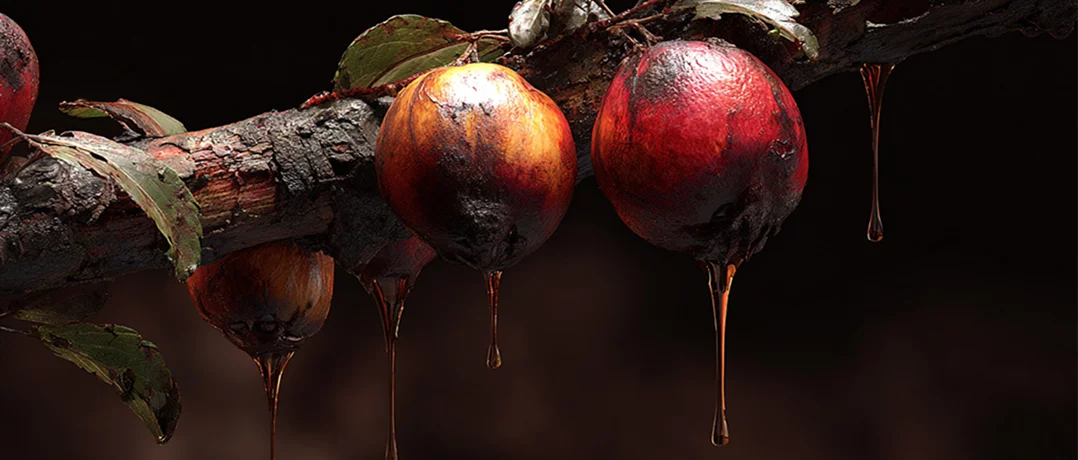
In southern Lebanon, war is not measured only in casualty counts. It is also visible in fruit left unpicked, in fields that can no longer be reached, in livestock that must be moved in haste, and in soils now shadowed by uncertainty. Behind the human catastrophe, another tragedy is unfolding quieter, but no less consequential: an agricultural sector abandoned under bombardment, production lost on the branch, and food security unravelling orchard by orchard.
Fruit rotting on the trees
In that context, the rural south is emptying out not because it has stopped producing, but because it has become impossible to access. One farmer from the south told The Beiruter that fruit is falling to the ground and rotting because he can no longer reach his plantations. Between Zahrani and the border, he said, access to a vast agricultural area has become either prohibited or too dangerous. Yet the farming calendar does not stop for air strikes: this is the season for bananas, lemons, avocados and oranges. What is rotting in the orchards today is therefore not merely a lost harvest. It is part of the production on which Lebanon depends to feed itself, decomposing where it stands.
A sector already brought to its knees
The most serious point is that this latest phase of war is not hitting an intact sector. It is falling on an agricultural economy already deeply wounded. An assessment published by the FAO, together with Lebanon’s Ministry of Agriculture and the CNRS-L, estimates that the Lebanese agricultural sector had already suffered $118mn in damage and $586mn in losses between October 2023 and November 2024. Reconstruction and recovery needs are estimated at $263mn, of which $95mn has been identified as a priority for 2025-2026. The regions hardest hit were already southern Lebanon and the Bekaa. In other words, the war of 2026 is not beginning on healthy ground. It is driving a sector already on its knees even deeper into crisis.
Land scarred by fire and chemicals
Damage to the land had already reached alarming levels. According to the UNDP report on the socio-economic impact of the 2024 war, shells and chemical agents including white phosphorus damaged or destroyed 2,193 hectares, including 1,917 hectares of forest and 275 hectares of agricultural land. The report also records the total loss of 134 hectares of olive groves, 48 hectares of citrus orchards, 44 hectares of banana plantations and 15 hectares of other fruit trees. Most strikingly, it states that the war forced farmers to abandon more than 12,000 hectares of agricultural land in the governorates of Nabatieh and South Lebanon.
The olive tree as a symbol of collapse
The olive tree alone captures the scale of the disaster. Reuters reported as early as November 2023 that fires caused by bombardment had destroyed around 40,000 olive trees in the south. Yet olives are far more than a symbolic crop: they account for more than 20 per cent of Lebanon’s cultivated land, support more than 110,000 farmers and producers, and represent 7 per cent of agricultural GDP. When olive trees burn in the south, it is not merely a landscape that disappears. It is income, an entire sector, rural memory and part of the country’s food resilience going up in smoke.
White phosphorus and the fear of poisoned soil
Added to this is the anxiety surrounding white phosphorus. On March 10, 2026, Reuters cited a Human Rights Watch report alleging that Israel had used white phosphorus munitions over residential areas in Yohmor on March 3, 2026. Reuters also noted that, according to the CNRS-L, 175 white phosphorus attacks had already been documented in southern Lebanon since October 2023, affecting more than 600 hectares of agricultural land. Here, war destroys on two levels: it renders land immediately inaccessible, and it casts a lasting shadow over the fertility, safety and future viability of certain plots.
Harvest losses on a devastating scale
Lost harvests are only part of the shock. UNDP estimates that harvests had already fallen by 84 per cent in Marjeyoun, 75 per cent in Bint Jbeil, 70 per cent in Hasbaya and 62 per cent in Nabatieh during the previous phase of the conflict. In the olive sector alone, 4,800 hectares of frontier groves went unharvested in 2023 and 2024, while delayed harvesting across 14,400 hectares south of the Litani led to a 60 per cent drop in production. The report places the total loss in the olive sector at 26,000 tons. The current war therefore threatens to prolong, or even worsen, an already severe rupture between the agricultural calendar and the military one.
When future agriculture is destroyed too
The rural productive apparatus has also been deeply damaged. UNDP reports the complete destruction of around 23 co-operatives, 16 olive presses and damage to more than 200 nurseries, not to mention the harm inflicted on irrigation networks and the forest environment. That means that beyond the fruit no longer being picked today, the very infrastructure that allows crops to be produced, processed, stored and sold tomorrow has also been weakened. The war is therefore not destroying only living agriculture. It is destroying future agriculture as well.
An emergency response, not a recovery plan
Faced with this hemorrhaging sector, the Ministry of Agriculture is trying to contain the collapse. In its emergency response, it says it is implementing a set of measures aimed at supporting farmers, protecting production and maintaining food supply chains during the conflict. These include direct support for farmers in affected areas, the provision of fodder, the relocation of livestock to safer areas, the continuation of support programs in accessible zones, co-ordination with partners to identify urgent needs, monitoring of agricultural markets, protection of the beekeeping sector through hive relocation, and a rapid needs assessment with the support of the CNRS, the FAO and the UNDP.
Agriculture minister Nizar Hani told The Beiruter that “measures are being taken on the ground, among the most important of which is to save cattle and goats, move their feed to safe locations and try to secure fodder for the animals, as the supply chain has been cut off in certain villages and neighborhoods.” In plain terms, the state is trying to salvage what can still be saved: livestock, beehives, inputs, administrative channels, permits and the minimal supply of markets.
And that is the heart of the problem. Herds can be moved. Fodder can be delivered. The most urgent links in the agricultural chain can be preserved. But banana plantations left unharvested, abandoned citrus groves, burnt olive orchards, potentially contaminated soils and lost growing seasons cannot be rebuilt in a matter of weeks. Southern Lebanon is not merely losing fruit. It risks losing agricultural capital, know-how, productive continuity and part of its ability to feed the country.
A threat to Lebanon’s food sovereignty
Most troubling of all is that this war is hitting agriculture at the very moment it had become strategically vital again. In an impoverished Lebanon, local production is no longer a luxury. It is a necessity for survival. When fruit falls and rots between Zahrani and the border, it is not merely a poignant image of war. It is the symptom of a country watching its food sovereignty erode not in speeches, but at the foot of its trees.
That is the tragedy of southern Lebanon: war does not merely destroy in the present moment; it weakens the future as well. It turns farmers into disaster victims, orchards into no-go zones, harvests into rotting fruit and productive land into suspect or abandoned plots. Behind every inaccessible hectare lies lost income. Behind every displaced hive, a weakened ecosystem. Behind every banana, lemon and orange left on the ground lies a portion of Lebanon that will be neither harvested, nor sold, nor eaten. And so long as the fighting, evacuations and fires continue, the agricultural bill for this war will continue to rise with them.
