

On the International Day of Sport for Development and Peace, Lebanon shows how sport can unite, empower, and transform society even amid challenges.
Sports as a force for peace, development, and dignity
Sports as a force for peace, development, and dignity
By The Beiruter | April 06, 2026

Reading time 4 min
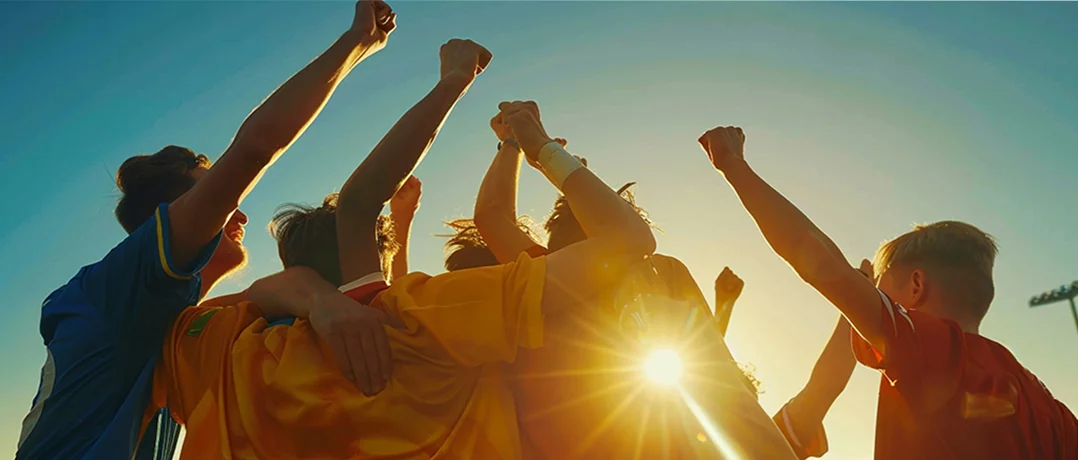
The International Day of Sport for Development and Peace, proclaimed by the United Nations General Assembly in 2013, exists to formalize sports as a language, a bridge, a classroom, and sometimes, a lifeline. The date is not arbitrary. April 6th marks the opening of the first modern Olympic Games in Athens in 1896, a moment that represented humanity's aspiration to compete rather than to conquer, to measure strength against one another without drawing blood.
Where sport meets society
In university gymnasiums, on school football pitches, and in the federation offices, administrators fight to keep Lebanese athletes competing on the world stage. For Ziad Saadeh, President of the Lebanese University Sports Federation, sport has never been simply about winning. It is, in his words, the foundation upon which societies are built. "Sport brings everyone together," he says. "It is the only thing that speaks the same language. In the past, nations competed over armies and civilizations. Today, they compete through sport, and it has genuinely transformed economies. Sport is fundamental to the state. It is fundamental to the lives of young people."
It is a conviction born not from idealism but from years of working inside a system that has had to fight for every resource, every recognition, every place on an international podium. And yet, when asked whether Lebanese student athletes can still hold their own regionally and on the world stage, Saadeh does not hesitate. "On the contrary, we are seeing progress and development. But every element matters: the state, the federations, the schools, the universities, the families. Every stakeholder in that cycle counts. When support comes from the top, everything develops faster."
The results are beginning to show. Under Saadeh's leadership, the Lebanese University Sports Federation now competes in three disciplines at the World University Championships, men's futsal, women's futsal, and men's handball. The distinction is significant. "Among Arab countries, Lebanon is the only one competing in all three," he notes.
Some countries only enter men's futsal. This is a very new achievement for Lebanon, and for us, it is enormously significant.
He assures that "there are many stakeholders who need to be engaged for Lebanese sport to truly ignite. And the most important factor remains support from the state."
Universities as incubators of Lebanese sport
Inside the universities themselves, the picture is one of genuine breadth. The federation encompasses 25 member universities competing across more than 40 championships, with clubs spanning martial arts, taekwondo, kickboxing, tennis, and judo, among others. "We compete in 40 disciplines, with both men and women participating," Saadeh explains. "We organize trips, we foster shared experiences. This is what we mean by community." Beyond the medals and the scoreboards, he sees the university sporting environment as a space where Lebanese young people develop resilience, belonging, and a sense of collective identity that the country's broader social fabric urgently needs.
Women's sport, he makes clear, is not an afterthought but a structural priority. "In every discipline, there is a women's team. Futsal, basketball, volleyball, all have girls' teams. Every category has representation. This is essential." In a region where female athletic participation has historically been uneven, the federation's insistence on parity across all 40 disciplines is a statement as much as a policy.
Lebanon's reach now extends well beyond its borders. Through its affiliation with FISU, the International University Sports Federation, the federation carries the Lebanese flag onto the world stage. Earlier this year, approximately 26 Lebanese student athletes competed at the World University Games in basketball and handball, a number that Saadeh speaks of with quiet pride.
He closes with the long view, the vision that animates everything else.
We want to develop our community, improve it, and transform it into a sporting society.
Then, with the measured confidence of someone who has watched the numbers move in the right direction: "And that is exactly what is happening."
The work ahead
On International Day of Sport for Development and Peace, Lebanon's story is worth telling: not because it is without difficulty, but because it demonstrates precisely what the day is meant to celebrate. When practiced with purpose and backed by commitment, sport does more than adapt to challenges, it transforms them. It builds communities, empowers youth, and lays the foundation for a more united, resilient society. In Lebanon, as in the world, sport does not wait for perfect conditions. It creates them.
-
-

-
The Beiruter
-
