



Thousands of Maronite Catholics in Australia celebrated the Feast of St Maron in Redfern, launching a Year of Prayer for Peace inspired by Pope Leo XIV’s visit to Annaya, Lebanon.
St Maron’s feast unites Australia’s Maronites
St Maron’s feast unites Australia’s Maronites
By Adella Beaini | February 09, 2026

Reading time: 3 min
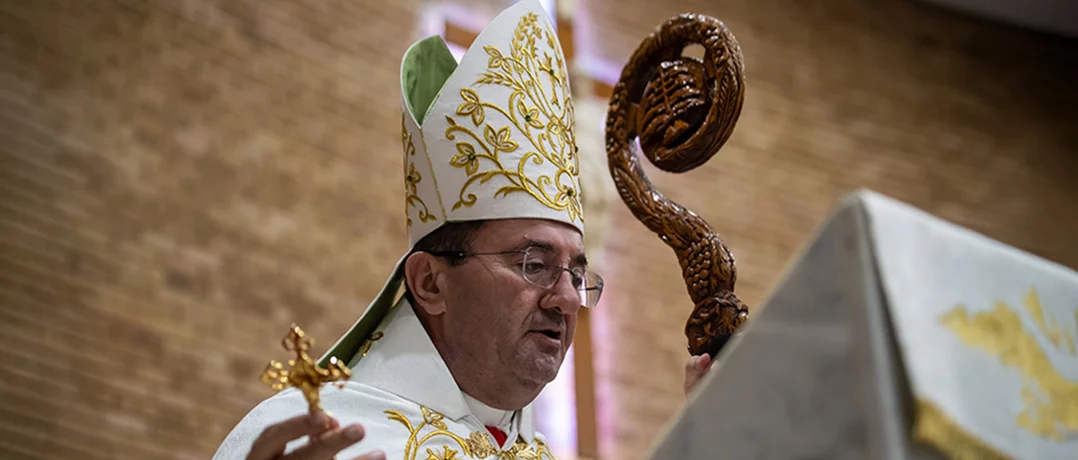
Thousands of Maronite Catholics across Australia are celebrating the Feast of St Maron this weekend, joining Maronites around the world in marking one of the most significant days in the Church’s calendar.
The celebrations are centred on St Maroun’s Cathedral in Redfern, Sydney the historic heart of the Maronite Church in Australia where Bishop of Australia, New Zealand and Oceania, Bishop Antoine-Charbel Tarabay, presided over the feast liturgy and formally launched a Year of Prayer for Peace.
St Maron, a 4th-century hermit and spiritual father of the Maronite Church, is revered for his life of prayer, asceticism and missionary influence, with his disciples laying the foundations for the Maronite Christian presence in Lebanon and beyond.
In his homily, Bishop Tarabay described St Maron as a bridge between cultures, faith and everyday life.
“Saint Maron was a man who lived between worlds. He stood at the crossroads between city and countryside, between the Greek speaking culture of Antioch and the Syriac speaking people of the Antiochian hills, between learning and simplicity,” he said.
“Yet above all, he was a bridge between the human heart and God. Though a hermit, Saint Maroun was never closed in on himself. From his solitude flowed a powerful missionary spirit.
The Feast of St Maron is also a major cultural and spiritual marker for Australia’s Maronite community, one of the largest Maronite diasporas in the world. Australia is home to tens of thousands of Maronite Catholics, forming a significant part of the broader Lebanese-Australian community.
St Maron’s Cathedral in Redfern, which hosted this year’s main celebrations, was first established in 1897, making it one of the oldest Lebanese Christian institutions in the country. The original church was consecrated on January 10, 1897, serving as a focal point for early Lebanese migrants, many of whom settled in Sydney’s inner south.
The cathedral later became the seat of the Maronite Eparchy of Australia following the establishment of the diocese in 1973, reflecting the rapid growth of the community in the post-war period.
Today, Maronite parishes and churches are spread across New South Wales, Victoria, Queensland, South Australia and Western Australia, including major centres such as Our Lady of Lebanon Co-Cathedral in Harris Park, St Charbel’s in Punchbowl, St Joseph’s in Croydon, and parishes in Melbourne, Adelaide, Brisbane and Perth.
In his homily, Bishop Tarabay used the feast to formally launch a Year of Prayer for Peace across the Eparchy, linking the initiative to recent global and regional events.
“The Feast of Saint Maron is a fitting moment to reflect and launch the Year of Prayer for Peace in our Eparchy,” he said.
“As we launch this year, I wish to recall a moment that deeply moved me, and that moved millions of Maronites throughout the world. On 1 December 2025, Pope Leo XIV prayed at the tomb of Saint Charbel in Annaya, Lebanon.
“To see the Holy Father kneeling at the tomb of a humble monk, who followed the spirituality of Saint Maroun and desired to remain unknown to the world, is an image that no Maronite and no Lebanese will forget for generations to come.”
“United with the Holy Father in his prayer for Lebanon and for the world, we dedicate 2026 as a Year of Prayer for Peace. For there can be no lasting peace without conversion.”
The bishop also addressed the meaning of peace in Australia at the moment and the need for reconciliation and unity in the wake of recent national tragedies.
“Here in Australia today, we are called to live the spirituality of Saint Maroun anew. It is a spirituality that rejects antisemitism, hate speech, and all forms of division,” he said.
Beyond the spiritual focus, Bishop Tarabay highlighted concrete in the Maronite community, including the upcoming opening of the Transformation Centre in Dooralong, NSW, in collaboration with Courtly Roy, to support people suffering from addiction. The centre is set to open in March.
He also confirmed that a new parish, St Rita’s Church in Guildford, is expected to open later this year, reflecting continued growth in Sydney’s western suburbs.
Among those in attendance were NSW Governor Margaret Beazley, Ukrainian Catholic Cardinal Mykola Bychok attending for the first time since being elevated to the College of Cardinals the Lebanese Consul in NSW, fellow Catholic bishops, clergy, and representatives from Maronite organisations.
As Bishop Tarabay concluded, the legacy of St Maroun continues to shape Maronites today.
“Saint Maroun formed disciples who transformed the mountains of Lebanon,” he said.
“May we, inspired by his example, form disciples who transform the cities and suburbs of Australia into places where the peace of Christ is lived, protected, and shared.”
