



Sydney becomes a new global center of devotion as the world’s largest bronze sculpture of St Charbel is installed atop the Punchbowl monastery, turning a quiet street into a historic public act of faith.
Sydney unveils world’s largest St Charbel sculpture
Sydney unveils world’s largest St Charbel sculpture
By Adella Beaini | January 22, 2026

Reading time: 4 min
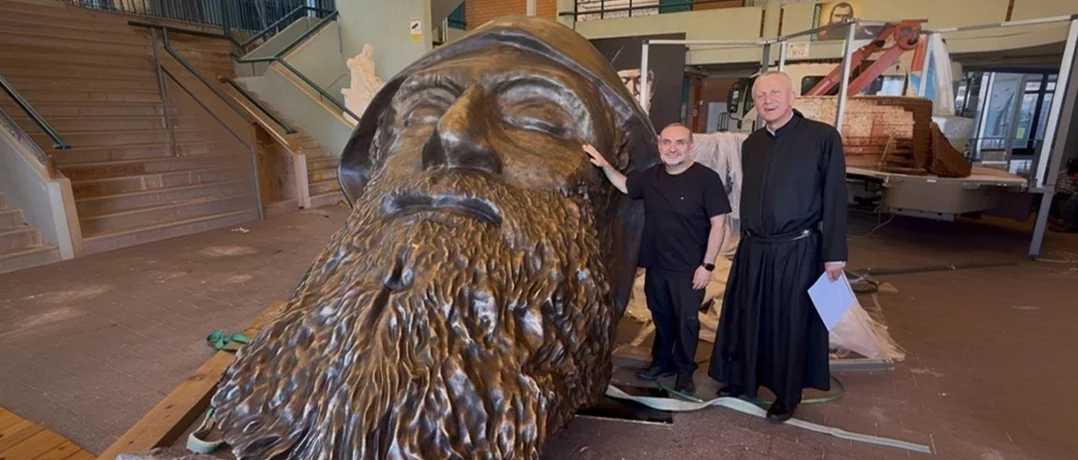
More than 20,000 worshippers, pilgrims and onlookers flooded a Sydney street on Thursday night as they witnessed a historic moment for Australia and the global Church, with the installation of the world’s largest monumental bronze sculpture of St Charbel’s face atop St Charbel’s Monastery.
The powerful night of faith, procession and prayer saw crowds line Highclere Avenue as a solemn Eucharistic procession involving 150 pallbearers moved through the streets, transforming an ordinary suburban setting into sacred ground.
The 900-kilogram bronze sculpture, standing more than four metres high, was craned onto the monastery building following the procession, becoming an immediate landmark on the Punchbowl skyline and a focal point of devotion for thousands.
The event coincided with the 33rd anniversary of the miracle of Nohad Chami, one of the most widely recognised healings attributed to St Charbel and formed part of the spiritual lead-up to a major milestone for the Church, the 50th anniversary of St Charbel’s canonisation next year.
“The idea did not arise from a desire to create something grand, but from something far more deeply rooted in the Maronite spiritual tradition,” Fr Anthony El-Kazzi, Secretary of the Lebanese Maronite Order in Australia and event organiser, said.
“It came from the desire to give visible expression to a mystery already lived: that all life finds its meaning when it is offered and returned to Christ present in the Holy Eucharist.”
That theological focus shaped every element of the sculpture.
Despite its size and weight, the saint’s face does not command attention outward, but draws the gaze upward.
“St Charbel never sought attention. His holiness was hidden, shaped by silence, prayer, fasting and total surrender to God,” Fr Anthony said.
“For this reason, the sculpture was never conceived as a monument to greatness, but as a sign of orientation.”
“Its scale speaks not of prominence, but of offering. Despite its size and weight, the face of St Charbel is gently inclined upward, fixed not on itself, but toward Christ.”
The procession began not with the sculpture, but with the Eucharist.
Maronite Bishop of Australia, New Zealand and Oceania, Bishop Antoine-Charbel Tarabay, led the way carrying Christ along with the monks, followed by the bronze face of St Charbel borne by 150 pallbearers, with the faithful surrounding them to form a 12-metre-long chalice-shaped procession.
The structure of the procession reflected the Maronite understanding of the Church itself.
“This ordering is essential: the saint does not stand at the centre, Christ does,” Fr Anthony said.
Here, the chalice is not made of metal, but of living bodies. The Church becomes what it celebrates.
The sculpture will permanently remain on the monastery building positioned not to dominate, but to point inward and upward.
“It does not dominate the building; it remains oriented toward the altar within,” Fr Anthony said.
“Its gaze is fixed upward, in perpetual prayer, reminding all who see it that even the most enduring signs must bow before the Mystery.”
The significance of the date highlights why devotion to St Charbel continues to resonate across cultures and continents.
“In the Maronite Church, miracles are not spectacles; they are signs of mercy, reminders that God remains close to His people, attentive to suffering, responsive to faith,” Fr Anthony said.
Since his death in 1898, more than 30,000 miracles have been attributed to St Charbel’s intercession worldwide, involving people from over 130 countries, many of them non-Lebanese.
Shrines dedicated to him exist across Europe, the Americas, Asia and Australia, cementing his status as one of the most widely venerated saints of the modern era.
That devotion is often deeply personal.
“My devotion to St Charbel began after a priest first used the holy oil that had been placed on his relics. It was a simple moment, but it stayed with me and changed the way I approached faith,” Bianca Vucetic, a mother of two, said.
“As a mum, I keep the oil close. If one of my children is hurt or wakes up from a nightmare, I bless them with it and pray. It’s become a quiet source of comfort in our home.”
For Fr Anthony, the night represented far more than a single event.
“This moment unites memory, faith and future. It honours the past, speaks to the present and leaves a legacy for generations to come, a visible reminder to return to the altar, fix the heart on Christ, and allow silence, obedience and sacrifice to shape the soul,” he said.
As bronze met stone and prayer filled the streets, Punchbowl hosted not just the installation of a sculpture, but a historic public act of faith one that now stands as a lasting sign in the lead-up to St Charbel’s golden jubilee of sainthood.
