



Israel’s strike on Syria’s Abu al-Duhur Air Base has intensified regional tensions, exposing growing Israeli-Turkish rivalry and renewed diplomatic efforts to prevent escalation.
Syria’s Abu al-Duhur puts Israel and Türkiye on edge
Syria’s Abu al-Duhur puts Israel and Türkiye on edge
By The Beiruter | August 20, 2026

Reading time: 6 min
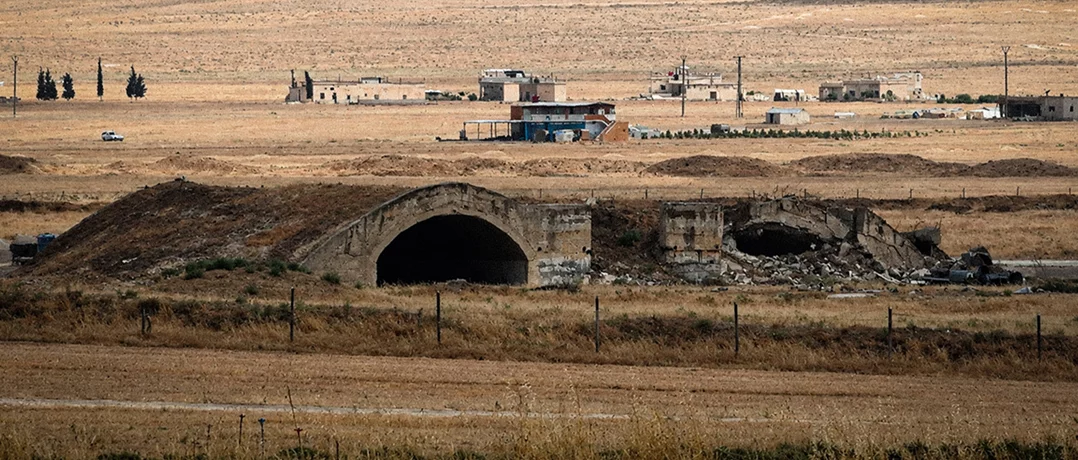
A new Israeli airstrike on Syria’s Abu al-Duhur Military Air Base has intensified regional tensions, drawing widespread condemnation from Arab governments while exposing the increasingly complex strategic competition unfolding in post-Assad Syria. The strike, which reportedly targeted the airfield in Syria’s Idlib province, came amid concerns of Turkish involvement in rehabilitating the facility and renewed efforts to rebuild Syria’s military capabilities following the collapse of the Assad regime in December 2024.
The incident has also highlighted Washington’s growing diplomatic challenge as it seeks to prevent direct military confrontation between two of its regional partners, Israel and Türkiye, while simultaneously supporting Syria’s stabilization.
Israeli strike targets strategic air base
Israeli aircraft conducted 8 airstrikes against Abu al-Duhur Military Air Base in eastern Idlib province in the early hours of Tuesday. The strikes reportedly damaged the runway and military infrastructure without causing casualties.
The Syrian Ministry of Foreign Affairs (MOFA) condemned the attack as an “unjustified aggression” and “a flagrant violation of Syria’s sovereignty and territorial integrity,” describing it as a dangerous escalation that threatens regional stability.
Although Israeli authorities initially refrained from publicly acknowledging responsibility, Prime Minister (PM) Benjamin Netanyahu’s office stated that Israel “will not tolerate any threat to its security” and accused Syria of preparing to violate existing security understandings by permitting Turkish military deployment at a facility near Aleppo.
The statement asserted that Israel had repeatedly warned Damascus that any Turkish military presence in northern Syrian air bases would constitute a security threat and stressed that Israel would continue acting against developments it considers detrimental to its national security.
Why Abu al-Duhur matters
Abu al-Duhur is considered the second-largest military air base in northern Syria after Taftanaz Air Base. Located at the intersection of Idlib, Aleppo, and Hama provinces, it occupies a strategically important position that provides logistical access across northern Syria while serving as a potential gateway to the Syrian desert.
The base has changed hands multiple times throughout the Syrian conflict. Opposition forces captured it in 2015 after a prolonged siege before Syrian government forces, backed by extensive Russian airpower, retook the installation in early 2018. Following the fall of the Assad regime, the facility remained largely inactive but has recently attracted renewed attention amid efforts to rehabilitate Syria’s military infrastructure.
A growing Israel-Türkiye geopolitical rivalry in post-Assad Syria
The strike on Abu al-Duhur underscores a broader geopolitical competition between Israel and Türkiye over the future security architecture of post-Assad Syria.
Since the fall of Bashar al-Assad’s regime, Ankara has emerged as one of Damascus’ principal security partners. In August 2025, Türkiye and Syria signed a military cooperation agreement covering training, defense consultations, logistics, and equipment support. Syrian military personnel have since trained in Turkish facilities, while Syrian officer cadets have enrolled in Turkish military academies. The rehabilitation of military installations such as Abu al-Duhur forms part of these broader efforts to rebuild Syria’s armed forces.
Reports that a Turkish military delegation recently inspected rehabilitation work at Abu al-Duhur reinforced Israeli concerns that the base could eventually support expanded Syrian-Turkish defense cooperation. Israel argues that Turkish involvement in restoring Syrian air bases, or any future deployment of Turkish personnel or military assets, could restrict its operational freedom in Syrian airspace and alter the regional military balance. This is because there are concerns that it can eventually accommodate surveillance assets, air-defense systems, or combat aircraft PM Benjamin Netanyahu’s office said Israel had repeatedly warned Damascus that allowing Turkish forces to operate from a northern Syrian air base would constitute a threat to Israeli security. Meanwhile, Israeli Defense Minister Israel Katz said in a post on X that Turkish President Recep Tayyip Erdoğan is “dragging Türkiye into dangerous adventures in Syria.”
Türkiye and Syria have rejected those allegations, maintaining that Abu al-Duhur is being restored for future Syrian Air Force operations rather than to serve as a Turkish military base. Ankara has described Israel’s accusations as unfounded and accused it of using them to justify continued strikes on Syrian territory. Syrian Foreign Minister (FM) Asaad al-Shaibani asserted that “there are no plans to establish a Turkish military base there, nor to maintain a permanent Turkish military presence or deploy Turkish troops at the site.”
U.S. seeks to prevent regional escalation
The Israeli strike also underscored Washington’s difficult balancing act between regional partners.
United States (U.S.) Special Envoy Tom Barrack revealed that his country is developing a deconfliction mechanism involving Israel, Türkiye, and Syria to prevent accidental military confrontations.
Barrack explained that Ankara had received no advance warning of the Israeli strike and therefore observed Israeli aircraft heading toward areas close to Turkish territory. Under different circumstances, such movements could have prompted Turkish military preparations or an unintended response.
Fortunately, cooler heads prevailed.
Barrack added that Washington’s immediate priority is reducing tensions and preventing misunderstandings that could escalate into direct conflict. He also characterized the strike as an “unnecessary escalation,” highlighting that diplomatic engagement remains essential to preserving regional stability.
The U.S. initiative reflects broader concerns that the overlapping military activities of Israel, Türkiye, and the emerging Syrian government increase the likelihood of miscalculation even if neither party seeks direct confrontation.
Arab states condemn the airstrikes
The Israeli operation prompted a coordinated wave of condemnations across the Arab world.
Saudi Arabia described the strikes as a blatant violation of international law and Syrian sovereignty, reaffirming its solidarity with Syria and urging the international community to halt repeated Israeli violations.
Egypt similarly condemned the attack as a clear breach of the United Nations (UN) Charter and warned that continued Israeli military operations undermine efforts to stabilize Syria while threatening broader regional peace.
Jordan characterized the strikes as an unjustified act of aggression and called upon the international community to fulfill its legal and moral responsibilities by ending repeated Israeli attacks against Syrian territory. Foreign Ministry (FM) spokesperson Ambassador Sufian Qudah’s office stressed that such actions represent “a dangerous escalation” likely to generate further regional instability.
Kuwait likewise denounced the strikes, urging both the international community and the United Nations Security Council (UNSC) to assume their responsibilities by ensuring respect for international law and protecting Syria's sovereignty.
The Gulf Cooperation Council (GCC) also issued a collective condemnation. Secretary-General Jasem Albudaiwi stated that the Israeli attack constituted an unacceptable violation of Syria’s territorial integrity and warned that continued military operations risk undermining regional and international efforts to achieve lasting stability.
Qatar additionally warned that the absence of accountability encourages further violations of international law and increases the likelihood of wider regional escalation.
As Syria rebuilds its military institutions and regional actors redefine their influence, Abu al-Duhur has become more than a military installation; it has emerged as a symbol of the evolving geopolitical contest between two key regional powers, Israel and Türkiye
.-
-

-
The Beiruter
-
