

The Beiruter reached out to Mai Najeh Khallouf, an elected member of the Syrian People’s Assembly in the October 2025 elections, to better understand Syria’s launch of its first public trial of Assad-era officials.
Syria’s first public trial of Assad-era officials
Syria’s first public trial of Assad-era officials
By The Beiruter | April 28, 2026

Reading time: 4 min
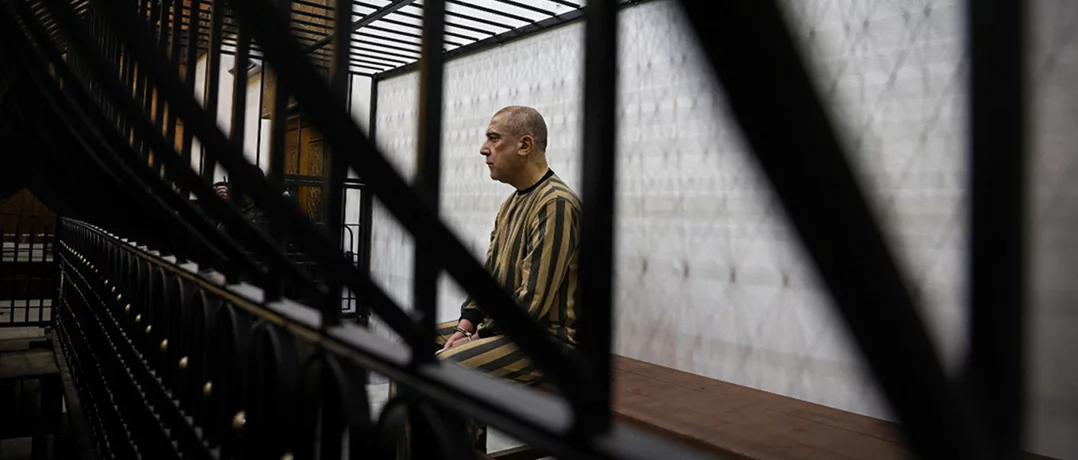
In a landmark moment for post-war Syria, authorities in Damascus have launched the first public trial of officials associated with the former regime of Bashar al-Assad. The proceedings mark a significant step toward transitional justice after more than a decade of devastating conflict.
For many Syrians, the trial represents not only an attempt to hold individuals accountable for past abuses but also a broader test of whether the country can rebuild its legal and moral foundations following years of violence, repression, and division.
Mai Najeh Khallouf on Syria’s early path to transitional justice
In an exclusive interview with The Beiruter, Mai Najeh Khallouf, an elected member of the Syrian People’s Assembly following the October 2025 elections, discussed and gave her insights regarding the early steps of judicial proceedings against individuals associated with the former Assad-era security and political apparatus.
Those who supported him in practice, those whose hands are stained with blood, are considered war criminals who committed major massacres.
Khallouf framed these developments as a notable shift in public life, particularly among Syrians who have long demanded accountability for serious human rights violations committed during and prior to the conflict. She stressed that the initiation of trials targeting figures linked to the former regime has been met with broad public approval, describing a strong sense of reassurance among victims’ families, who perceive these proceedings as an acknowledgment that past atrocities will not go unaddressed.
In her view, this development also signals the gradual emergence of a state governed by legal norms. Indeed, Khallouf asserted that,
This is the beginning of a state governed by law, where the courts begin to play their role.
Moreover, Khallouf noted that current efforts are widely seen as only the first stage in a broader process of transitional justice that may include legal accountability, reparations, and institutional reform. Within this framework, she highlighted the prevailing public belief that meaningful justice ultimately requires addressing higher levels of responsibility within the former political hierarchy.
Atif Najib was the spark that led to the massacres; he was the first criminal to commit abuses against the children of Daraa, which ignited the Syrian revolution.
Khallouf also addressed the legal and diplomatic uncertainties surrounding potential extradition-related discussions involving Bashar al-Assad, particularly given his reported presence in Russia. According to Khallouf, such questions remain unresolved and depend heavily on future legislative developments, including the anticipated adoption of a transitional justice law by the Syrian legislature.
Overall, Khallouf viewed the current judicial steps as foundational, while acknowledging that full accountability and national reconciliation remain contingent on a longer and more complex political-legal process.
A historic courtroom moment
The trial opened on Sunday in Damascus, drawing both national and international attention. At its center is Atef Najib, a former brigadier general and head of the Political Security Branch in Daraa province. Najib, who is also a cousin of Bashar al-Assad, appeared in court to face charges described as “crimes against the Syrian people.” He is the only defendant currently in custody and physically present in court, while several other high-ranking figures, including Assad himself and his brother Maher, are being tried in absentia.
The session was largely procedural, setting the stage for more substantive hearings scheduled in the coming weeks. Still, its symbolism was undeniable. For the first time, a figure closely linked to the early repression of the 2011 uprising stood before a Syrian court in a public and transparent setting. Crowds gathered outside the courthouse, some celebrating what they viewed as a long-overdue step toward justice.
The Daraa catalyst and the road to war
The charges against Najib are deeply tied to the origins of the Syrian conflict. In 2011, a group of teenagers in Daraa were arrested and reportedly tortured after writing anti-government graffiti on a school wall. Najib, then the senior security official in the region, is accused of overseeing the crackdown that followed. The incident ignited widespread protests, as public outrage over the treatment of the youths quickly spread beyond the city.
What began as localized demonstrations soon escalated into a nationwide uprising. The government’s harsh response, including the use of live ammunition against protesters, transformed the unrest into an armed conflict. Over the next 14 years, Syria descended into a brutal civil war that claimed hundreds of thousands of lives, displaced millions, and left much of the country in ruins.
The trial thus revisits one of the earliest and most defining moments of the conflict, linking individual accountability to the broader narrative of state repression that fueled the war.
Charges in absentia and the limits of justice
While Najib’s presence in court is significant, many of the most prominent figures of the former regime remain beyond the reach of Syrian authorities. Bashar al-Assad, who was overthrown on 8 December 2024 and reportedly fled to Russia, is among those being tried in absentia. His brother Maher, once commander of the elite 4th Armored Division, also faces charges related to alleged involvement in killings, torture, and other abuses.
Trying defendants in absentia allows the judicial process to move forward despite their absence, but it also raises questions about the effectiveness and legitimacy of such proceedings. Without the physical presence of key figures, critics argue, the trials risk being seen as incomplete or symbolic rather than fully accountable exercises in justice.
Nevertheless, Syrian officials have defended the approach as a necessary step under the circumstances, stressing that legal frameworks permit such trials and that they can still establish an official record of alleged crimes.
Hence, the public nature of the proceedings may help build trust, offering transparency in a system that has historically been associated with secrecy and political control. However, sustained credibility will depend on the consistency, independence, and thoroughness of the process. For now, the courtroom in Damascus stands as a symbol of a place where the long and difficult journey toward justice may finally be beginning.
-
-

-
The Beiruter
-
