



Syria struggles to balance foreign fighter integration, security stability, extremist risks, and international pressure amid its evolving post-war political order.
Syria’s foreign fighters conundrum

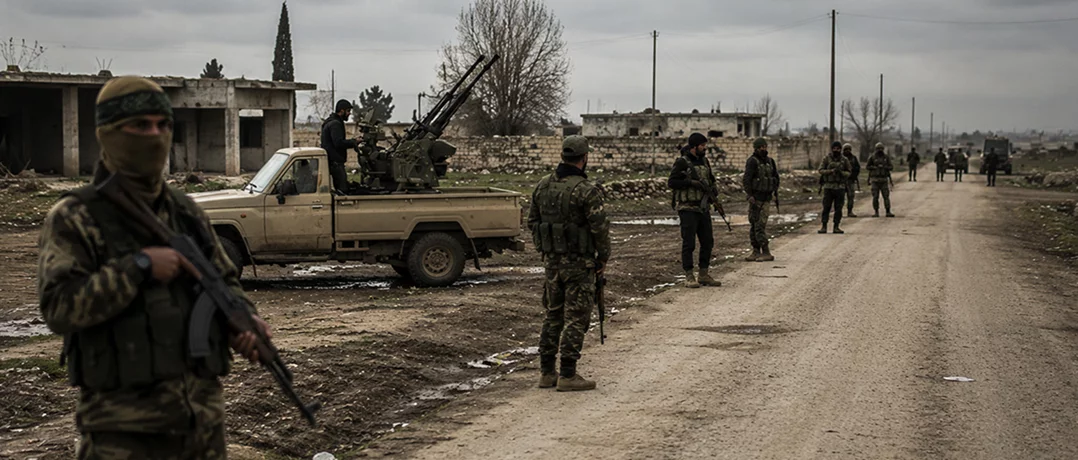
More than a decade after the outbreak of the Syrian Civil War in 2011, the issue of foreign fighters remains one of the most sensitive and controversial challenges facing Syria’s new political and security order.
The recent detention of Uzbek fighters by Syrian security forces in Idlib has once again drawn attention to the fragile balance Damascus is attempting to maintain between consolidating state authority, preserving internal stability, and addressing growing international and regional concerns over extremist networks operating inside the country.
The Idlib incident
The incident, which reportedly began after authorities attempted to arrest an Uzbek fighter accused of opening fire in Idlib city, quickly escalated into protests by armed Uzbek militants demanding his release.
Syrian security forces subsequently launched operations across parts of Idlib countryside, including Kafriya and al-Foua, arresting several foreign fighters involved in the demonstrations. Although the exact number of detainees remains unclear, it revealed the continuing complexity of managing foreign armed groups that have become deeply embedded in Syria’s post-war landscape.
Far from being an isolated security event, the confrontation highlights broader questions surrounding the future of foreign fighters in Syria, the evolving strategy of President Ahmad al-Sharaa’s administration, and the changing international approach toward these groups.
The origins of foreign fighters in Syria
Foreign fighters began arriving in Syria in large numbers during the early years of the civil war. Motivated by ideological, sectarian, and geopolitical factors, thousands of militants from Central Asia, the Caucasus, the Middle East, Europe, and North Africa joined various armed factions fighting the Assad government.
Some aligned themselves with extremist organizations such as the Islamic State (ISIS) and al-Qaeda (AQ) affiliates, while others later integrated into Hayat Tahrir al-Sham (HTS), the group that eventually emerged as the dominant force in northwestern Syria and leading the country today. Among the most prominent contingents were Uyghur fighters from China and Central Asia, Uzbek militants, Chechens, and Arab jihadists from countries including Egypt, Tunisia, and Jordan.
Over time, President Ahmad al-Sharaa gradually distanced his movement from transnational jihadist agendas. After severing ties with both ISIS and al-Qaeda and reaching power, Sharaa and the current authorities increasingly portrayed themselves as a nationalist Syrians focused on establishing political authority inside Syria rather than pursuing global jihad.
This transformation became particularly significant after HTS-led forces succeeded in toppling Bashar al-Assad on 8 December 2024. Since then, Syria’s new leadership has attempted to reframe the role of foreign fighters as disciplined military allies rather than uncontrollable extremists.
Integration rather than expulsion
One of the most controversial decisions taken by Syria’s new authorities has been the integration of foreign fighters into the newly reorganized Syrian military structure. Reports indicated that several foreign commanders, including Uyghurs and other non-Syrians, were granted senior military positions within the new army since late 2024.
While this development initially alarmed Western governments, the international position has gradually evolved. The United States (U.S.), which had previously demanded the exclusion of foreign fighters from Syria’s security institutions, later signaled conditional acceptance of their integration in June 2025 under strict oversight and transparency measures.
Washington’s changing approach appears rooted in pragmatic security calculations. American officials increasingly view controlled integration as less dangerous than abandoning thousands of experienced fighters outside formal state institutions, where they could potentially drift back toward ISIS or al-Qaeda networks.
According to reports, around 3,500 foreign fighters (primarily Uyghurs from China and neighboring regions) may be incorporated into a newly established Syrian military division. Syrian officials argue that most of these fighters have demonstrated loyalty to the current administration and no longer pursue international extremist agendas.
Supporters of the policy point to international precedents such as the French Foreign Legion and foreign personnel serving in various Arab militaries, arguing that nationality alone should not determine whether someone can serve within a national armed force.
Security risks and internal tensions
Despite efforts to normalize the presence of foreign fighters, significant concerns remain both inside Syria and abroad; including in Lebanon. This is true given that many of these militants were positioned along the Lebanese-Syrian border, raising concerns of potential border tensions and infiltrations with local Lebanese.
Additionally, hardline elements continue to pose potential security risks, particularly those dissatisfied with the government’s increasingly pragmatic and internationally oriented policies.
ISIS has actively sought to exploit these tensions. Following Ahmad al-Sharaa’s diplomatic engagement with the West, the group publicly denounced the Syrian leader and called on foreign fighters to defect from the government and join extremist insurgent networks instead.
This appeal reflects deeper ideological divisions within Syria’s militant landscape. Some radical fighters reportedly view the new government’s tolerance of social diversity, diplomatic outreach to Western states, and participation in international political processes as ideological betrayal.
The recent arrests of Uzbek fighters in Idlib may therefore signal more than a localized security dispute. They could indicate a broader attempt by Damascus to assert centralized authority over foreign armed groups and demonstrate to international partners that the state (not autonomous militant factions) ultimately controls Syria’s security environment.
Domestic perceptions and political sensitivities
Within Syria itself, public opinion regarding foreign fighters remains deeply divided. Critics of the new administration often portray their continued presence as evidence that extremist influence still permeates state institutions. Opponents, including remnants of the former Assad regime, frequently use the issue to question the legitimacy of the post-Assad order.
Meanwhile, many Syrians, particularly within communities supportive of the revolution, remain divided in approaching this matter. Some secularists view these fighters with a warry eye inside the country given their impact on the stability and composition of the Syrian state, while others view certain foreign fighters as essential partners who sacrificed alongside Syrians during years of brutal conflict.
For Syria’s leadership, the challenge lies in balancing competing pressures: reassuring international partners, preventing extremist resurgence, maintaining domestic stability, and preserving the loyalty of forces that played a major role in overthrowing the previous regime.
As Syria gradually re-enters regional and international diplomacy following the easing of sanctions, the foreign fighter issue may become less central than it once was.
-
-

-
The Beiruter
-
