

Low trading volumes and confusion over old and new banknotes mark the Syrian pound’s hesitant transition in Lebanon’s Chtoura market.
Syria’s new Lira arrives in Lebanon

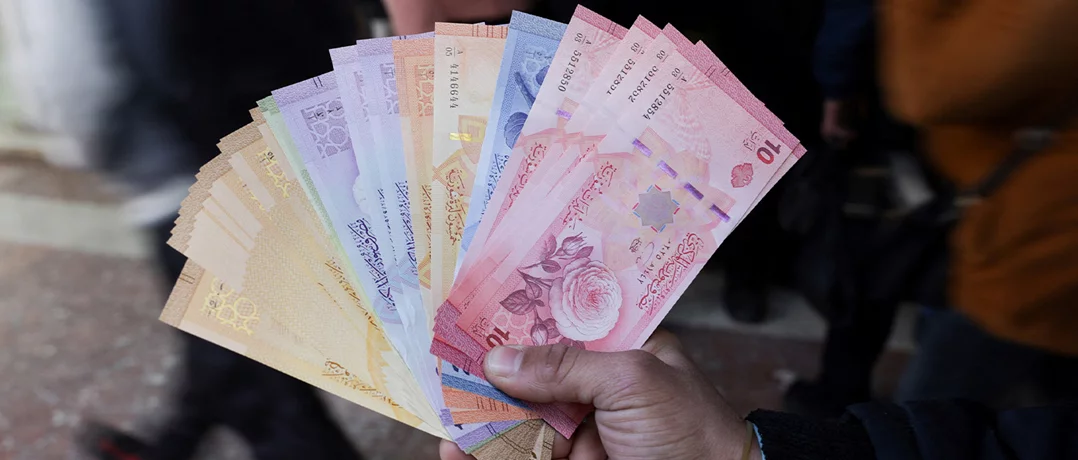
In its first days of circulation, the new Syrian pound made a tentative appearance in the money-exchange shops of Chtoura Square, without yet amounting to a real market test. Volumes traded in the square, long regarded as a bellwether for currency movements, particularly Arab currencies, remain extremely limited, if not virtually nonexistent. This hesitancy reflects not only the fact that the new banknotes have yet to enter wide circulation, but also the deep erosion of confidence in the Syrian pound since the fall of Bashar al-Assad’s regime.
In the weeks that followed Syria’s major political shift, Chtoura’s exchange market, according to traders, witnessed a rapid rush to convert the old Syrian pound into US dollars. The motivation was straightforward: fears that the currency would soon become unusable because it bears the image of the ousted president. Many worried that the Syrian pound could meet the same fate as the Iraqi currency after 2003, when it was withdrawn from circulation and gradually replaced, effectively losing its transactional value in the market. Since then, exchangers in Chtoura have described two clearly distinct phases in the trading of the Syrian currency.
Before and after Assad’s fall
Before the collapse of the Assad regime, exchangers say the Syrian pound maintained a substantial presence in Chtoura, both in trading volume and in the number of users, even at the height of Syria’s crisis and despite the sharp depreciation caused by international sanctions. At the time, the pound was the only currency legally used for transactions inside Syria. Families living in Lebanon routinely sent part of their income or humanitarian assistance, whether in Lebanese pounds or US dollars, to relatives in Syria, who were then compelled to exchange those funds into Syrian pounds.
More than a year after Assad’s fall, the market today appears to have largely “purged” itself of the Syrian currency. Trading in the pound has dwindled sharply in Chtoura Square, particularly as transactions inside Syria have increasingly shifted toward foreign currencies, foremost among them the US dollar.
A transitional phase likely to cause confusion
Despite the sharp decline in trading volumes, several exchangers interviewed by Nidaa Al-Watan expect the transition from the old currency to the new one to generate a degree of confusion, particularly when it comes to distinguishing the value of the old notes from that of the new issue. Exchangers in Chtoura stress that their role is not to replace old notes with new ones, but to convert currencies into foreign exchange, or vice versa, an area where the main complication arises.
Under the new issue, 10,000 Syrian pounds will be worth the equivalent of one million pounds from the old issue when exchanged into dollars, a disparity that could easily confuse customers and traders alike. As one exchanger put it, “The confusion is there, but activity remains weak.” Estimates vary, with some suggesting the transition could last several months, while others believe it may stretch to two years. In all cases, the market continues to operate with what is available, anticipating that the currency transition will accelerate once relations between Lebanon and Syria normalize.
The first 500-pound note, and the buzz around it
During a tour of Chtoura Square in search of the new banknotes, Nidaa Al-Watan encountered just a single 500-pound note from the new issue. The note quickly became a talking point among exchangers, who pointed to the colleague who had received it from a customer.
According to the exchangers, the old currency is expected to be phased out gradually through individual transactions in the coming days, or at most weeks. Those holding large quantities of the old notes, they add, can rely on contacts in Syria to exchange them through the central bank.
For now, exchangers continue to accept the old Syrian pound without fearing a sudden collapse in its value. The currency, they explain, was issued within a banking system that cannot simply be annulled overnight and is subject to an organized financial process of replacement. Information available to them indicates that Syrian authorities have set a three-month deadline for exchanging the old currency, with widespread expectations that this period may be extended.
Still, some exchangers do not rule out the possibility of opportunistic practices, particularly in converting the old notes. Certain traders may impose an additional profit margin under the pretext of the currency’s age, a practice that could, paradoxically, act as an incentive for the new Syrian pound to make its way more decisively into the market.
-
-

-
The Beiruter
-
