



More than four decades later, the Lebanese Front's 1980 manifesto remains one of the defining political blueprints of the civil war era, offering a vision for Lebanon rooted in sovereignty, constitutional reform, and pluralism.
The 1980 Lebanese front manifesto

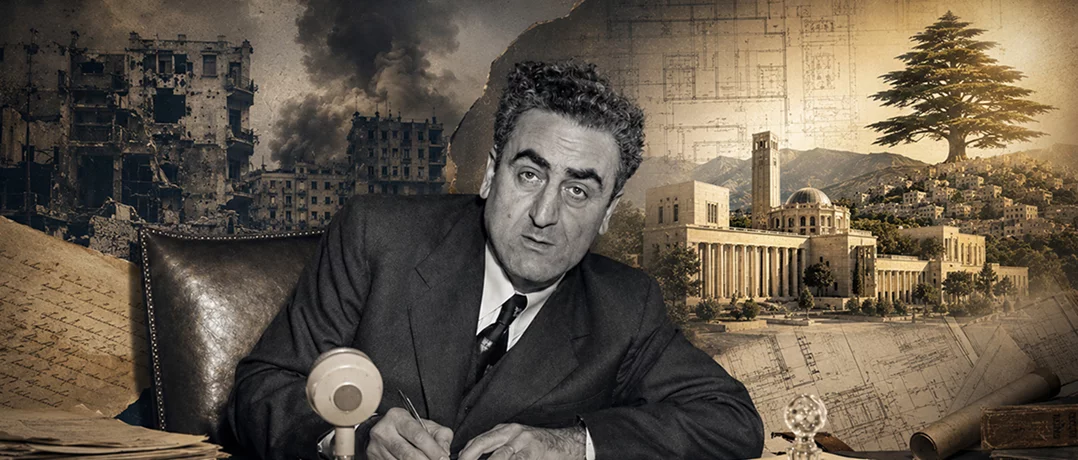
On 23 December 1980, as Lebanon entered the sixth year of the war that had erupted in April 1975, the Lebanese Front issued one of the most important political documents of the conflict: The Lebanon We Want to Build. Introduced by philosopher, diplomat, and former Foreign Minister Charles Malik in January 1981, and signed by Camille Chamoun, Pierre Gemayel, Abbot Boulos Naaman, Charles Malik, Fouad Afram Boustany, and Edouard Honein, the manifesto was the Lebanese Front's most complete statement of political doctrine.
The document appeared when Lebanon's sovereignty was collapsing under multiple pressures. By the end of 1980, the Palestine Liberation Organization, whose presence had expanded after Black September in Jordan in September 1970, operated from large areas of South Lebanon and West Beirut. Syrian forces had been deployed since June 1976 under the Arab Deterrent Force mandate. Israel had already launched Operation Litani in March 1978, and Lebanon was less than eighteen months away from the full-scale Israeli invasion of June 1982. In this setting, the Lebanese Front sought to define not only what it opposed, but what Lebanon should become.
The first principle was sovereignty. The manifesto rejected any attempt to dissolve Lebanon into its regional environment or reduce it to an arena for foreign conflicts. Lebanon, it insisted, had to remain an independent, sovereign, and free state within its internationally recognized borders. A Lebanon without sovereignty, in the Front's view, would no longer be Lebanon, but merely a battlefield for Palestinian, Syrian, Israeli, Arab, or international strategies.
The second principle was freedom. The document described Lebanon as a free, open, and pluralistic society, distinct from the centralized and authoritarian models surrounding it. The Lebanese Front located Lebanon's political identity in its protection of religious liberty, freedom of thought, open education, free economic exchange, and political diversity. Lebanon was therefore presented not only as a state, but as a civilizational model.
The third principle was pluralism. The manifesto rejected the idea that Lebanon was merely an uneasy coexistence between Christians and Muslims. Instead, it described the country as a "federation of communities" composed of sixteen religious groups. Lebanon, in this vision, was not a nation that should erase its communities in the name of artificial uniformity, nor a state where one community should dominate the others. It was a common homeland whose stability depended on protecting the freedom, dignity, and equality of all its components.
This led to a fourth principle: equality without discrimination. The manifesto stated that no Lebanese should be considered superior to another except through loyalty to Lebanon, its freedoms, and its values. This was a direct answer to the demographic and ideological pressures of the time. The Lebanese Front argued that Lebanon's political system should not be governed by numerical domination, armed coercion, or imported revolutionary projects, but by constitutional guarantees protecting all Lebanese regardless of religious identity or community size.
The fifth principle was the protection of Christian freedom, but not as a call for Christian supremacy. The document argued that the Christian community in Lebanon had a special historical responsibility because it represented one of the last free Christian presences in the Middle East. Yet it insisted that Christians did not want more for themselves than they wanted for others, while refusing to accept less than others demanded for themselves. This distinction is central to understanding the manifesto. Christian security was presented not as a sectarian privilege, but as a test of Lebanon's ability to protect all minorities and all freedoms.
The sixth principle was constitutional reform. The Lebanese Front did not defend the pre-war system as untouchable. It acknowledged that the political formula established with the National Pact of 1943 required reconsideration and proposed that Lebanon might need a new structure based on decentralization, federation, or confederation within a single unified Lebanon. Nearly nine years before the Taif Agreement of 1989, the Front had already placed decentralization and federal thinking at the center of its vision for preventing future conflict.
This proposal was not presented as a step toward partition. The manifesto explicitly rejected partition, just as it rejected any arrangement that would weaken responsible freedom. Its objective was to reconcile unity with diversity. The Lebanese Front believed that Lebanon could not survive through forced centralization or through the denial of communal realities. It needed a constitutional architecture that allowed communities to feel secure while preserving one sovereign state.
The seventh principle was rejection of foreign domination. The manifesto called for "total liberation from the two occupations": the Syrian military presence and the Palestinian armed presence. This dual rejection is crucial. The Lebanese Front did not frame Lebanon's crisis as the result of one foreign actor alone. It saw both the Syrian Army and the militarized Palestinian presence as violations of Lebanese sovereignty. It also categorically rejected the permanent settlement of Palestinians in Lebanon, arguing that such settlement would alter the country's identity, demography, and political balance.
The eighth principle was Lebanon's openness to the world. The manifesto defended Lebanon's relationship with the Arab world while insisting on preserving its historical ties with Europe, the West, and the Lebanese diaspora. It rejected the idea that Lebanon should be cut off from the wider world or absorbed into a single ideological camp. The Lebanese Front envisioned Lebanon as Arab in its environment, Mediterranean in its history, universal in its vocation, and organically connected to its emigrants abroad.
The ninth principle was moral and institutional renewal. The manifesto spoke of public ethics, social justice, respect for others, community solidarity, the supremacy of law, and the responsibility of leaders. This element shows that the Lebanese Front understood state-building as more than institutional design. It also required a political culture capable of placing the common good above factional interest.
Only four months later, these principles faced their first major strategic test. On 2 April 1981, the Battle of Zahle began and continued until 30 June 1981. Zahle was not merely a local confrontation. Because of its position overlooking the Bekaa Valley and the Damascus-Beirut corridor, Syrian control of the city would have strengthened Damascus' ability to institutionalize its dominance over Lebanon. For the Lebanese Front, defending Zahle became a blunt strategic move: a direct confrontation with Syrian hegemony designed to prove that the principles announced in December 1980 were not theoretical.
Zahle was therefore the first practical demonstration of the manifesto's doctrine as unified forces. The document had declared that Lebanon must be sovereign, pluralistic, free from foreign occupation, and resistant to absorption by regional powers. The battle showed that the Lebanese Front was prepared to translate those principles into forward military strategy. Zahle did not inspire the manifesto; it tested it. It revealed the political meaning of the document: sovereignty was not a slogan, but a line of confrontation.
More than forty-five years after its publication, The Lebanon We Want to Build remains one of the most consequential political texts produced during the Lebanese war. Its importance lies in the principles it placed at the center of Lebanon's future: sovereignty, freedom, pluralism, equality, decentralization, rejection of foreign tutelage, openness to the world, and institutional renewal.
Whether one agrees with its conclusions or not, the manifesto remains indispensable for understanding the Lebanese Front's political project at the beginning of the 1980s. It argued that Lebanon could not be saved by arms alone, nor by a return to the old formula without reform. It had to be rebuilt around a political vision capable of protecting both unity and diversity. That debate, first articulated with force on 23 December 1980, remains unresolved in Lebanon today.
-
-
-
Dr. Elie EliasUniversity Lecturer & Political Historian
-
