



At 20, Lebanese athlete Toufic Bou Ali completed his first full Ironman in Argentina and is now pursuing a world-record attempt to finish six races across six continents before turning 21.
The 20-year-old Lebanese chasing six Ironman records
The 20-year-old Lebanese chasing six Ironman records
By The Beiruter | November 23, 2026

Reading time: 4 min
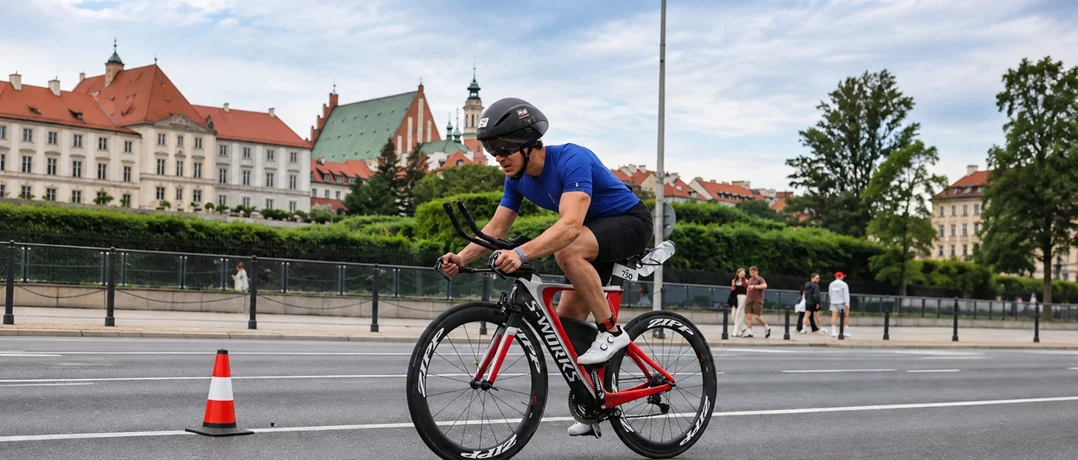
On 1 November 2026, in San Juan, Argentina, Toufic Bou Ali crossed the finish line of a full Ironman in 14 hours, 31 minutes and 56 seconds. He was 20 years old, among the youngest athletes in the field, and the only Lebanese competitor. He had prepared for roughly two months, with no coach, no medical supervision, no sponsors and no racing bicycle of his own.
He described the result as the beginning of an attempt to become the youngest man in the world to complete six full Ironman races on six continents before turning 21.
From bullying to the starting line
Bou Ali did not grow up as an athlete. He began practicing sport at 18, he told The Beiruter, when he was struggling with excess weight and bullying. "I had absolutely no self-confidence," he recalled.
Then came a decision. He cut out sugar, fast food and everything else that was hurting his health, and started racing, training at the gym and in his own room. The early results were discouraging. "At first, I was losing races," he explained, "but eventually I started seeing results from the work I was putting in."
He has since taken part in more than 60 races and reached the podium more than 20 times. After moving to France and competing abroad, he attempted his first half Ironman and became the youngest Lebanese person to complete one. A full Ironman was the obvious next question. "I had already broken a record in Lebanon, so why not break another one?"
He admitted that he had made the decision without the means to carry it out. "I made that decision without having the resources, the training or even an idea of how I would accomplish it. My body was not even ready for such a challenge."
His preparation for Argentina was improvised. Most of his training took place on a stationary bike at the gym, and he had barely practiced swimming. Much of his fitness came from weekly short races in Lebanon, which were not designed as Ironman preparation. Visas, financing, travel and equipment took up much of the time he would otherwise have spent training.
The trip nearly ended before the race began. He received his visa only 14 hours before his flight and pulled together the travel costs at the last minute with help from family and relatives. After passing through about five airports without sleeping, he arrived in Buenos Aires in pain, barely able to put weight on his left leg.
Argentine officials initially denied him entry, confiscated his passport and booked his return flight, giving him just 30 minutes to intervene. After contacting Ironman’s CEO and diplomatic contacts, his entry was unexpectedly approved with only minutes to spare. The organizers, local athletes and Lebanese community then rallied around him, providing accommodation, transport, equipment and a bicycle so he could compete. "It was like a miracle. I honestly do not know how it happened," he explained.
The hardest race of his life
The bicycle arrived 14 hours before the race began. Rivals had trained on theirs for years.
The swim, 3.8 kilometers in very cold water, was a surprise. "Surprisingly, it was the part I enjoyed the most."
The 180-kilometre ride was brutal. The conditions were desert-like, with sandstorms and gusts strong enough to push him and his bike almost two meters sideways at speed. His chain came off 17 times, and each time he had to stop, dismount and fix it. The ride took about seven hours.
Then came the marathon, run through the night. After the first 21 kilometers, his body began to fail. He experienced severe pain and nausea, struggled to eat or drink, and shivered in the cold. In the final kilometers his eyes were half shut. "At that point, you are simply moving, almost as if you are asleep and dreaming that you are walking."
It was the hardest race of his life, "but I would not wish it on anyone unless they genuinely wanted to take on something extremely difficult."
The finish brought a different feeling. Officials were waiting, and so were members of the Lebanese community, including some with Lebanese roots who did not speak Arabic. "Seeing everyone there made all the exhaustion I had experienced throughout the race disappear."
The next race is in Oman on 5 December 2026. After that come New Zealand, South Africa, the United States and Austria. The final race is planned for 13 June 2027, one day before his 21st birthday.
A Guinness World Record is the stated goal, but he noted it is not the real one. "Guinness is the goal, but it is not the main objective." What he is after is to find his own limits and see who he becomes. "The person I could become after completing this project will be very different from the person I am today."
The project has no safety net. "There is no Plan B," he explained. "I might fail, or I might succeed, but I will accept either outcome because, ultimately, I have nothing to lose."
His message to others is the one he returned to most. "The circumstances in which you begin should never determine how far you can go."
-
-

-
The Beiruter
-
