

The 2026 Oscars celebrated bold storytelling, historic wins, and standout performances in a night full of surprises.
The 2026 Oscars: Historic firsts and a tie that surprised everyone
The 2026 Oscars: Historic firsts and a tie that surprised everyone
By Sunil Sadarangani | March 17, 2026

Reading time: 5 min
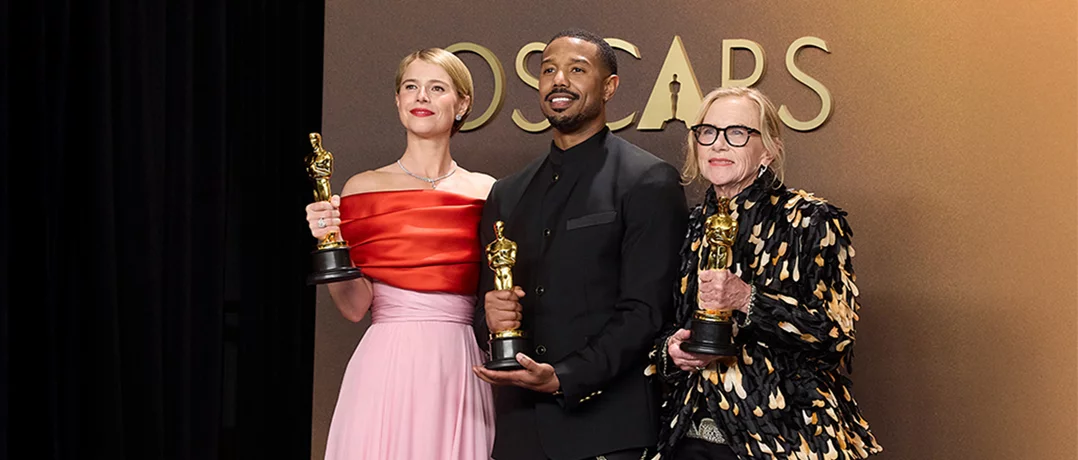
Jessie Buckley, Michael B. Jordan and Amy Madigan pose backstage with the Oscar®️ for Actor in a Leading Role during the 98th Oscars at Dolby Theatre at Ovation Hollywood on Sunday, March 15, 2026. Credit/Provider: Etienne Laurent / The Academy. Copyright A.M.P.A.S.
The 98th Academy Awards delivered a night of big wins, historic milestones and one particularly surprising moment that had the Dolby Theatre buzzing. Hosted by Conan O'Brien, the 2026 ceremony celebrated a wide spectrum of filmmaking from ambitious studio productions to daring independent voices highlighting a year in cinema defined by bold storytelling and striking artistic vision.
Leading the night was One Battle After Another, which emerged as the Academy’s clear favorite, taking home six Oscars, including Best Picture and Best Director for Paul Thomas Anderson. The film also won Best Adapted Screenplay, Best Supporting Actor for Sean Penn, Best Casting for Cassandra Kulukundis, and Best Film Editing for Andy Jurgensen, cementing its place as the most decorated film of the evening. Penn, as he had previously indicated, was not present at the Oscars in protest, urging greater recognition of Ukraine and its filmmakers amid the ongoing war.
Anderson’s sweeping victory reflected the Academy’s enthusiasm for the film’s audacious tone and layered storytelling. With its mix of dark humor, political satire and strong ensemble performances, One Battle After Another stood out in a competitive field and ultimately became the defining film of this year’s Oscars.
Backstage, in the interview room, Anderson summed up One Battle After Another, saying, “We always knew that we were trying to make something complicated…What happens when your parents, who are damaged and have handed quite a difficult history to you, how do you manage that? That’s our story.”
Another major force of the night was Sinners, which delivered one of the evening’s most talked-about performances. Michael B. Jordan won Best Actor for his emotionally intense and commanding turn in the film, a performance widely praised for its complexity and range.
Jordan’s win once again highlights a starkly short lineage of Black leads at the Oscars: he is only the seventh Black performer ever to take home a lead acting prize. In an emotional acceptance he said, “I stand here because of the people that came before me: Sidney Poitier, Denzel Washington, Halle Berry, Jamie Foxx, Forest Whitaker, Will Smith. To be amongst those giants, amongst those greats, amongst my ancestors…thank you, everybody in this room and everybody at home for supporting me over my career. I feel it.”
Sinners ultimately collected four Oscars, including Best Original Screenplay for Ryan Coogler and Best Original Score for Ludwig Göransson. The film also made history in the cinematography category, where Autumn Durald Arkapaw won Best Cinematography. Her visually striking work on the film marked a milestone moment she became the first woman and first woman of color to win the Oscar in this category, a field historically dominated by male cinematographers.
Rooting Sinners in the stories and blues records he inherited from his late Uncle James, Coogler used the backstage interview room to spell out just how much that relationship shaped him, saying, “I’m so proud that he gave me the gift of his stories about Mississippi, that he played blues music for me and talked to me about it, he continues to give me gifts from where he is now.”
In the acting honors, Jessie Buckley took home Best Actress for her emotionally resonant performance in Hamnet, while Amy Madigan won Best Supporting Actress for her work in Weapons. Both performances were widely celebrated for their emotional depth and nuance.
Music also had a historic night at the Oscars. The animated film KPop Demon Hunters won Best Animated Feature, while its highly infectious track “Golden” captured Best Original Song. The win marked a milestone moment, as the song became the first K-pop track ever to win an Academy Award, underscoring the genre’s growing influence on global pop culture and cinema.
International storytelling also found strong recognition. The Norwegian drama Sentimental Value won Best International Feature Film, while the powerful documentary Mr. Nobody Against Putin took home Best Documentary Feature, highlighting the Academy’s continued support for films tackling urgent political and social realities.
In the craft categories, Frankenstein proved to be a technical powerhouse. The film won Best Production Design, Best Costume Design, and Best Makeup and Hairstyling, with its richly detailed gothic world capturing the imagination of voters. Meanwhile, the racing drama F1 won Best Sound, while Avatar: Fire and Ash once again pushed the boundaries of visual technology to claim Best Visual Effects.
One of the ceremony’s most memorable surprises came in the Best Live Action Short Film category. In a rare outcome, only the seventh tie in Academy Awards history, the Oscar was shared by The Singers and Two People Exchanging Saliva.
The Singers, directed by Sam A. Davis and produced by Sam A. Davis and Jack Piatt, follows an impromptu barroom singing contest that transforms a quiet evening into a moment of connection through music.
Its co-winner, Two People Exchanging Saliva, directed by Alexandre Singh and Natalie Musteata, offered a surreal and provocative narrative set in a world where kissing is forbidden, using satire and absurdity to explore repression and power.
The dual win brought two filmmaking teams to the stage and served as a reminder of the extraordinary range present in the short film category, where inventive storytelling often thrives outside the conventions of feature filmmaking.
The ceremony also featured several high-octave musical moments on stage, stunning production design and choreography with the nominees for Best Original Song bringing bursts of energy throughout the evening. The performance of “Golden” from K-Pop Demon Hunters, which would later win the Oscar, drew one of the loudest reactions of the night.
The In Memoriam tribute, honoring members of the film community who passed away over the past year, was anchored by some heartfelt remembrances. Billy Crystal paid tribute to filmmaker Rob Reiner; Barbra Streisand offered a moving homage to her longtime collaborator Robert Redford, including a brief performance of “The Way We Were;” and Rachel McAdams delivered a tribute honoring several of the year’s departed screen legends including Diane Keaton and Catherine O’Hara.
The 2026 Oscars saw a film year unafraid to take risks and think beyond linear narratives. From the dominant showing of One Battle After Another to the historic cinematography win for Sinners and the rare tie in the Live Action Short category, the ceremony unfolded as a celebration of bold filmmaking. If anything, the night reaffirmed that the Oscars can still surprise, and that cinema, at its best, continues to evolve in exciting and unexpected directions.
