



The nawl reflects generations of Lebanese craftsmanship, turning a simple thread into intricate textiles through skill, patience and precision.
The ancient handloom art of Mount Lebanon

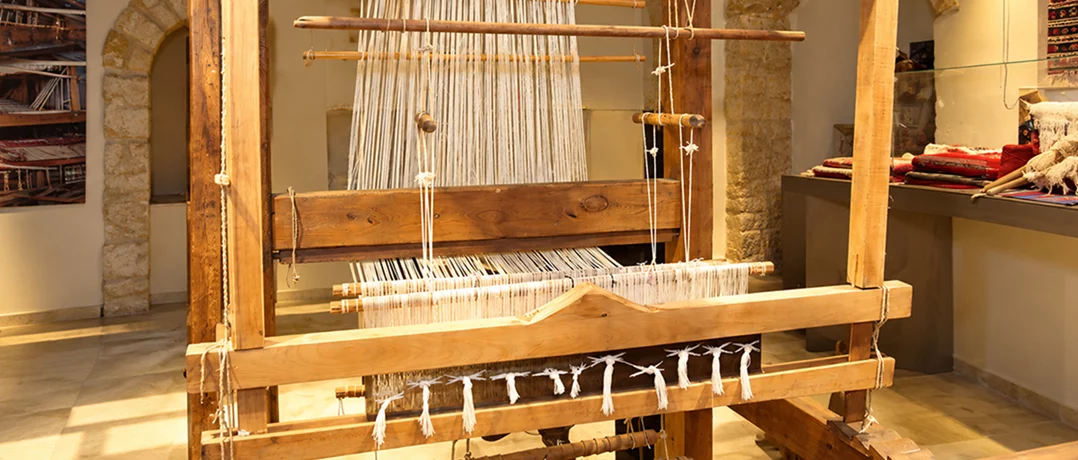
The nawl, a wooden floor loom whose origins can be traced to Phoenician workshops along the coast, once clothed entire communities, producing everything from ceremonial abayas to fine silk scarves and tablecloths. Villages across Mount Lebanon and the Bekaa built their economies around it, none more famously than Zouk Mikael, once known simply as "the silk village" for the extraordinary quality of its weave. Today, as synthetic fabrics and industrial looms have overtaken the market, only a handful of artisans, concentrated mainly in Zouk Mikael and pockets of the Chouf. continue to sit behind these towering wooden frames, keeping alive a technique unchanged for generations.
Among them are Mariam Akiki and Gescard Tabet, two weavers separated by years of experience but united by the same unhurried devotion to thread, shuttle, and beam.
The loom as an inheritance
Tabet’s family has operated a loom for generations. "This loom is older than I am," he told The Beiruter. "The wood has been repaired, replaced piece by piece over the years, but its bones, its proportions, have never changed. It was built to hold tension exactly the way it has always held it."
He described the loom's basic architecture, a warp beam at the back holding hundreds of parallel threads, a series of heddles that lift alternating threads to create an opening called the shed, and a shuttle that carries the weft thread back and forth through that gap. A wooden reed then beats each new thread firmly into place. "It sounds simple when you say it quickly," Tabet noted, "but every part depends on the others. If the tension on the warp is wrong, nothing that follows will be right."
He considers the abaya, the traditional ceremonial cloak historically woven with wool or silk, the pinnacle of the craft, and still receives occasional commissions for one from families honoring older traditions. Producing it demands a rhythm few other textiles require. "Your hands and your feet move together," he continued, referring to the foot pedals that raise and lower the heddles. "Push, throw the shuttle, beat the reed, push again. Once you find the rhythm, the cloth grows almost on its own. But losing that rhythm even for a moment shows immediately in the weave."
The loom's slow pace is precisely what gives it value against industrial competition. "A machine can produce meters of cloth in minutes," he admitted. "But it cannot produce the small imperfections that tell you a human hand made this, that someone sat here for hours thinking about nothing but this thread."
Mariam Akiki: The discipline of the thread
Akiki, who learned the craft from her mother in a household where weaving was simply part of daily life, insisted that the real labor of nawl weaving happens long before anyone sits at the loom. "People see the finished cloth and think the beauty is in the weaving," she reflected, "but half the work, maybe more, is in preparing the thread."
Traditionally, this meant spinning raw silk or wool by hand, then winding it onto bobbins in careful, even lengths before it could be threaded onto the loom. "Silk is very precious," Akiki continued. "It tangles easily, it can fray if you pull it wrong, and mounting the warp threads one by one, in order, without crossing them, can take an entire day before you've woven a single line." Only once the warp is fully dressed and tensioned across the beam does the actual weaving begin, a process she called "the reward for all that patience."
Patterns were traditionally drawn directly into the memory of the weaver, often incorporating gold or silver thread for special commissions. "My mother never used a written pattern. It lived in her hands. I try to keep those same patterns alive the way she gave them to me."
Akiki framed the loom's unhurried pace as the very reason the craft still matters. "People are in a hurry for everything now," she reflected. "The nawl forces you to slow down. Maybe that's exactly why so few people want to learn it anymore and exactly why those of us who still know it feel responsible for it."
A thread connecting past and present
From Phoenician workshops producing prized purple-dyed fabrics to the silk ateliers that once defined Zouk Mikael's prosperity, the story of the nawl is woven into the broader history of Mount Lebanon itself. In that sense, the nawl reveals the true value of Lebanese craftsmanship, the ability to turn something as simple as a thread into an expression of extraordinary skill, memory and care.
-
-

-
The Beiruter
-
