



From Ayman Baalbaki’s scarred cityscapes to Walid Raad’s invented archives and Mona Hatoum’s installations of exile, Lebanese artists have transformed decades of war into powerful works that document trauma, memory, and the resilience of a country shaped by conflict.
The art of war

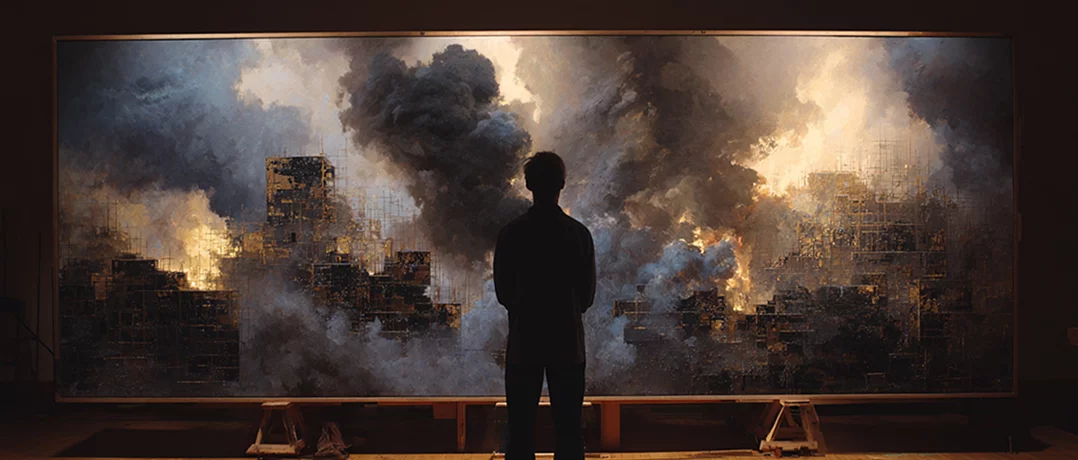
Through times of war and conflict, Lebanese artists have been working to preserve the emotional truth of what it is like to live inside a country that has never fully stopped being at war. On canvas, in sculpture, in photographs and installations and conceptual archives, they have built a parallel record of Lebanon’s modern history.
Walid Raad: Who controls the memory of war?
Walid Raad dismantles the narrative wreckage of war, the competing stories, the suppressed testimonies, the photographs that prove different things depending on who is looking at them.
Through his long-running conceptual project The Atlas Group, Raad constructed a fictional archive of the Lebanese Civil War: invented documents, fabricated photographs, false testimonies presented alongside real ones with no clear demarcation between them. Raad’s work asks the question that Lebanon has spent thirty years refusing to answer: who decides how this war is remembered, and what gets buried in the process?
His work has been shown at the Museum of Modern Art in New York and major institutions across Europe, carrying Lebanon’s unresolved history into rooms where it becomes impossible to ignore.
Hayat Nazer: Sculpture from the wreckage
Few artistic responses to the August 4, 2020
port explosion have been as viscerally direct as that of Lebanese sculptor
Hayat Nazer, who created a sculpture using metal fragments recovered from the
blast site itself.
The result is an object that carries the event inside it: not a representation of destruction, but destruction reshaped by human hands into something that demands to be looked at rather than turned away from. It is one of the most literal acts of artistic witness in the Lebanese canon, the city's wound becoming, in her hands, the city's monument.
Mona Hatoum: Exile as a permanent condition
Mona Hatoum was in London when the civil war began in 1975, and she could not go home. That inability that enforced distance from a country coming apart became the engine of some of the most internationally recognized art to emerge from the Lebanese experience.
Hatoum’s installations are built from the materials of control and confinement: barbed wire, steel grids, hospital beds fitted with electrodes, surveillance systems that watch the viewer back. Her 2008 piece “Hot Spot,” a globe of the world rendered in glowing red wire, makes the entire planet look like a conflict zone, because, for the Palestinian-Lebanese artist who made it, it has always felt like one.
Hatoum’s work captures the experience of conflict as a permanent psychological condition rather than a series of discrete events. Displacement does not end when the fighting does. It follows you.
Micheline Nohra: Painting war with humor and heart
Not every Lebanese artist processes war through grief. Micheline Nohra processes it through defiance.
During the 2024 war, as Israeli strikes repeatedly targeted areas near Beirut's Rafic Hariri International Airport, Middle East Airlines kept flying.
To many Lebanese, the sight of MEA planes lifting off against a backdrop of smoke and bombardment became a symbol of the stubborn, almost irrational insistence on continuing. Nohra painted it. Her canvas shows an MEA aircraft ascending defiantly over flames, tongue out. She has described the painting but as a visual declaration that Lebanon would not be grounded.
Paul Guiragossian: The bodies that survive
Paul Guiragossian’s paintings do not show you the war. They show you what the war leaves behind. The son of Armenian genocide survivors, Guiragossian grew up carrying the weight of a catastrophe that happened before he was born, and then watched Lebanon generate its own catalogue of catastrophes across his lifetime. His response was to paint people: elongated, compressed figures crowded together on the canvas, pressing against each other with a mixture of solidarity and desperation. They are not identifiable as Lebanese or Armenian or any particular nationality. They are human beings in extremity, which is both more specific and more universal than any national portrait.
The figures in his late work, he died in 1994, having lived through the worst years of the civil war, carry an exhaustion that is also somehow a form of defiance. After everything, they are still standing. In a country that has had to rebuild itself so many times, that quiet persistence is its own kind of statement.
Zena El Khalil: The city as sacred body
Zena El Khalil was in Beirut during the 2006 war, and she blogged through it, a daily record of life under bombardment that became the basis for her memoir “Beirut, I Love You.” But it is her visual art that most powerfully processes the collision of beauty and destruction that defines her relationship to the city.
El Khalil’s paintings are crowded with color and symbol: the Virgin Mary alongside pop culture icons, Arabic calligraphy woven through psychedelic pattern, flowers blooming in the wreckage. There is nothing ironic about this maximalism. It is a direct confrontation with the question of how a person continues to love a city that keeps trying to kill them, and a refusal to let war have the last word on what Beirut is. Her work insists that the city is sacred, even when it is burning.
Ayman Baalbaki: Standing inside the ruin
There is nothing distant about Ayman Baalbaki’s paintings. They pull you into the rubble. His canvases are dense with damaged facades, bombed apartment blocks, layers of paint applied with a violence that mirrors the destruction it depicts. In the “Beirut Towers” series, Baalbaki renders the city’s wounded architecture as buildings that have been struck, cracked, and stripped back but remain standing, enduring in their ruin the way the city itself has endured.
Why art when there are wars to fight?
Wars do not end when the shooting stops. They continue in the silence that follows, in the histories that are not written, the testimonies that are not heard, the trauma that is not named and therefore cannot be healed. Art does not stop wars. But it refuses to let them be forgotten on the terms of the people who started them. To paint the ruins is to insist they happened. To sculpt the displaced body is to insist it was a real person. To construct a fake archive is to expose the fraudulence of the real ones.
-
-

-
The Beiruter
-
