



Dabke AUS turned a traditional Lebanese dance into a modern cultural movement across Australia’s diaspora.
The Australian “dabikehs”

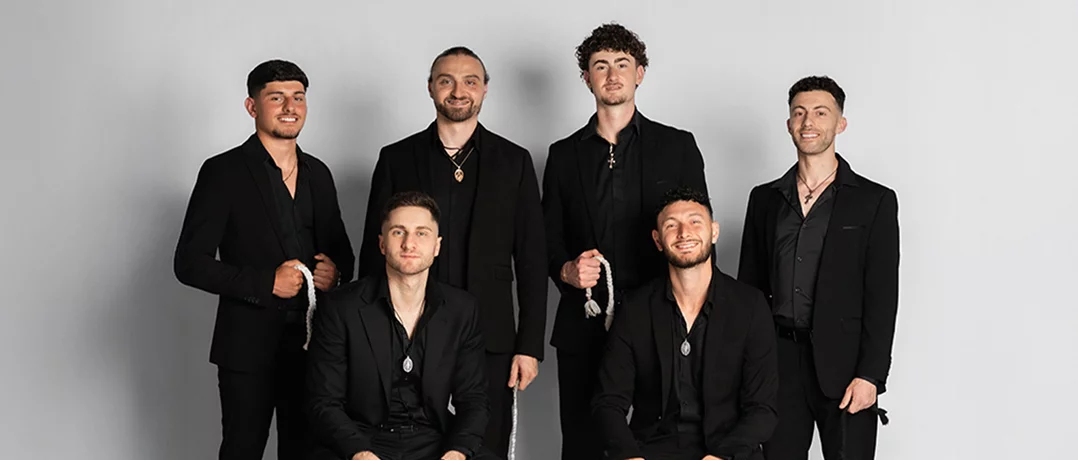
For many Lebanese Australians, dabke has always lived at weddings, family gatherings and village celebrations, a familiar rhythm passed down through generations.
But for Sydney-based dancer Danny Raad, dabke became something more: a calling that would eventually grow into Dabke AUS, one of the most influential cultural dance groups in the diaspora today.
With nearly half a million followers across social media platforms and more than 229,000 followers on TikTok alone, Dabke AUS has transformed a traditional folk dance into a modern cultural movement, capturing the attention of young Lebanese Australians and international audiences alike.
Raad admits that when people ask how Dabke AUS began, the answer doesn’t always come easily.
“To be honest, many people ask me this question and my mind goes blank,” he says.
“The idea definitely came from God.”
The spark came while scrolling through social media and watching professional dabke crews perform overseas, particularly in Lebanon.
“I kept asking myself why we didn’t have anything like this in Sydney,” Raad said.
“There was a strong, professional dabke presence overseas… but nothing here that truly captured the same significance.”
At the same time, friends were asking him to teach them dabke — requests he was only willing to accept under one condition.
“I explained to them that if I was going to teach them, it wouldn’t be casual — we would form a committed crew and perform together,” he says. “They were immediately on board.”
From there, Raad reached out to dancers he knew who were strong dabikeh, making it clear that commitment and discipline would be non-negotiable.
“Everyone whom I approached believed in the vision and said yes,” he says.
Momentum came quickly, and unexpectedly.
A casual video of Raad dancing dabke at a wedding went viral, drawing attention to what the group was building.
Soon after, another clip of several dancers performing in a car park also took off online.
“Those moments confirmed that there was a real demand for dabke in Australia and showed us that people were ready to connect with it in a modern, authentic way,” he says.
One of Dabke AUS’s earliest supporters was Claudine, a photographer who encouraged Raad to formalise the idea.
She even offered her own wedding as the group’s debut performance a moment that marked the official beginning of Dabke AUS and was captured through her business, Captured by Claudine.
However, despite its rapid growth, Raad says he never imagined the group would reach this scale.
“I believed it would be successful, because dabke is loved by so many people, but I didn’t expect it to reach this level,” he says.
It was only after several pivotal moments that he realised the group had become something bigger than a side project, prompting him to pursue it with greater intention.
“Personally, dabke feels like home,” he says. “As weird as it sounds, it feels like family.” Introduced to the dance at a young age by his father, dabke has always been deeply embedded in his life — and his family’s roots in Deir El Ahmar, where the dance holds strong cultural significance.
“Even something as simple as doing dabke at home brings my parents joy my mum cheering, my dad smiling and clapping,” he says.
“That reaction alone shows how deeply rooted dabke is in our culture and emotions.”
That emotional connection is especially powerful within the Australian diaspora.
“In the Australian diaspora, dabke serves as a powerful link to Lebanese identity and heritage,” Raad says.
“Dabke is one of the most accessible ways for young Lebanese-Australians to connect with their culture.
“Many don’t speak Arabic fluently, which can create a sense of distance from their heritage. Dabke removes that barrier.”
Among the group’s biggest milestones was performing alongside Lebanese and international icon Najwa Karam — a moment Raad describes as surreal.
“It was without a doubt one of the biggest highlights… and a major milestone for the group,” he says, validating how far Dabke AUS had come.
Like any growing collective, the journey has not been without challenges.
Losing dancers, training new members, and maintaining a high standard while expanding has required constant effort and discipline.
Still, Raad believes these challenges have helped shape the group’s identity.
That same discipline sits at the heart of the Dabke Academy, an initiative designed to ensure the tradition continues with integrity.
“The Dabke Academy is designed to take someone with no experience and develop them into a fully-fledged dabikeh,” Raad said.
“It’s structured, disciplined, and requires commitment both inside and outside of training. “Progress comes through hard work, consistency, and respect for the dance.”
Today, Dabke AUS balances tradition with contemporary performance by giving each its own space.
“Traditional dabke is always kept at the core of our performances and treated with respect, while modern elements are introduced through styling, stage presence, energy, and character,” he said.
“This approach allows us to preserve the tradition while presenting it in a way that feels relevant and engaging for contemporary audiences.”
Looking ahead, the vision is growth digitally and globally.
With plans to expand its YouTube presence, move into apparel available worldwide, and reach wider audiences through digital platforms, Dabke AUS is only just getting started.
“This is just the beginning,” Raad says. “There is much more to come.”
