

Retired Lebanese General Georges Nader tells The Beiruter why effective Lebanese-Syrian border security requires surveillance, cooperation, demarcation, and political commitment.
The challenge of securing Lebanon’s border with Syria
The challenge of securing Lebanon’s border with Syria
By The Beiruter | August 08, 2026

Reading time: 5 min
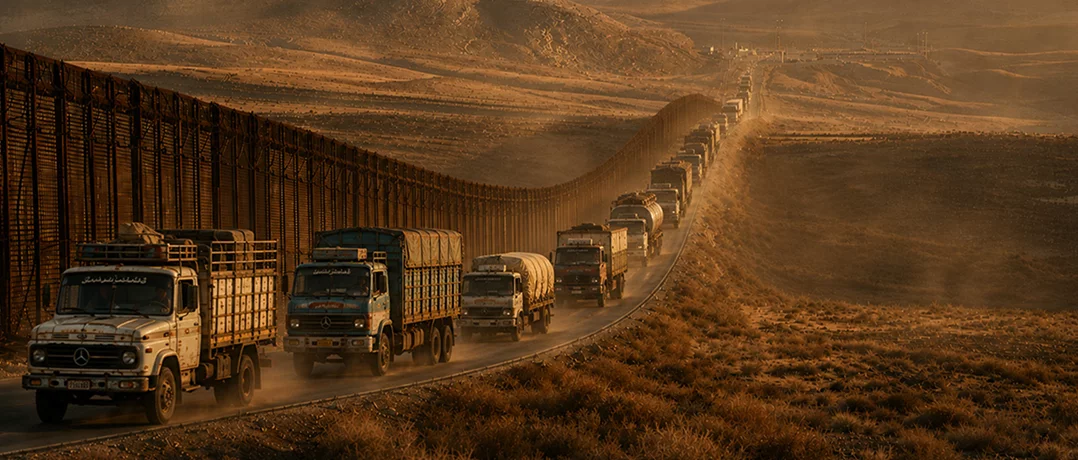
As Lebanon continues to strengthen state institutions and improve border management, discussions over the effectiveness of current security measures have gained renewed importance. In an interview with The Beiruter, retired Lebanese General Georges Nader provided an assessment of the current state of border security.
Shared responsibility for border security
According to General Nader, responsibility for securing the Lebanese-Syrian border is clearly divided between the two sovereign states. Lebanon bears full responsibility for security on its side of the frontier, while Syria is responsible for maintaining order within its own territory.
On the Lebanese side, the Lebanese Armed Forces (LAF) serve as the principal authority responsible for protecting the country’s eastern and northern borders. Their mandate includes monitoring illegal crossings, combating smuggling activities, and safeguarding national sovereignty across the entire frontier.
On the Syrian side, border security falls primarily under the country’s General Security Directorate alongside Syria’s newly reorganized military structure. General Nader noted that the former Syrian Arab Army (SAA) no longer exists in its previous form, having been dissolved and replaced by a force assembled from various armed factions. While this new military structure now functions as Syria’s national army, he stressed that it remains difficult to assess its institutional discipline and its ability to consistently implement orders.
Despite these institutional changes, General Nader highlighted the existence of an operational coordination mechanism between Lebanese and Syrian military authorities. This communication channel enables both sides to address incidents occurring along the frontier, exchange information when necessary, and manage emerging security challenges. Such coordination, he argued, reflects the reality that effective border security depends on cooperation between both neighboring states.
Border security is never absolute
Assessing the current situation, General Nader rejected the notion that any international border can ever be completely secure.
He pointed to the example of the United States-Mexico border, one of the world’s most technologically monitored frontiers, where successive administrations, including that of President Donald Trump, have invested heavily in surveillance systems, fencing, and enforcement measures without fully eliminating illegal crossings or smuggling.
The comparison serves to illustrate a broader principle: no country can realistically achieve perfect border security. Geography, human ingenuity, and the sheer scale of border management make some degree of unauthorized movement inevitable.
Within this context, General Nader believes that the Lebanese-Syrian border is currently secured to a reasonable and acceptable extent. While challenges persist, the existing security framework has significantly improved the state’s ability to monitor border activity and respond to violations compared to previous years.
The growing importance of surveillance towers
One of the most significant developments in Lebanon’s border management has been the deployment of surveillance towers across the eastern and northern frontier.
General Nader described these installations as multi-level container-based structures equipped with advanced day- and night-vision cameras. Positioned strategically across elevated terrain, each tower maintains direct visual contact with neighboring towers, creating continuous observation coverage over large sections of the border.
Equally important is the communication network linking these positions. Through wireless communications, military personnel stationed along the frontier remain in constant contact, allowing information about suspicious movements or security incidents to be transmitted rapidly throughout the monitoring system.
According to General Nader, these towers have substantially strengthened the LAF’s ability to oversee remote border regions. Based on his observations, the surveillance network has successfully fulfilled its intended mission by improving situational awareness, enhancing operational coordination, and increasing the military’s capacity to detect and respond to unauthorized crossings.
While surveillance technology alone cannot eliminate all security risks, it has become an essential component of modern border management by providing continuous monitoring capabilities that were previously unavailable.
Why border demarcation remains essential
Despite improvements in surveillance and military coordination, General Nader considers the formal demarcation of the Lebanese-Syrian border to be the single most important unresolved issue.
He argues that effective border control begins with clearly defined and internationally recognized boundaries. While parts of the northern frontier are naturally delineated by the Nahr al-Kabir River, the eastern border presents far greater complexity due to overlapping land ownership and historical property claims.
According to General Nader, numerous Lebanese families own land extending into areas currently located inside Syrian territory, particularly across the Bekaa Valley, Rashaya, Majdal Anjar, and the Mount Hermon region. Similar claims also exist on the Syrian side, reflecting years of unresolved border arrangements.
These overlapping property rights create legal uncertainty and complicate efforts to establish clear jurisdiction. Without mutually agreed boundary lines, security forces often face practical difficulties in determining responsibility for specific areas along the frontier.
General Nader therefore believes that Lebanon and Syria should jointly complete the official demarcation process to eliminate ambiguity and establish a permanent legal framework for border management.
Building a more secure border
Looking ahead, General Nader highlighted that infrastructure alone cannot guarantee effective border security.
Once the border is formally demarcated, he argues that all legal movement between Lebanon and Syria should occur exclusively through officially recognized border crossings. Individuals entering either country should pass through the appropriate security procedures involving Lebanese General Security, the LAF, Syrian General Security, and the relevant Syrian military authorities. Meanwhile, unofficial crossings frequently used for smuggling should be physically blocked through fencing, barbed wire, or other barriers designed to prevent unauthorized movement.
Beyond physical infrastructure, General Nader stressed that successful border management ultimately depends on political commitment. Both governments must demonstrate genuine determination to prevent the smuggling of people, weapons, and goods rather than allowing violations to occur through negligence or deliberate inaction.
He further noted that political will must be supported by sufficient financial resources, trained personnel, modern equipment, and sustained military capabilities. Without these elements, even well-designed border security strategies are unlikely to achieve lasting success.
Therefore, as Lebanon continues its efforts to reinforce state authority and protect its sovereignty, achieving a more secure and clearly defined border with Syria will remain a critical objective for both national security and regional stability.
The Lebanese-Syrian border has long represented one of the most complex security challenges facing both countries. Stretching approximately 375 kilometers across mountainous terrain, agricultural lands, and sparsely populated regions, the frontier has historically been characterized by overlapping land ownership, unofficial crossing points, and extensive cross-border movement., The border has increasingly become a focal point for concerns related to smuggling, illegal migration, weapons trafficking, and broader regional security dynamics.-
-

-
The Beiruter
-
