

Globalization is not retreating, but geopolitical risk is redirecting trade and investment across a wider range of countries, creating new opportunities for those able to connect the world’s largest markets.
The changing geography of globalization

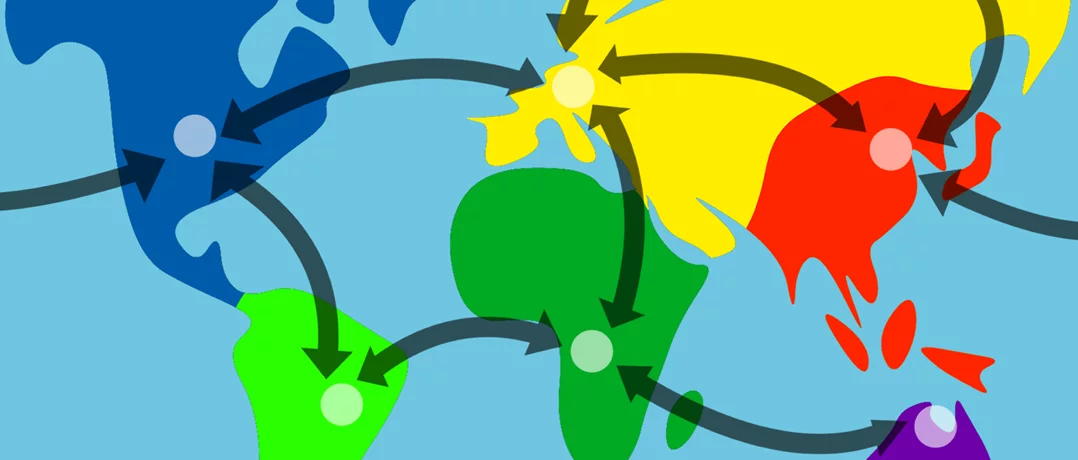
Globalization is entering a more politically contested era. Tariffs have returned as an instrument of economic policy, governments are spending heavily to cultivate domestic industries, and geopolitical tensions have made dependence on foreign suppliers look less like efficiency and more like vulnerability. Yet even as the politics of globalization have become more contentious, trade across borders continues to grow. Global trade reached a record of about $35 trillion in 2025, an increase of almost 7.5% from the previous year, according to UN Trade and Development (UNCTAD). Its July-August 2026 Global Trade Update found that goods trade alone reached approximately $13.7 trillion in the first half of 2026, 12.5% higher than during the same period a year earlier. Part of that increase came from higher prices, particularly after disruption around the Strait of Hormuz raised energy and transport costs, but the continued expansion suggests that the nature of globalization is changing more than its scale. “Globalization is not really in retreat, nor is it contracting,” Joanna Darwiche, assistant professor of economics and finance at Saint Joseph University of Beirut, told The Beiruter. Production is moving, trade is passing through new countries, and governments and companies are placing greater value on political reliability and geographic proximity. Globalization may not be disappearing so much as acquiring a different map. Modern supply chains were built largely around the advantages of specialization, allowing companies to locate different stages of production where labor, inputs or manufacturing capacity were most cost-effective. Nearly two-thirds of global trade now takes place within value chains, according to UNCTAD’s January 2026 Global Trade Update. But the calculation behind those networks has become more complicated. Tariffs can change the price of an imported component, export controls can restrict access to technology, and wars can disrupt shipping routes or supplies of energy and raw materials. “Traditionally, companies decided where to produce and source based on two main factors: cost and efficiency,” Darwiche said. The shift is particularly visible in industries governments consider strategically important. UNCTAD’s June 2026 Global Trade Update found that nearly 100 new export measures covering critical minerals have been introduced since 2020, while 58 critical-mineral agreements have been signed since 2022. China accounted for 69% of rare earth mine production in 2025, while the Democratic Republic of the Congo supplied 74% of mined cobalt and Indonesia 67% of mined nickel. Such concentrations can offer efficiencies, but also create exposure. The lowest-cost supplier may become considerably more expensive once tariffs, sanctions, export restrictions or transport disruptions enter the calculation. As companies look for ways to reduce that exposure, production is not simply returning to domestic markets but spreading across a wider range of countries, creating opportunities for economies positioned between the world’s largest markets. Mexico, for instance, has become more important to U.S. supply chains, while Vietnam and other Southeast Asian economies have attracted manufacturing and investment seeking alternatives to China. Yet greater trade through a third country does not necessarily mean production has moved there. A June 2025 IMF working paper distinguished between “rerouting,” in which goods pass through an intermediary with little domestic value added, and “reallocation,” in which production moves. Among six Asian economies examined, Vietnam showed particularly strong evidence of reallocation, with greater domestic content in U.S.-bound exports in strategic sectors. Even when production moves, economic ties can remain. A supply chain can shift one stage out of China while retaining Chinese investment, components or intermediate goods elsewhere. Diversification can therefore create new links between major economic powers rather than simply severing old ones. “We may be moving toward a more multipolar global economy, rather than one dominated only by the U.S. and China,” Darwiche said. The emerging geography of trade is not simply one in which China loses production and another country gains it. It is a denser network of intermediaries and commercial hubs able to remain connected to competing economic powers. The changing geography of trade could create opportunities across the Middle East, but countries enter that competition from different positions. Gulf states combine access to markets in Asia, Europe and Africa with strong logistics infrastructure, capital and commercial relationships spanning East and West. “Some Gulf economies are relatively well positioned to act as connectors between major markets,” Darwiche said. As investment and trade routes spread across a wider range of countries, Darwiche sees opportunities for Gulf economies in finance, services and manufacturing, where infrastructure, capital and relatively strong state capacity can convert geographic advantage into commercial opportunity. Lebanon illustrates the limits of geography alone. Its eastern Mediterranean location, large diaspora and professional expertise could appear well suited to a trading system that places greater value on intermediary economies. “Lebanon has genuine strengths, particularly its human capital, diaspora networks and entrepreneurial capacity,” Darwiche said. A December 2025 IMF study of the Middle East, North Africa, Caucasus and Central Asia similarly found that the ability to benefit from trade diversion depends heavily on reducing trade barriers, improving infrastructure and strengthening regulatory environments. For Lebanon, those constraints make large-scale manufacturing relocation considerably less plausible than opportunities built around services and expertise. Darwiche sees the country’s more realistic prospects in “services, digital activities and selected niche sectors,” rather than expecting major manufacturing supply chains to relocate in the near term. The opportunities created by a more dispersed trading system will therefore depend not simply on where countries are located, but on their ability to capitalize on that position. Smaller economies can gain as production and trade move across a wider range of countries, particularly if they can serve as credible links between major markets. But those with weaker institutions, fewer financing options and limited bargaining power are also more exposed to higher trade costs and external disruptions. Globalization may be acquiring a new geography, but geography alone will not determine who captures its opportunities. What is changing quite significantly is the geography of trade. This is not really deglobalization, but rather a reconfiguration of globalization.
When geopolitical risk becomes an economic cost
Now, geopolitics is part of how companies calculate expected profit and risk. Geopolitical risk itself has become an economic cost.
The rise of the connector economy
Many countries continue to trade and invest with both powers, and some are becoming more important precisely because they can maintain economic relationships across these two blocs.
The Middle East’s uneven opportunity
They have strategic geography, strong logistics infrastructure, access to capital and increasingly diversified trade relationships.
But geography and expertise only create potential. Institutions determine whether that potential becomes investment.
-
-

-
The Beiruter
-
