



Great-power rivalry is moving from conquest to conditional access.
The chokepoint order

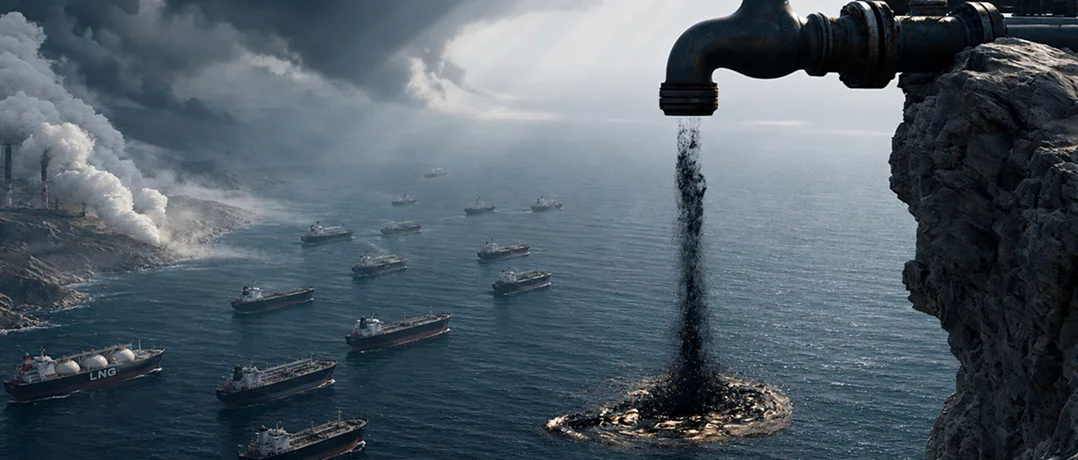
The next international order will be contested through denial rather than conquest, and the 2026 closure of the Strait of Hormuz was its first full demonstration. Iran answered the Israeli and American air campaign by interruption, not invasion. Chips, dollars, refining capacity, cloud access, shipping lanes and the gas that heats Europe are the instruments by which states discipline one another. Territory still matters, as Ukraine and Taiwan remind us. But the struggle shaping the next order is over access: who receives it, who is denied it, who pays, and who sets the conditions.
The crisis proved that not all chokeholds squeeze equally, and that the difference is whether exposure can be cushioned. Oil could be. The International Energy Agency released four hundred million barrels from strategic reserves, its largest coordinated draw ever, and the price climbed toward a hundred dollars, not the two hundred of 2008. Gas could not. No coordinated strategic reserve for it exists, and when Iranian missiles struck the liquefaction trains at Ras Laffan, they removed roughly a sixth of Qatar's export capacity for years. The reach runs past heat into food: the Gulf supplies about a third of the world's urea and a quarter of its ammonia. The oil chokehold depreciates as it is used; the gas chokehold holds. Leverage is a function of what the target cannot store, reroute or replace.
The same weeks sorted states by conversion capacity. China, holding four months of oil in reserve, absorbed the shock. Much of Asia, which draws nearly three-quarters of its crude from the Gulf and had built no such buffer, could not: governments declared emergencies and shortened the working week. The United States, alone a net exporter among great powers, did something sharper: it converted disruption into dependence, inviting the stranded to buy American cargoes and binding allies to its supply, as it bound Germany when Washington, not Berlin, decided the fate of Nord Stream. Whoever commands what others must buy, or what they cannot make, holds more than whoever commands how a payment is messaged.
Yet control of a chokepoint confers influence, not legitimacy, and without legitimacy coercion produces motion without movement. Used too freely it does worse, for it teaches its targets to build around it. Within weeks the stranded were turning toward nuclear power, coal and, most consequentially, the electron: solar and wind that arrive as a single purchase no one can switch off, immune to strait and embargo alike. China had already grasped this, electrifying to escape the Gulf and Malacca; much of the global South now spends the bulk of its power budget likewise. Pressure on a chokepoint accelerates the search for alternatives, until coercion has assembled the coalition it meant to prevent. Every order is undone by one of two things, a shift in the balance of power or the loss of belief that its terms are fair. Dominance without that belief invites its own revision.
Small and middle powers should read the lesson closely. A country need not sit on a chokepoint to be governed by one; it need only depend on systems it cannot secure, price or replace. Lebanon commands no strait, yet its sovereignty is shaped daily by access to fuel, ports, dollars, wheat and electricity. The remedy runs the other way, toward coalitions of economic resilience and supply that has no gate: shared reserves, diversified processing, interoperable payments, and the electron that cannot be embargoed. Such coalitions would not replace security alliances. They would complete them, for a country cannot defend itself if its hospitals lack fuel and its banks cannot clear. Societies hold until they suddenly do not.
The decisive variable is conversion capacity: the power to turn exposure into resilience and leverage into rules that others accept. It rests on a hard choice among interdependence, security and rivalry, of which a state may hold two but never all three. The old order promised openness. The one emerging offers access, conditional, revocable and priced by power. It will be reordered by whoever decides what others may buy, clear, ship, refine or connect, and by whether that power consents to be bound by rules rather than trusting the fear it provokes.
-
-

-
Dr. Joseph SokhonWriter
-
