

The unprecedented closure of the Church of the Holy Sepulchre raises urgent questions about control, faith, and access to Christianity’s holiest site amid war.
The Church of the Holy Sepulchre shuts its doors
The Church of the Holy Sepulchre shuts its doors
By The Beiruter | March 19, 2026

Reading time: 3 min
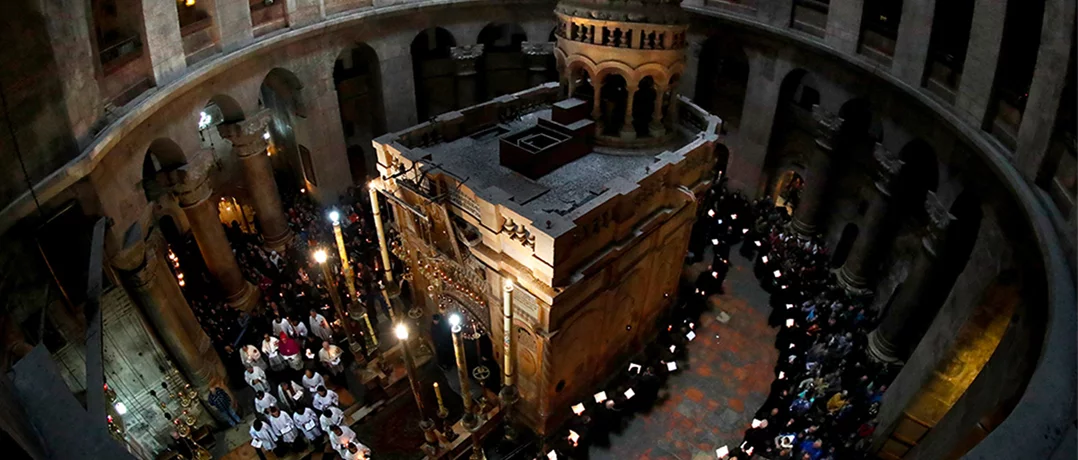
For the first time in recorded history, the church built over the site of Christ's crucifixion and resurrection has been indefinitely shuttered but by military order. The world's Christians are asking: who controls the holiest ground in their faith?
There is a wooden ladder on the facade of the Church of the Holy Sepulchre that has not moved in nearly three hundred years. It cannot be moved without the agreement of all six Christian denominations that share the church. It is known as the Immovable Ladder: a symbol of Christian division so stubborn it became sacred.
The great bronze gates of the Holy Sepulchre have closed by Israeli military order. It is, by multiple accounts, the first time in the church's history that it has been sealed so completely for so long.
Closed by order
The closure came in the context of the widening war. Israeli authorities cited security concerns, the genuine threat of missile strikes on the Old City's narrow, shelter-less alleys. Fragments reportedly landed near the church itself.
And yet the closure falls on the holiest weeks of the Christian year, stripping the faith's central sanctuary of its function for the duration of a war with no visible endpoint. Hundreds of thousands of pilgrims who travel from across the world to walk the Via Dolorosa and pray at the Tomb will find the gates locked. Meanwhile, large Jewish gatherings have continued elsewhere ahead of Passover.
The UN's High Representative for the Alliance of Civilizations has described the closure of Old City holy sites as a violation of international humanitarian law. Meanwhile, the Vatican and Eastern Churches are appealing to Israeli authorities to reopen it. Israel cites "security reasons," a claim the Vatican rejects, calling it a pretext to restrict Christian worship-especially as large gatherings for Israeli Jews continue.
A History written in faith and power
The story of the Holy Sepulchre begins with politics. In 326 CE, the Emperor Constantine's mother Helena traveled to Jerusalem on an imperial mission to locate the sites of Christ's Passion. What she identified, Golgotha, site of the crucifixion, and a nearby limestone tomb, became the axis of the Christian world. Constantine's basilica, built to enclose both, was as much an act of imperial assertion as devotion. The building was destroyed by the Fatimid Caliph Al-Hakim in 1009, an act that helped trigger the First Crusade, rebuilt, and then substantially reconstructed by the Crusaders in the twelfth century. The structure that pilgrims enter today is essentially the church as it stood in 1149 CE: Romanesque arches over ancient rubble, atop a first-century Jewish tomb.
Saladin's keys and the Ottoman Status Quo
When Saladin retook Jerusalem in 1187, he made a decision that would prove durable across eight centuries: he entrusted the keys of the church to two Muslim families of Jerusalem, the Joudeh and the Nusseibeh, as neutral custodians. The denominations competing for the church were incapable of agreeing among themselves. A Muslim keyholder, beholden to no sect, was the only party all sides could tolerate.
The Ottoman Empire codified this arrangement in 1852, when Sultan Abdülmecid I issued a decree known as the Status Quo, freezing the rights of each Christian community over specific chapels, altars, and stairways exactly as they stood. The decree was incorporated into the 1856 Treaty of Paris and the 1878 Treaty of Berlin, giving it the force of international law. Every sovereign power that has controlled Jerusalem since, including Israel, has upheld it. Until now.
As pressure mounts and appeals grow louder, the justification remains contested. In a city where every stone carries history and every door holds meaning, the closure leaves behind a single, lingering question: what is the true reason for these doors to remain closed?
-
-

-
The Beiruter
-
