



Lebanon’s new Media Law modernizes media regulation but has sparked sharp debate over press freedoms, judicial safeguards, and implementation challenges.
The controversy surrounding Lebanon’s new media law
The controversy surrounding Lebanon’s new media law
By Anthony Chamoun | August 12, 2026

Reading time: 7 min
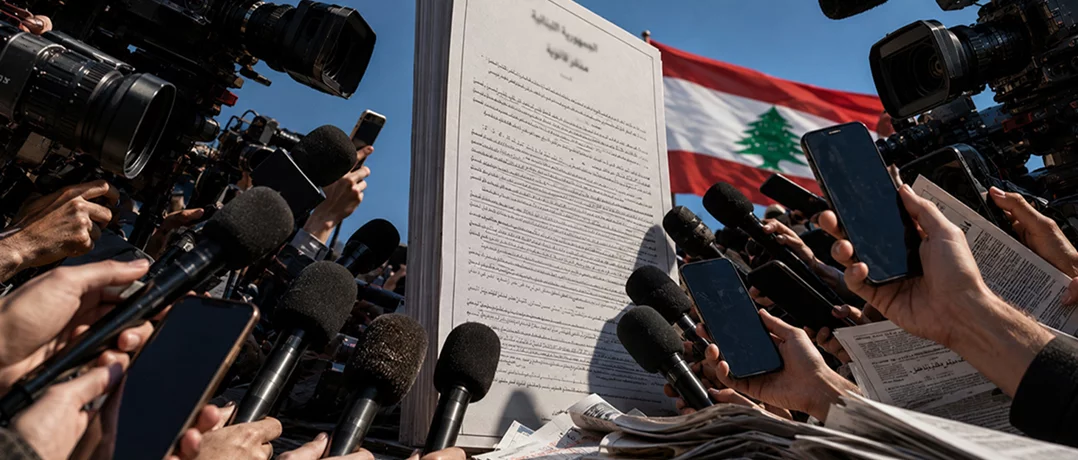
Lebanon has entered a new chapter in media regulation following Parliament’s approval of the new Media Law without amendments. After around 16 years of efforts, the legislation replaces a legal framework that had become increasingly outdated amid profound changes in journalism, broadcasting, and digital communication.
Although government officials have welcomed the legislation as a long-overdue reform that aligns Lebanon’s media framework with technological developments, the law has also generated significant criticism from parliamentarians, journalists’ syndicates, and media professionals.
Controversy and amendments
Despite the law’s passage, controversy surrounding its content continues. Lebanon’s Minister of Information Paul Morcos acknowledged that Parliament did not adopt several amendments he had proposed, most notably the complete abolition of prison sentences for journalists. He subsequently announced his intention to submit urgent legislation aimed at removing any remaining custodial penalties.
It is my duty as Minister of Information to convey media concerns, and we attempted to pass these amendments for inclusion in the media law, but this did not happen, and I am not satisfied.
Journalists’ organizations, however, remain dissatisfied. In a joint press conference, the Lebanese Press Editors Syndicate and the Press Syndicate have rejected the law, arguing that important concerns were left unresolved despite numerous amendments during parliamentary deliberations. Union representatives maintain that certain provisions remain ambiguous and could still restrict media freedoms or expose journalists to legal risks.
Following the law’s approval, both syndicates announced plans to organize joint actions and public advocacy campaigns, arguing that additional legislative revisions are necessary to safeguard freedom of the press and preserve the independence of Lebanon's media sector.
Similar reservations were expressed by MP Waddah Sadek to The Beiruter, who highlighted that while he supports the adoption of a new Media Law in principle, several last-minute provisions approved by Parliament require revision.
Among his concerns were provisions relating to intellectual property rights and the exclusivity of advertising, which he warned could create serious financial challenges for television stations if implemented in their current form. He also criticized provisions allowing journalists to establish separate professional syndicates, arguing that in Lebanon’s sectarian political environment such measures could fragment the country’s existing journalists’ unions and weaken their representative role.
Sadek further criticized the legislative process itself, stating that amendments previously agreed upon with both the Lebanese Press Syndicate and the Press Editors Syndicate were ultimately disregarded when Parliament voted on the version approved by the joint parliamentary committees.
Despite these objections, Sadek indicated that the legislative process may not be over. He suggested that the disputed provisions could still be amended either through an appeal before the Constitutional Council or by introducing an expedited draft law incorporating the necessary revisions.
Modernization of Lebanon’s media framework
For others, the law represents the most comprehensive modernization of Lebanon’s media regulations in decades. Minister Paul Morcos congratulated the Lebanese on the law’s adoption, describing it as an important step toward updating laws that no longer reflected the realities of today’s media landscape, particularly following the emergence of digital journalism and online news platforms. Morcos asserted in an X post that
There is no doubt that the new law will bring about a significant shift in regulating the media sector and keeping pace with its developments.
A similar assessment was offered by Samir Kassir Foundation Executive Director Ayman Mhanna, who described the law as a necessary and long-overdue reform after more than 16 years of parliamentary discussions. In an interview with The Beiruter, Mhanna argued that Lebanon’s previous media legislation, dating from 1962, 1977, and 1994, had become obsolete because it predated the internet and failed to regulate the realities of digital journalism.
According to Mhanna, the new legislation introduces several important safeguards, including the abolition of pretrial detention for journalists, the exclusive jurisdiction of the Publications Court over media-related offenses, stronger protection of journalists’ confidential sources, and the extension of legal protections for freedom of expression to individuals publishing across various media platforms. He also welcomed the introduction of transparency requirements concerning media ownership and financing, arguing that these provisions would provide greater public accountability while avoiding restrictive licensing procedures for online media. Although he criticized the wording of Article 104, warning that it could permit conflicting judicial interpretations and potentially expose journalists to prison sentences, he nevertheless argued that adopting an imperfect law was preferable to preserving an outdated legal framework and that future amendments could address its shortcomings. In his view, while legislation does not eliminate all risks of judicial abuse, it constitutes a significant improvement over the previous legal environment and provides a stronger foundation for future amendments.
A cornerstone of any democratic society
Lebanese lawyer Elie Klimos likewise viewed the legislation as an overall improvement. Speaking to The Beiruter, Klimos stressed that media freedom is a cornerstone of any democratic society but highlighted that, like all freedoms, it must be exercised responsibly within the framework of the law.
In any democratic country, one of the best ways to measure the strength of its democracy is by examining the level of media freedom it enjoys. However, like every freedom, media freedom has limits; the limit of one’s freedom is the freedom of others.
He welcomed the replacement of decades-old media legislation, describing the modernization of Lebanon’s legal framework as long overdue. Klimos also highlighted several provisions he considered significant advances, including the abolition of pretrial detention in publication-related cases, the exclusion of journalists from military court jurisdiction in media offenses, the incorporation of electronic media into the legal framework, and the strengthening of the right of reply and correction. At the same time, he argued that the composition and appointment mechanism of the new National Media Authority deserves further review, while maintaining that any remaining shortcomings should be assessed through the law’s practical implementation before Parliament considers targeted amendments. Overall, he concluded that the legislation represents a clear improvement over the previous legal framework, even if further refinements ultimately prove necessary.
The law’s key provisions
One of the law’s most significant reforms is the formal recognition of electronic media. Professional news websites are now explicitly regulated alongside traditional newspapers, television stations, and radio broadcasters. While the legislation confirms that establishing online media platforms does not require prior licensing or government approval, professional outlets must disclose information regarding their ownership, responsible editor, and contact details, promoting greater transparency.
The law introduces a comprehensive framework governing television and radio broadcasters by defining licensing procedures, the duration of licenses, and the conditions for renewal. It also addresses Lebanon’s gradual transition toward digital broadcasting and includes provisions aimed at preventing excessive concentration of media ownership while encouraging pluralism and locally produced programming. To strengthen transparency, media organizations must maintain detailed public records identifying their owners, shareholders, management structures, capital, and sources of financing, including advertising revenue, subscriptions, grants, and loans.
A central feature of the legislation is the creation of the National Media Authority, an independent body with legal personality and administrative and financial autonomy. The authority is tasked with issuing licenses and notifications, maintaining the national media registry, preparing codes of conduct, monitoring media pluralism, protecting media freedoms, and publishing reports on the state of Lebanon’s media sector. The authority is also empowered to oversee compliance with the law by issuing warnings and referring serious violations to the judiciary when necessary.
The law strengthens the right of reply by allowing individuals who believe false factual information has been published about them to request corrections, removals, or the publication of responses. These provisions apply to newspapers, broadcasters, news websites, and media organizations’ social media accounts. Media institutions are required to publish replies free of charge and with visibility comparable to the original content. Individuals may also seek judicial intervention if a media outlet refuses to comply.
The legislation requires a clear separation between editorial content and advertising to safeguard editorial independence and prevent disguised commercial or political messaging. It also regulates the publication of opinion polls by requiring disclosure of the polling organization’s identity, funding source, sample size, methodology, and margin of error. In addition, the law establishes provisions governing media-related offenses, including incitement to hatred or discrimination and the publication of false and harmful information. It also specifies that, where applicable, the Media Law takes precedence over certain provisions of the Penal Code relating to publication offenses.
As implementation begins, the practical application of the law, and any future legislative revisions, will ultimately determine whether it succeeds in balancing media regulation with the protection of freedom of expression in Lebanon.
-
-

-
Anthony ChamounResearcher/WriterFocusing on Political Science and International Affairs.
-
