



From the Massabki brothers to the Cedar Revolution, this essay traces how Maronite sacrifice shaped a vision of Lebanon built on religious freedom and sovereignty.
The country is already paid for

On 20 October 2024, in St Peter's Square, Pope Francis raised to sainthood three Maronite laymen who had been dead for 164 years. Francis, Abdel Moati and Raphael Massabki were killed in Damascus on the night of 9-10 July 1860, inside the Franciscan convent where they had sought refuge as armed mobs swept through the Christian quarter. Offered their lives in exchange for conversion, the eldest brother, a merchant, father of eight and representative of the Maronite Patriarch's affairs in Syria, gave the answer his Church still repeats: "no one can make me renounce my faith."
Two years earlier, on 4 June 2022, at the Convent of the Cross in Jal el-Dib north of Beirut, the Church had beatified two Lebanese Capuchin friars, Leonard Melki and Thomas Saleh, killed under Ottoman rule in 1915 and 1917.
These ceremonies were reported as church news. They are, in fact, chapters of a single political history: the history of a community that has repeatedly preferred death to submission, and in doing so kept alive the very idea of Lebanon.
The pattern predates the name. In 517, according to Maronite Church Sinksar, 350 monks of Beit Maroun in the Orontes valley were ambushed on their way to the shrine of Simeon the Stylite and killed, their monastery burned, for defending the doctrine of Chalcedon against its opponents. The Maronite Church still commemorates them every 31 July.
The survivors drew a lesson that was geographic as much as theological: a community that would not bend its conscience needed a terrain that would not bend to armies.
Over the following centuries the Maronites climbed into Mount Lebanon, and the mountain became their answer to empire. It was a costly answer.
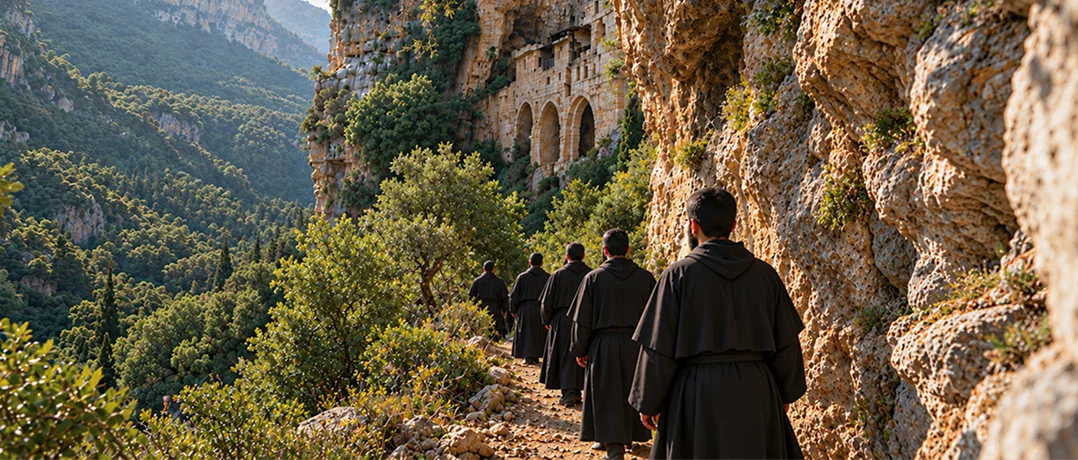
In 1283 the Mamluks besieged the grotto-fortress of Hadath al-Jebbeh; in 1305 their campaigns ravaged Kesrouan; in 1367 Patriarch Gabriel of Hjoula was burned alive in Tripoli. The patriarchs withdrew into the Qadisha Valley and governed a people from caves and hermitages for generations. Here lies the root of the Christian attachment to Lebanon. It is not a sentimental love of scenery. It is the inherited memory that this land was both the price and the guarantee of freedom. For the Maronites, territory was never mere property; it was the precondition of conscience.
From that refuge came achievements far beyond the community's numbers.
The Maronite College opened in Rome in 1584 and sent back scholars who carried Syriac and Arabic learning into Europe's libraries and Europe's learning back into the mountain. At the monastery of Qozhaya, a press produced a Syriac-Arabic Psalter in 1610, among the earliest books printed in the region. Patriarch Estephan Douaihy, who led the Church from 1670 to 1704 and was beatified in August 2024, wrote the first systematic history of his people and anchored their identity in documents rather than legend.
The Synod of Mount Lebanon in 1736 called for the schooling of boys and girls alike, generations before such ideas took hold elsewhere in the region. A community persecuted for its difference turned that difference into institutions.
The nineteenth century tested it again. In the spring and summer of 1860, massacres in Deir el-Qamar, Hasbaya, Rashaya and Zahle spilled over into Damascus, where thousands of Christians were killed in July, the Massabki brothers among them. Out of the catastrophe came the Mutasarrifate of 1861, ere alos 15000 martyrs from the Christians of Deir el Qamera and neigboring region just because they were defender of a project of freedom.
The First World War brought the harshest test. Leonard Melki, a friar from Baabdat, refused to renounce his faith and was marched into the desert with more than 400 Christian prisoners, then killed on 11 June 1915 alongside the Armenian Catholic Archbishop Ignatius Maloyan. His confrere Thomas Saleh was sentenced to death for sheltering an Armenian priest during the genocide and died on the deportation road in January 1917, telling his captors, by his order's account, that he trusted fully in God and did not fear death. At home, blockade, requisitions and locusts produced the Great Famine of 1915-1918, which emptied whole villages of Mount Lebanon; estimates of the dead commonly reach 200,000, perhaps a third of the mountain's population.
And yet from that wound the state was born. Patriarch Elias Howayek led the Lebanese delegation to the Paris Peace Conference in 1919 and argued not for a Christian enclave but for a Lebanon of all its communities within viable borders. On 1 September 1920, Greater Lebanon was proclaimed. The community that had bled most in the mountain chose to share the country rather than hoard it.
That choice, sovereignty for all rather than privilege for one, is the key to everything that followed, and the National Pact of 1943 that sealed independence rested upon it.
When the state began to erode, the test changed shape but not substance. The Cairo Agreement of 1969 granted Palestinian armed organizations freedom of action on Lebanese soil, and the state lost exclusive authority over its weapons and territory. Lebanon's Christians mobilized with virtually no regional or international backing and scarce resources, not only to survive but to recover an independent and sovereign Lebanon. The dead of Damour in January 1976, the Achrafieh that held out under Syrian bombardment in 1978, the besieged Zahle of 1981, and President-elect Bashir Gemayel, assassinated on 14 September 1982, belong to the same ledger as the monks of 517.
After Taif, the Christians, that acted as a de facto government in the Lebanese areas when the state collapsed, filling a vacuum out of necessity surrendered their arms and committed themselves to strengthening the central state, while their leader, Samir Geagea, spent eleven years, from 1994 to 2005, in solitary confinement under Syrian tutelage, because its refusal to surrender the country to de facto failed state. Another party kept its arsenal under the banner of "resistance," and in time turned it on the very state it claimed to protect. One camp returned the gun to the state; the other made the state hostage to the gun.
After 2005, martyrdom took yet another form. The Cedar Revolution ended the Syrian military presence, and the price was paid in car bombs and bullets: Gebran Tueni on 12 December 2005, Pierre Amine Gemayel on 21 November 2006. They carried no weapons. They were killed for words, for votes and for a flag that belonged to no faction.
Today, with the Assad regime gone since December 2024 and the question of the state's exclusive authority over arms finally on the national table, this long record acquires a present-day meaning. The Christians of Lebanon did not defend the country because they owned it. They defended it because, for fifteen centuries, it was the only ground on which they could remain free, and because each time they had the choice, they chose a state for everyone over a fortress for themselves.
The Maronite calendar keeps the accounts. The Massabki brothers on 10 July. Melki and Saleh in June. Saint Nohra, martyred near Jbeil in the third century, on 22 July. The 350 monks on 31 July. 5000 martyrs in the so called Lebanese Civil war. Read in sequence, it is not a liturgy of defeat. It is the register of a country that was paid for in advance.
-
-
-
Dr. Elie EliasUniversity Lecturer & Political Historian
-
