


In an exclusive interview with The Beiruter, Dr. Hussein Ismail, the first Deaf person in Lebanon and the Arab region to earn a PhD, shares the journey that made history and the mission that followed: creating a future where Deaf children grow up with opportunities, not barriers.
The deaf scholar who turned achievement into advocacy
The deaf scholar who turned achievement into advocacy
By Michella Rizk | September 23, 2026

Reading time: 7 min
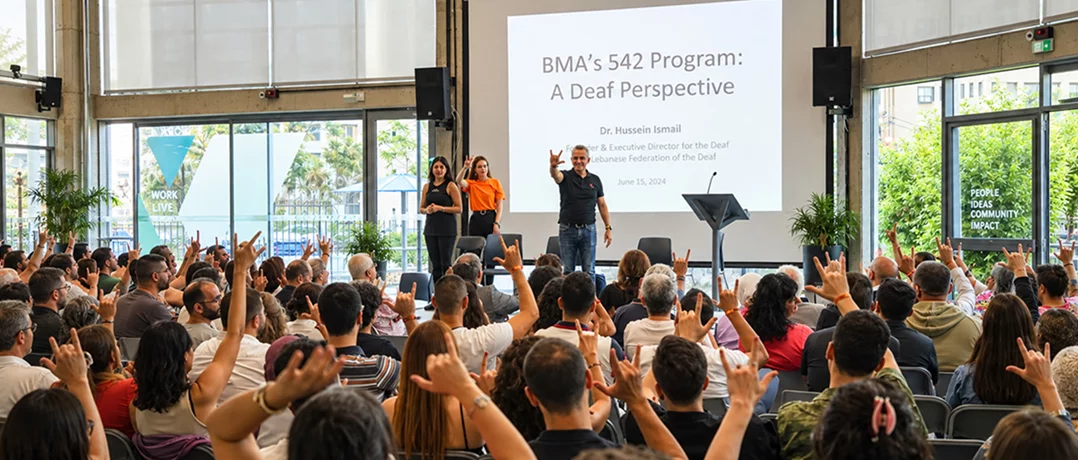
Source: Association Learning Center for the Deaf.
Communication is something people barely have to think about. You walk into a classroom, sit across from a doctor, watch the news, ask a question at a public office, and assume you will be understood.
Until that assumption is no longer guaranteed.
Meaning may instead travel through the hands, the face, the eyes, through a language that is fully formed, yet still too often treated as secondary.
“My PhD was not simply an academic degree. It represented hope, equality,” Dr. Hussein Ismail told The Beiruter.
For Dr. Ismail, who became Deaf as an infant, access has shaped almost every stage of his life. It followed him through school, higher education and eventually into the work he chose to build around Lebanon’s Deaf community as an educator and advocate.
Making history
After losing his hearing following meningitis as a baby, Dr. Ismail was enrolled before the age of five at Father Andeweg’s school for Deaf children. The decision gave him access to an education at a time when few specialized options existed in Lebanon, but it also meant spending much of his childhood away from home. He would see his family only once a month.
He remained at the school until graduating in 1982. Those years showed him how narrow the road ahead could be for a Deaf student. Sign language was not widely recognized, adapted material was scarce and expectations rarely extended as far as university.
“Communication was often the greatest challenge,” he said.
I frequently had to work harder than my hearing peers to access lessons, understand information, and participate fully in school life.
Dr. Ismail nevertheless kept moving beyond the limits placed around him. After leaving school, he travelled to the Netherlands, where he pursued training in the education and support of Deaf people. His studies later took him to Britain, where he earned a university degree in Deaf education, and then to the United States.
At Gallaudet University in Washington, an institution built around Deaf and hard-of-hearing education, he completed a master’s degree in his field in 1991.
By then, his academic path had taken him through several countries. But the questions occupying him were increasingly about Lebanon.
What determined whether a Deaf child in Lebanon could keep learning? How much rested on teachers and school leadership, and why did higher education remain out of reach for so many?
Those questions followed Dr. Ismail into his doctoral work.
To complete the research, he moved with his family to Belgium, where he could work closely with his academic supervisor. His dissertation turned back to Lebanon, examining the role of school directors and teachers in shaping the education of Deaf students in Lebanon and the surrounding region.
In 2000, that work culminated in a PhD in Educational Administration. Dr. Ismail became the first Deaf person in Lebanon and the Arab region to reach that academic level in the field. The achievement was formally recognized that same year with a medal from the Lebanese president.
Dr. Ismail had reached the highest level of education, yet the path that took him there remained far from ordinary for a Deaf student. It had required years of study across several countries, access to institutions equipped to support him, and opportunities that were still unavailable to many others back home.
For Dr. Ismail, becoming the first mattered. What mattered more was making sure he would not remain an exception.
The student becomes the teacher
A year after completing his doctorate, Dr. Ismail founded the Learning Center for the Deaf with his wife, Nadine, a teacher of Deaf students.
The center focused on a problem he knew firsthand: access often came too late. Its work includes early support for young Deaf children and their families, as well as secondary education aimed at helping students reach the Baccalaureate and continue to university.
 Children participate in educational activities at the center, where learning combines classroom exercises, play and social interaction. Source: Association Learning Center for the Deaf.
Dr. Ismail eventually found himself back in the classroom, no longer as a student but as an educator.
Today, he teaches sign language and Deaf culture at university, including at Saint Joseph University.
“Sign language is not merely a collection of gestures; it is a rich and complete language,” he said.
For Dr. Ismail, learning it should not stop with Deaf people or their families. He wants teachers, healthcare workers, social workers and public employees to be able to use it too.
The more people who learn sign language, the more accessible and inclusive our society becomes.
A language in its own right
The misunderstanding begins with sign language itself. There is no universal sign language used by every Deaf person around the world.
“Lebanese Sign Language has its own vocabulary, grammar and linguistic structure”, Dr. Ismail explained. It is not simply spoken Arabic converted into movements of the hands, and it is not identical to sign languages used elsewhere in the Arab world.
“Just as spoken languages differ from one country to another, sign languages also vary,” he said.
Much of his work has focused on giving Lebanese Sign Language greater recognition. Through the Learning Center for the Deaf, he has worked on documenting and teaching the language, including the development of learning materials and video resources.
Many people still assume sign language is universal, or reduce it to simple gestures. Others mistake a lack of access for an inability to communicate. The problem, he argues, is often the opposite: the language exists, but too few people outside the Deaf community understand it.
Sign language is an important part of Deaf identity, culture, and community.
Rights on paper
Lebanon has had a disability rights law since 2000. Law 220/2000 sets out protections in areas including education, healthcare and employment.
In 2025, Lebanon also ratified the United Nations Convention on the Rights of Persons with Disabilities, nearly 18 years after signing it.
For Dr. Ismail, the problem is not the absence of rights, but how unevenly they are applied.
“There remains a significant gap between legal provisions and everyday reality,” he affirmed.
While important rights exist on paper, implementation is often inconsistent and insufficient.
Dr. Ismail represents Deaf people on the National Council on the Rights of Persons with Disabilities and has headed the Lebanese Federation of the Deaf since 2017.
His advocacy now centers on stronger recognition of Lebanese Sign Language, more qualified interpreters and better enforcement of rights already written into law.
 The team behind the association, working together to promote inclusion, awareness and support for the Deaf community. Source: Association Learning Center for the Deaf.
A community Lebanon still cannot properly count
Even determining the size of Lebanon’s Deaf community exposes another problem: the country still lacks reliable national data.
A 2022 study examining Deaf and hard-of-hearing adults in Lebanon concluded that there was still no valid nationwide data on the community. Researchers found poorer socioeconomic conditions, lower literacy and limited access to information among Deaf adults, alongside discrimination and inadequate access to healthcare, education, employment and public services.
One indication of scale came in May 2024, when Télé Liban introduced sign-language interpretation into its 7:30 p.m. news bulletin for the first time. Then-Information Minister Ziad Makari said the move would allow around 12,000 to 13,000 people to follow the news in sign language.
Similar problems appear in workplaces, hospitals and public offices. According to Dr. Ismail, some employers still underestimate Deaf applicants or fail to make workplaces accessible. Lebanon’s disability law sets a 3 percent employment quota for persons with disabilities in the public sector and in private companies with more than 60 employees.
A medical appointment may require a Deaf patient to explain complex symptoms without an interpreter. A government office may offer no accessible way to communicate.
“In healthcare, communication barriers between Deaf patients and medical professionals can lead to misunderstandings and unequal access to services,” Dr. Ismail told The Beiruter. “Similar challenges exist in public services, where information is often not available in sign language.”
A silver jubilee of advocacy
Twenty-five years after the Learning Center for the Deaf was founded, the milestone marks both progress and unfinished work.
Awareness has grown, educational opportunities have expanded and more institutions have begun engaging with Lebanon’s Deaf community. But many of the same demands remain.
“Deaf people still have to fight for accessibility and equal opportunities that should be guaranteed as basic rights,” Dr. Ismail said.
For him, the anniversary is less about looking back than about what comes next.
I want the next generation of Deaf children to grow up with opportunities, not barriers.
-
-
-
Michella RizkContent Manager/WriterFocusing on social affairs.
-
