More than a dish, kibbeh is a living symbol of Lebanese identity, reflecting generations of tradition, regional diversity, family rituals, and the resilience of a culture that continues to preserve its heritage through food.


More than a dish, kibbeh is a living symbol of Lebanese identity, reflecting generations of tradition, regional diversity, family rituals, and the resilience of a culture that continues to preserve its heritage through food.

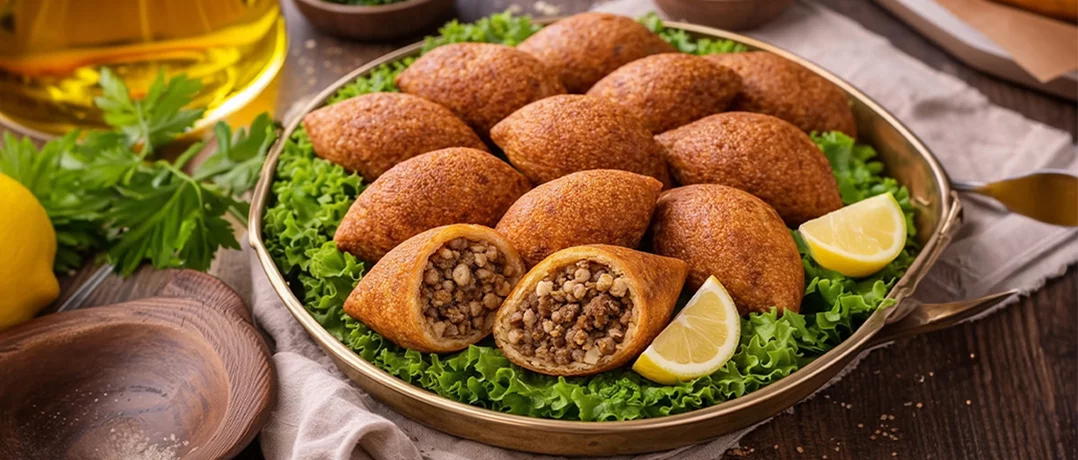
Ask a Lebanese family about kibbeh and you will rarely get a simple answer. You will get an argument. You will get a memory. You will get a grandmother’s recipe recited from heart, a story about the last time the whole family gathered around a tray fresh from the oven. Kibbeh is not merely food in Lebanon. It is a language, one spoken differently in every household, in every region, in every season of the year.
It is also, if you look closely enough, a kind of living archive. The dish has absorbed everything Lebanon has been through: its agricultural rhythms, its religious calendar, its waves of migration and return, its capacity to adapt and persist without ever losing the what it was. To understand kibbeh is, in some measure, to understand the country that made it.
The preparation of kibbeh has always been as significant as the eating of it. Traditionally, the process began with the jorn, the heavy stone mortar in which meat and bulgur were pounded together by hand, a task that required both strength and patience and that no machine has ever quite managed to replicate.
In households across the country, making kibbeh remains a communal act. It is rarely done alone. Mothers teach daughters. Grandmothers correct grandchildren. Aunts arrive with opinions. The kitchen fills with conversation, with the sharp fragrance of allspice and cinnamon and dried mint, with laughter and inherited argument.
Across Lebanon’s regions, the dish speaks in a dozen dialects, each shaped by local ingredients, local custom, and the particular character of the people who make it.
Kibbeh nayyeh: raw, finely pounded meat folded with bulgur, onion, and spice, finished with good olive oil and fresh herbs, is the form that most divides opinion and most inspires devotion. For its adherents, it is the dish in its most essential, unmediated state: a direct encounter between quality ingredients and the skill of the person who prepared them. It demands the freshest meat, the most careful seasoning, and a willingness to trust the cook completely.
Kibbeh maqliyeh, the torpedo-shaped croquettes fried until their shells crack into golden crispness, are what most of the world outside Lebanon knows first, and they reward familiarity. Inside the shell, the filling of spiced minced meat, caramelized onions, and toasted pine nuts contains an entire flavor history: the fat richness of pine nut, the warm aromatic heat of seven spices.
Kibbeh bil saniyeh, baked flat in a tray and layered like a savory pie, is the version of abundance: generous, sharable, built for tables where everyone is welcome. In the mountains, kibbeh labaniyeh floats in a tangy yogurt broth that softens the meat and carries the perfume of dried mint. Kibbeh ras asfour, tiny, sparrow’s-head-sized dumplings, are the version of patience and precision, each one a small testament to the time a cook was willing to give.
Other regional variations add their own character to Lebanon’s kibbeh map. Kibbeh 2ras appears as small rounded patties, often pan-fried or baked. Kibbeh el shahmeh, rich and indulgent, incorporates lamb fat for extra depth of flavor. Kibbet raheb, associated with village traditions, highlights simpler ingredients and rustic preparation methods. Each reflects the creativity that Lebanese cooks have long brought to the dish.
Lebanon’s Christian communities observe Lent with a dietary discipline that, over centuries, has produced some of the most inventive cooking in the Lebanese repertoire. Denied meat and dairy for weeks at a time, cooks found ways to preserve the pleasures of familiar dishes through substitution and imagination. Kibbeh, typically built around lamb or beef, became one of their most inspired canvases.
Kibbet batata replaces meat with mashed potato, the starch taking on the bulgur’s texture, the filling adapted with spiced onions and sometimes walnuts producing something that satisfies in a different register but satisfies completely. Kibbet lakteen, made with pumpkin, carries the warm, earthy sweetness of autumn harvest, a flavor that feels ancient even when tasted for the first time.
Lentil and vegetable kibbeh, meanwhile, demonstrate that the dish’s soul was never really about the meat at all. It was about the bulgur and the spice, the shape and the care, the act of making something by hand. Remove the meat and those things remain. The dish endures.
Lebanon has endured a lot. Through all of it, the kitchen remained. Recipes were carried in memory across borders, reconstructed in diaspora apartments in Paris and São Paulo and Sydney, adapted to whatever ingredients were available, argued over and refined and passed on. Kibbeh traveled wherever Lebanese families traveled, and it arrived everywhere still recognizably itself.
Food is how communities maintain continuity when everything else is threatened. It is how a culture says: we are still here, we still know who we are, we still make this the way our grandmothers made it. In that sense, kibbeh is an instrument of Lebanese identity, a technology of belonging, deployed at every table, in every season, across every generation that has called this country home.

