From doctrine and geography to diplomacy and diaspora, Washington’s twin confrontations expose deeper truths about American power and leave Lebanon bracing for impact.




From doctrine and geography to diplomacy and diaspora, Washington’s twin confrontations expose deeper truths about American power and leave Lebanon bracing for impact.

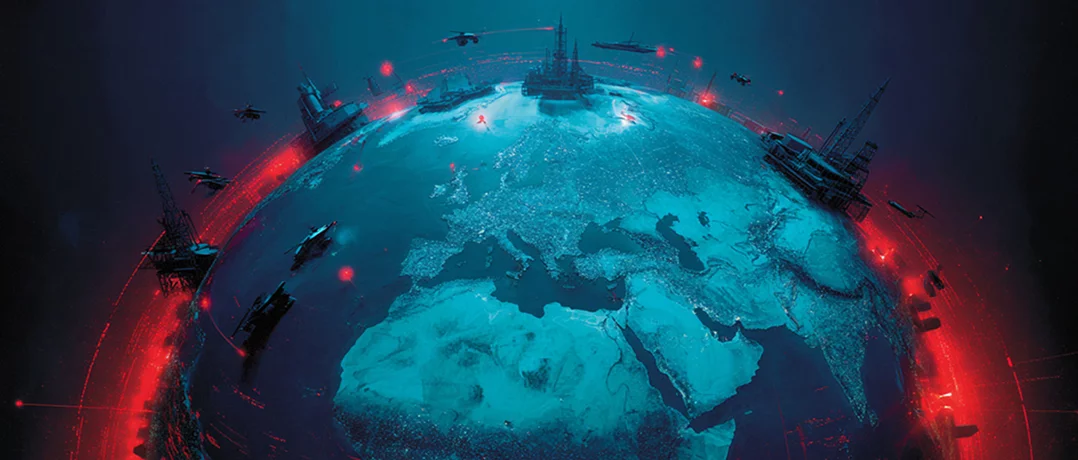
When President Trump used his State of the Union address to praise the raid that captured Nicolás Maduro and justify escalating pressure on Iran, he portrayed both episodes as expressions of one coherent foreign-policy doctrine: confront threats, reassert dominance, and restore U.S. primacy. But while the political messaging casts both as proof of renewed U.S. strength, the two operations reveal stark differences. One unfolded on Washington’s doorstep, aided by geography, intelligence penetration, and a century-old doctrine of hemispheric primacy. The other involves a regional power with layered air defenses, deep ideological cohesion, and a constellation of proxy forces capable of opening simultaneous fronts from Yemen to Lebanon.
The divergence exposes something deeper than tactics. It reflects two competing American instincts: hemispheric control rooted in the Monroe Doctrine, and a decades-long effort to contain Iran’s nuclear and regional ambitions. And for Lebanon, entangled in Iran’s regional calculations while bound to Venezuela through a large diaspora, both confrontations have carried, and will continue to carry, immediate consequences.
The raid in Caracas lasted little more than two hours. U.S. forces moved in swiftly, aided by coastal proximity and years of criminal indictments that allowed Washington to frame the operation as an extraterritorial law-enforcement action rather than a military intervention. The capital’s location, just a short distance from the Caribbean Sea, made rapid extraction feasible.
Iran is an entirely different strategic reality. Tehran lies hundreds of miles inland, shielded by mountains and one of the most complex air-defense networks in the region. The state’s authority is dispersed through a theocratic architecture: a supreme leader with final power, political hard-liners who dominate decision-making, and the Islamic Revolutionary Guards Corps, a force estimated around 150,000 members with a mandate to protect and export the regime’s revolutionary mission. Removing a leader in such a system would not resemble the capture of a single embattled president. It would amount to attempting to dismantle a regime that has spent nearly half a century entrenching itself.
Iran’s reach extends far beyond its borders. Its so-called axis of resistance, Hezbollah in Lebanon, Hamas in Gaza, the Houthis in Yemen, and aligned militias in Iraq and Syria, was designed to retaliate if necessary across multiple theaters. Even groups weakened by recent conflicts retain the ability to target American forces, Gulf states, or critical shipping routes. U.S. officials reviewing recent intelligence have warned that these networks could activate quickly if Iran is struck, especially after Tehran concluded that its restrained response to last year’s U.S. nuclear strike failed to deter Washington.
This combination of geography, ideology, and proxy reach means the kind of lightning raid Trump likened to Venezuela is not physically or politically possible in Iran. Any action there risks spiraling into a drawn-out conflict with cascading regional consequences.
The Venezuela operation fits comfortably within a long-standing American model of hemispheric control. Trump openly described the approach as a revived Monroe Doctrine, what he has now branded the “Donroe Doctrine,” asserting that the Western Hemisphere is “America’s backyard” and should remain free of rival influence. Grounding the mission in preexisting criminal indictments allowed Washington to avoid the legal complexities of claiming humanitarian intervention or collective defense, and it reinforced a broader campaign of seizing oil tankers, striking alleged drug-running vessels in the Caribbean, and tightening pressure on Cuba.
Iran, by contrast, sits outside any familiar doctrinal template. Washington frames Tehran as an ideological and nuclear threat whose ambitions destabilize the region and endanger U.S. partners. Trump’s envoys, including Steve Witkoff and Jared Kushner, have met Iranian officials in Geneva, but Tehran insists talks focus exclusively on the nuclear issue. The U.S., alongside Israel, wants Iran’s missile program and regional proxy activity addressed as well. Trump has said regime change would be “the best thing” that could happen, yet he has not specified what any military engagement should accomplish, leaving both American policymakers and military planners without a defined end state.
This mismatch between expansive aims and unclear objectives makes the Iran standoff far more volatile than the Venezuelan raid.
The Middle East, reacting to U.S. pressure on Iran, has voiced near-uniform concern. Even close partners like Saudi Arabia and the UAE, hosts to key American bases, publicly refused to allow their airspace to be used for strikes, aware that any confrontation with Iran could bring retaliation directly onto their own territory. The result is a sharp divergence: ideological fault lines in one region, and in the other, a shared urgency to prevent a conflict that could reshape the entire Middle East.”
Both crises reverberate sharply in Lebanon. Following Maduro’s capture, the sizable community of Venezuelans of Lebanese descent watched events with unease, worried that political turmoil could jeopardize their status and livelihoods. But as attention shifts to Washington’s actions toward Iran, it is now the Lebanese inside Lebanon who find themselves on high alert, aware that any escalation could spill onto their own soil.

