

As Iran relies on an expanding shadow fleet to sustain oil exports despite Western sanctions, the network may represent not only a sanctions-enforcement challenge but also a growing environmental risk, as aging tankers operate through some of the world's most economically and ecologically important waterways.
The ecological risks of Iran's shadow fleet
The ecological risks of Iran's shadow fleet
By Katharine Sorensen | June 16, 2026

Reading time: 7 min
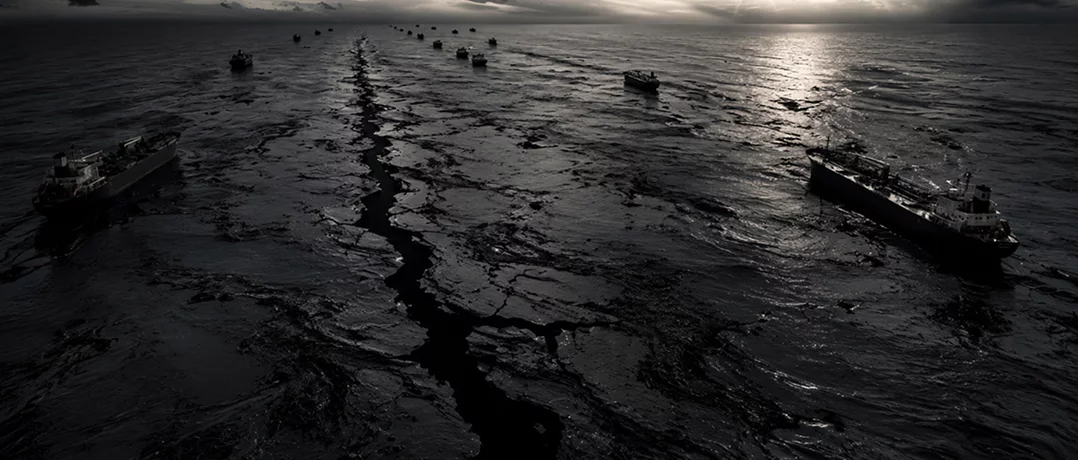
In March 1989, the supertanker Exxon Valdez struck a reef in Alaska's Prince William Sound, releasing roughly 257,000 barrels of crude oil into one of North America's most productive marine ecosystems. The spill contaminated more than 1,300 miles of coastline, killed hundreds of thousands of seabirds, and devastated local fisheries whose livelihoods depended on the surrounding waters. A little more than two decades later, the 2010 Deepwater Horizon disaster, triggered by an explosion aboard a BP-operated offshore drilling rig, released an estimated 3.19 million barrels of oil into the Gulf of Mexico, becoming the largest marine oil spill in the history of the petroleum industry and leaving lasting environmental and economic consequences.
Today, attention is turning toward a different environmental threat that may not come from a single tanker accident or drilling catastrophe: Iran's shadow fleet, a network of tankers that has helped sustain the country's oil exports despite years of Western sanctions.
Over the past decade, Iran has developed a shadow fleet of tankers used to transport oil despite Western sanctions. Operating through opaque ownership structures, ship-to-ship transfers, and periods of limited or absent public tracking, the fleet has become a critical component of Iran's ability to sustain crude oil exports despite Western sanctions.
According to analysis by maritime intelligence firm Pole Star Global shared with The Beiruter, twenty-nine Iranian-flagged tankers linked to this network recently spent weeks or months operating with limited public visibility before reappearing across Asia, the Middle East, and Africa. Ten of those vessels are now clustered near Teluk Ramunia, Malaysia, an established ship-to-ship transfer hub situated along one of the world's busiest maritime corridors.
Collectively, the vessels operating within the Malaysia-Singapore-Indonesia corridor possess a combined carrying capacity of approximately 24.5 million barrels of crude oil. Yet for Saleem Khan, Chief Data & Analytics Officer at Pole Star Global, the volume of oil involved is only part of the concern. Fifteen of the vessels are more than twenty years old, while three exceed thirty years of age.
“The average service life for an oil tanker is between fifteen to twenty years,” he said.
Anything outside of that age range is essentially a giant bomb at sea.
For years, concerns surrounding Iran's shadow fleet have focused on sanctions enforcement, maritime transparency, and the movement of illicit oil. Pole Star's findings point to an additional challenge. The same fleet that allows Iranian crude to reach international markets may also be concentrating environmental risk in one of the world's busiest and most ecologically sensitive maritime corridors.
 Twenty-nine Iranian-linked tankers identified across Asia, the Middle East, and Africa, including a concentration of vessels near Malaysia. Credit: Pole Star Global
What exactly is a shadow fleet?
The term "shadow fleet" entered mainstream policy and maritime discussions following sanctions imposed on oil exports from countries including Iran, Venezuela, and, more recently, Russia. Yet despite its growing use, the term is often applied imprecisely.
The Atlantic Council, a Washington-based think tank, defines the shadow fleet as a network of vessels used to transport sanctioned cargo through opaque ownership structures, reduced transparency, and other deceptive shipping practices. Lloyd's List, one of the maritime industry's leading trade publications, has similarly described it as a parallel shipping ecosystem operating with significantly less visibility than conventional commercial shipping.
Critically, a sanctioned vessel is not necessarily a shadow-fleet vessel. While sanctioned ships are subject to restrictions on activities such as insurance, financing, port access, or trade, many continue to operate openly while broadcasting their locations and complying with international maritime regulations.
Shadow-fleet vessels, by contrast, typically rely on methods designed to obscure ownership, cargo origin, destination, or operational history. These can include disabling or manipulating Automatic Identification System (AIS) transmissions, conducting ship-to-ship transfers at sea, repeatedly changing flags and registries, operating through shell companies, or moving cargo through intermediary jurisdictions before final delivery.
AIS is particularly important because it allows maritime authorities and commercial tracking services to monitor a vessel's identity, location, speed, and course. When ships stop transmitting, broadcast false positions, or engage in AIS spoofing, tracking their activities becomes significantly more difficult.
Iran has relied on variations of these techniques for years to move crude oil to international markets despite sanctions. According to Khan, the twenty-nine vessels examined in the company's latest assessment represent only 8% of Iran's broader shadow-fleet network, which would place the total fleet at roughly 360 vessels.
What drew attention, however, was not simply the existence of these vessels, but where many of them ultimately resurfaced.
Malaysia's emerging tanker cluster
One location appeared repeatedly in Pole Star's analysis: Teluk Ramunia, Malaysia. Little known outside maritime circles, the area has long served as a hub for ship-to-ship transfers. According to Khan, the location offers a combination of geographic, regulatory, and commercial advantages.
“Teluk Ramunia sits in an overlapping jurisdictional zone between Malaysia and Singapore where enforcement authority is genuinely ambiguous,” he said.
Its established anchorage infrastructure allows vessels to blend into normal maritime traffic, while ship-to-ship transfers can make it more difficult to determine the precise origin of cargoes.
The area also provides direct access to the South China Sea and major shipping routes linking Southeast Asia to Chinese refineries and is located near the Strait of Malacca, one of the world's most important maritime chokepoints and a critical artery for global trade and energy shipments moving between the Indian and Pacific Ocean.
Any incident involving one of these vessels would occur in waters that support extensive fishing industries, coastal communities, and some of the busiest commercial shipping routes in the world.
Khan said the scale of the Iranian cluster is unusual even by shadow-fleet standards.
We have not seen the Iranian dark fleet amass in this manner anywhere else in the world.
 DOVER (23 years old) and ARGO I (26 years old) were among the older Iranian-linked tankers identified near Teluk Ramunia, having spent 114 and 88 days, respectively, without public AIS transmissions. Credit: Pole Star Global
The concern is therefore not any single vessel, but the convergence of three factors: the concentration of millions of barrels of crude oil, the age profile of the fleet, and the ecological and economic significance of the surrounding waters.
An aging fleet
Age alone does not make a vessel unsafe. Yet as sanctions-driven trade extends the operational life of older tankers, questions surrounding maintenance, inspections, and regulatory oversight take on greater significance.
Dr. Simon Boxall, Professor of Oceanography at the University of Southampton, told The Beiruter that the decline in major tanker spills over recent decades reflects significant improvements in vessel design, navigation systems, and safety regulations.
“International regulations on tanker design and control have improved with experience over the years,” Boxall said, noting that modern tankers are typically equipped with double hulls and other safety features designed to reduce the likelihood and severity of spills following collisions or groundings.
This means many shadow fleets rely on older vessels that would no longer be allowed to enter the waters around most countries across the globe.
Few vessels encapsulate the risks associated with an aging shadow fleet more clearly than the Iranian crude carrier ARMAN 114.
 ARMAN 114, the oldest tanker identified in Pole Star's ecological risk assessment. Credit: Pole Star Global
At twenty-nine years old, it is the oldest tanker identified in Pole Star's assessment. In February, analysts found the vessel broadcasting false AIS coordinates at 0,0, a location commonly associated with spoofed maritime positions. Its last confirmed transmission occurred near Indonesia in June 2025. Since then, the 300,579-deadweight-ton tanker, capable of carrying more than two million barrels of crude oil, has remained absent from publicly available tracking systems.
Whether those risks ultimately translate into environmental damage depends on several factors. The consequences of a major spill, however, could extend well beyond the vessel involved.
The challenge of a major spill
A major spill involving any large tanker would present significant environmental challenges. A spill involving a vessel operating outside conventional insurance and liability frameworks, however, could create additional complications.
Dr. Boxals noted that geography would play an important role in determining the scale of any environmental damage. Parts of the region are both shallow and geographically constrained, meaning that a spill would have less room to disperse before reaching nearby coastlines. As a result, coastal ecosystems and communities could face more immediate impacts than in more open waters.
While warm temperatures can accelerate the natural breakdown of oil, the relatively confined nature of some regional waterways and weaker tidal circulation can complicate dispersion and recovery efforts.
The challenge extends beyond environmental cleanup. Speaking to The Beiruter, Joe Lane of the ITOPF, a nonprofit organization that advises on marine pollution response, said vessels operating outside established insurance frameworks can complicate both response operations and compensation efforts.
“From a response perspective, vessels operating outside established insurance frameworks can introduce additional complexity,” he said.
In the absence of insurance from any insurer, it can be more difficult to organise, resource and sustain an effective response.
Insurance plays a critical role in financing clean-up operations, coordinating technical expertise, and managing compensation claims following major spills. Concerns surrounding uninsured vessels have become significant enough that in 2024, the governing bodies of the International Oil Pollution Compensation Funds adopted resolutions intended to raise awareness of the risks posed by unsafe or uninsured tankers operating outside established liability systems.
Where states have ratified international compensation conventions, mechanisms exist to support affected communities and provide compensation for pollution damage. Those systems can help cover cleanup costs and economic losses affecting fisheries, tourism operators, and coastal businesses.
Yet even where compensation frameworks exist, the immediate consequences of a major spill can be substantial. Lane noted that while many marine ecosystems demonstrate considerable capacity for recovery, major incidents can still inflict serious economic damage.
“In major incidents the combination of environmental damage and disruption to fisheries, tourism and trade can result in significant consequences for coastal communities and their economies,” he said.
While no major spill has occurred and many of the vessels continue to operate without incident, the broader trend is harder to ignore. Some of the world's oldest and least transparent oil tankers are moving through one of the world's most economically important maritime corridors, carrying volumes of crude oil measured not in thousands of barrels, but in tens of millions.
The environmental risks associated with the shadow fleet are often overshadowed by discussions of sanctions, energy markets, and geopolitics. But environmental disasters are often obvious only in hindsight. The challenge is recognizing potential vulnerabilities before they become headlines.
-
-

-
Katharine SorensenReporterSpecializing in global affairs, technology and economics, with a focus on on-the-ground investigative reporting.
-
