



The wars involving Russia and Iran are altering the economic geography of global aviation, influencing which airlines can compete, which airports attract connecting traffic and how international flight networks develop over the coming years.
The economic geography of closed airspace
The economic geography of closed airspace
By Katharine Sorensen | November 24, 2026

Reading time: 7 min
On March 16, 2026, Emirates flight EK10 was approaching the final stages of its journey from London Gatwick to Dubai when news of an Iranian drone strike at its destination forced an abrupt change of course. Already flying over Saudi Arabia, the aircraft turned back toward Britain, eventually landing at Gatwick after an 11-and-a-half-hour journey that covered approximately 9,100 kilometers. Its passengers had spent nearly half a day in the air without reaching their destination. The incident was one of dozens of diversions triggered by the war involving Iran, adding to disruptions already affecting international aviation since Russia's invasion of Ukraine in 2022. In March 2026, EUROCONTROL, the European organization responsible for coordinating air traffic management, estimated that Middle Eastern airspace restrictions were forcing approximately 1,150 flights to reroute daily, adding 206,000 kilometers of flying and 602 tonnes of fuel consumption each day. Restrictions associated with the war in Ukraine have also increased flight distances between Western Europe and China by as much as 18%, according to the German Aerospace Center. “Airspace closures caused by Russia's invasion of Ukraine and fighting between Iran and Israel have disrupted global flight networks,” aviation management professor Luis Martín-Domingo told The Beiruter. As political boundaries determine which airlines can use the most efficient routes, geopolitical conflict is changing the economics of international aviation, influencing airline profitability, passenger fares, and the competitiveness of major connecting hubs. Since Russia's invasion of Ukraine in 2022, restrictions on Russian airspace have forced many Western airlines onto longer routes to East Asia, while the war involving Iran has disrupted key corridors farther south. “Geopolitical airspace restrictions primarily affect airline operating costs through longer flight times and therefore increased fuel consumption,” explained Dr. Alexander Lau, acting head of the Flight Operations Concepts Department at the German Aerospace Center's Institute of Air Transport. Using actual flight data from 2023, Lau found that Russian airspace restrictions produced detours of approximately 16% to 18% on routes between Western Europe and China, increasing fuel requirements by 12% to 20%, depending on direction and prevailing winds. Services between Europe and Japan or South Korea experienced approximately 22% longer distances and 20% higher fuel consumption. Longer journeys also occupy aircraft for additional hours and complicate crew scheduling, potentially requiring additional personnel or extended duty periods. John Grant, senior analyst at aviation data company OAG, estimated that avoiding Russian airspace typically adds more than two hours to eastbound European flights to Asia and as much as four hours westbound, depending partly on prevailing winds. Such disruptions, he told The Beiruter, are “changing the fortunes of airlines on a daily basis” and making long-term planning considerably more difficult. The Iran war has also disrupted corridors connecting Europe, Asia and Africa. According to EUROCONTROL's March 2026 assessment, Middle Eastern airspace restrictions were estimated to force approximately 1,150 flights to reroute daily, adding 206,000 kilometers of flying, 602 tonnes of fuel consumption and 1,900 tonnes of carbon dioxide emissions each day. The disruption has coincided with rising energy prices. In its June 2026 Global Outlook for Air Transport, the International Air Transport Association (IATA) reported that jet fuel prices had roughly doubled since late February. It forecast global airline net profits of $23 billion in 2026, equivalent to a margin of just 2%. Airspace restrictions do not impose identical burdens on every airline. Their economic consequences depend partly on nationality, because access to particular flight corridors is determined by political decisions and reciprocal restrictions rather than geography alone. “Airlines that retain access to restricted airspace can gain a competitive advantage over those required to take longer routes," Lau explained. Shorter journeys reduce fuel consumption and operating expenses, potentially allowing carriers to offer lower fares or operate more frequent services. Between Europe and China, European carriers generally cannot cross Russian airspace, while Chinese competitors retain access to shorter routes. The competitive imbalance is evident in the recovery of Europe–Asia air traffic. In 2024, airlines with access to Russian airspace operated 19% more flights than in 2019, while those without access operated 18% fewer, according to EUROCONTROL's March 2025 analysis. Airlines avoiding Russian airspace also lost approximately nine percentage points of passenger-flight market share. Pandemic recovery, airline capacity and passenger demand also contributed to this divergence, which cannot be attributed solely to airspace restrictions. Martín-Domingo identified a similar advantage among airlines operating outside Western restrictions. “Airspace bans from Russia's invasion of Ukraine and fighting in the Middle East have given major advantages to airlines and airports outside Western sanctions,” he said. While longer routes make flights more expensive to operate, higher expenses do not necessarily translate into equivalent fare increases for passengers. “An airline's ability to pass on higher costs depends on several factors,” Lau explained. When competitors face similar restrictions or passenger demand is relatively insensitive to prices, airlines have greater scope to raise fares. Otherwise, they may absorb additional expenses, reduce frequencies or deploy smaller aircraft. These pressures are particularly consequential for airlines that depend on connecting passengers through major international hubs. In the Middle East, the Iran war has disrupted the traffic on which Gulf airports depend. EUROCONTROL's March 2026 assessment recorded approximately 1,200 fewer daily flights between Europe and the Middle East, a 59% reduction from the normal level of around 2,000 flights. IATA's June outlook forecast global passenger traffic growth of just 2.1% in 2026, with the Middle East particularly affected by reduced connectivity. Historical capacity data supplied to The Beiruter by OAG reveal substantial differences across the region. Between 2019 and 2025, scheduled departing seat capacity increased 26.6% in Saudi Arabia, 22.2% in the United Arab Emirates and 20% in Qatar, while declining 32.5% in Iran, 25.1% in Iraq and 20.3% in Lebanon. The UAE, Saudi Arabia and Qatar collectively accounted for approximately 74.3% of regional scheduled departing seats in 2025, compared with 66.2% in 2019. Grant attributed part of this concentration to the commercial advantages accumulated by major connecting networks. “The big are getting bigger,” he observed, while smaller airlines are “struggling for market relevance” and relying more heavily on local and diaspora demand. Prolonged airspace restrictions complicate decisions about aircraft purchases, airport slots, international partnerships and connecting schedules, potentially influencing airline investment and route planning long after restrictions are lifted. “If geopolitical airspace closures continue, they will likely cause a permanent shift in global flight networks rather than just a temporary detour,” Martín-Domingo said. Istanbul illustrates the potential importance of geography. Lau noted that connections between Western Europe and Northeast Asia through the Turkish hub can offer overall travel distances comparable to itineraries through Western European airports under current Russian airspace restrictions. The Gulf presents a more complicated case. Its airlines have faced fewer disadvantages from Russian restrictions than many European competitors, but the Iran war has threatened the corridors supporting their international networks. “Restrictions affecting Iranian and Iraqi airspace may also influence the competitiveness of Middle Eastern hubs,” Lau explained, as longer detours can make direct connections between Europe and Asia relatively more attractive. These changes are not necessarily irreversible. Lau pointed to the reopening of Afghan airspace as an example of how restored access can reduce flying distances on services to India and Southeast Asia. Shorter routes remain commercially attractive when political and operational conditions permit. “What we are seeing is the evolution of aviation and competition,” Grant said.These northern and southern airspace closures have made many long-distance flights much harder to run profitably by driving up costs and giving certain airlines an unfair advantage.
The rising cost of detours
The additional fuel required can be substantial, particularly on long-haul routes, where fuel accounts for a significant share of an aircraft’s direct operating costs.
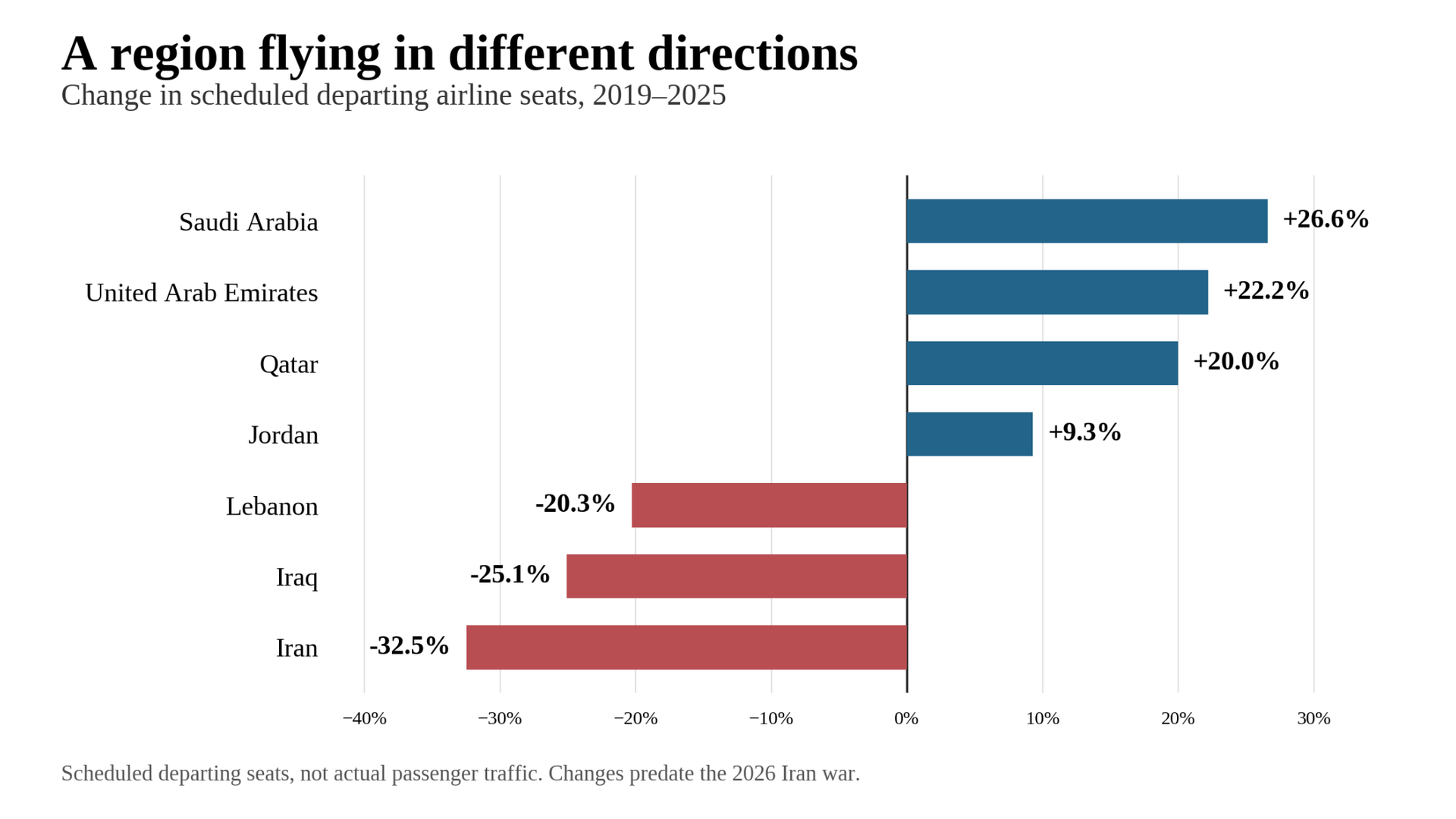 Source: EUROCONTROL, Aviation Trends, Edition 11: Impact of the Current Middle East Crisis on European Aviation, March 31, 2026.
An unequal competitive landscape
Carriers from China, Türkiye, the Middle East, and Central Asia can still use shorter northern routes over Russia, avoiding the hours-long detours, extra fuel costs, and higher ticket prices that hurt European and North American rivals.
The price of connectivity
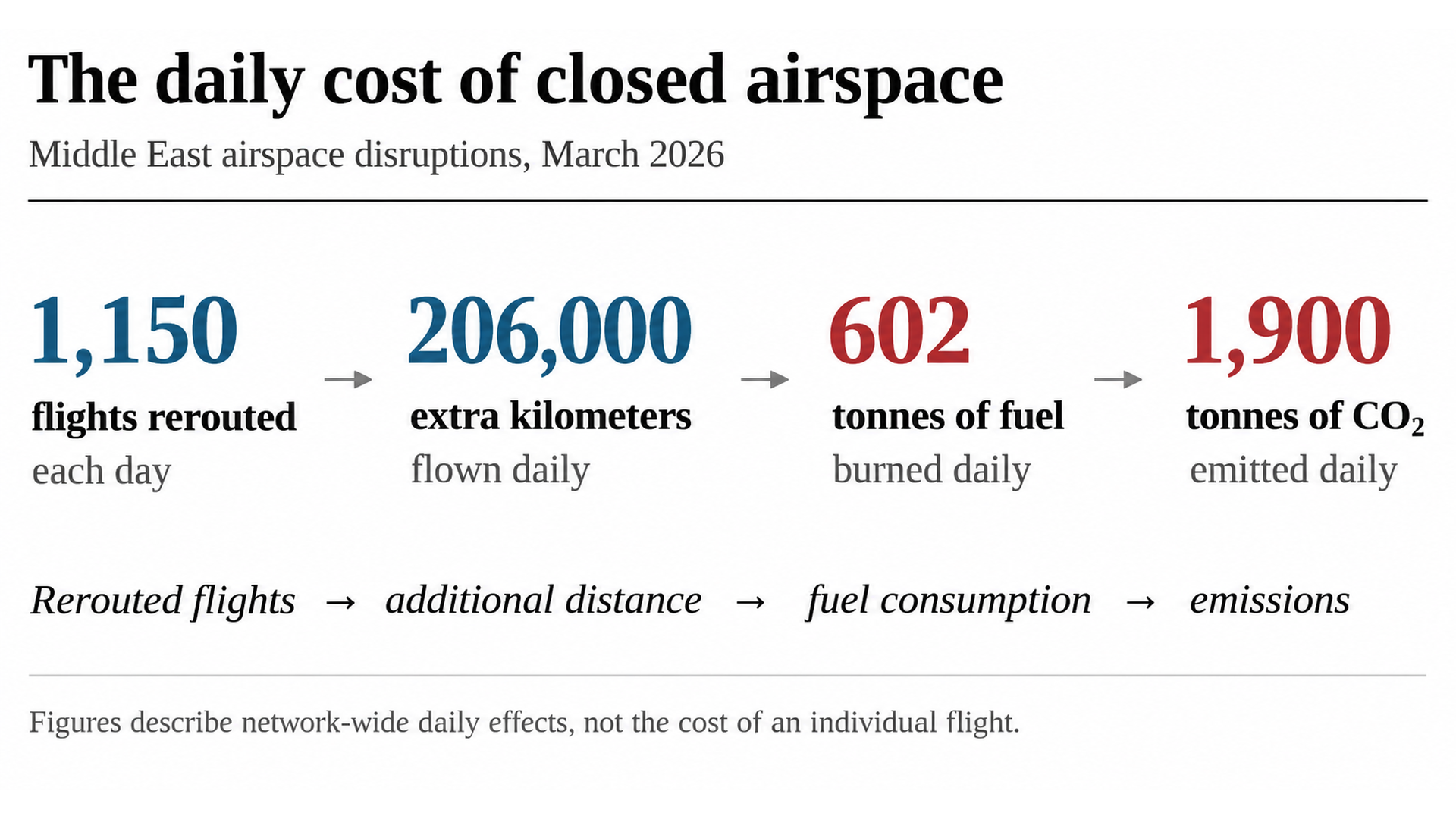 Scheduled departing airline seat capacity increased in Saudi Arabia, the UAE, Qatar and Jordan between 2019 and 2025, while declining in Lebanon, Iraq and Iran. Source: OAG data supplied to The Beiruter.
A new geography of aviation
Even if official airspace bans were eventually lifted, airlines are unlikely to quickly or fully return to their old flight networks due to lingering economic, legal, and competitive hurdles.
Aviation has sadly become a pawn in a bigger world of geo-political incidents.
-
-

-
Katharine SorensenReporterSpecializing in global affairs, technology and economics, with a focus on on-the-ground investigative reporting.
-
