



Israel’s emerging strategic partnership with Somaliland, following recognition and high-level visits, signals a geopolitical shift with implications for the Horn of Africa and Red Sea security dynamics.
The emerging Israel-Somaliland strategic partnership
The emerging Israel-Somaliland strategic partnership
By The Beiruter | June 19, 2026

Reading time: 4 min
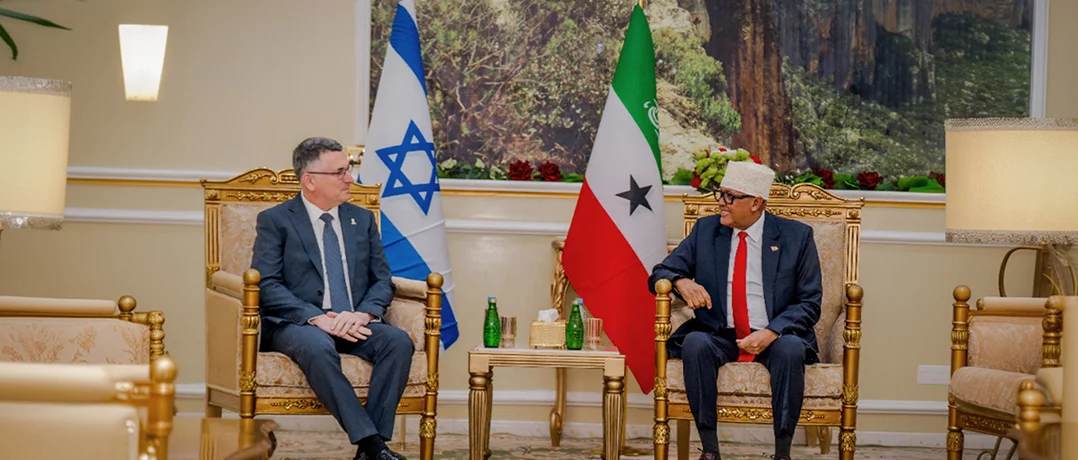
The recent visit of Somaliland President Abdirahman Mohamed Abdullahi, widely known as Cirro, to Israel marks a significant milestone in the evolving relationship between the two sides. Coming months after Israel became the first United Nations (UN) member state to formally recognize Somaliland as an independent country, the visit has elevated a previously limited relationship into a strategic partnership with potentially far-reaching implications for the Horn of Africa, the Red Sea region, and Middle Eastern geopolitics.
A historic diplomatic breakthrough
President Cirro’s visit to Jerusalem was described by Somaliland officials as historic. During meetings with Israeli President Isaac Herzog and other senior Israeli leaders, both sides stressed the importance of strengthening bilateral cooperation in areas ranging from trade and technology to security and maritime affairs.
For Somaliland, the visit represented the highest-profile diplomatic engagement in its modern history. Since declaring independence from Somalia in 1991 following the collapse of the Somali state, Somaliland has maintained its own government, security institutions, currency, and electoral system. However, despite operating as a de facto state for more than 3 decades, it has struggled to obtain formal international recognition.
Israeli recognition in late 2025 therefore represented a major diplomatic breakthrough. Somaliland officials have portrayed the move as validation of their long-standing argument that the territory has fulfilled the practical requirements of statehood through stable governance, functioning institutions, and the ability to conduct international relations.
Somaliland’s case for recognition
Advocates of Somaliland’s independence argue that the territory possesses a distinct historical and political identity. Formerly known as British Somaliland, it briefly gained independence in 1960 before voluntarily uniting with the former Italian Somaliland to create the Somali Republic.
Supporters contend that the union ultimately failed, particularly during the rule of Somali President Siad Barre, whose military campaign against northern communities in the 1980s left deep scars. Following the collapse of Somalia’s central government in 1991, Somaliland reasserted its independence and gradually built its own political institutions.
Proponents further point to Somaliland’s relative stability compared with much of Somalia. While Somalia has faced decades of conflict, insurgency, and political instability, Somaliland has held multiple elections, experienced peaceful transfers of power, and maintained a comparatively secure environment.
For many Somalilanders, international recognition is viewed not as secession but as the restoration of sovereignty that existed before the 1960 union.
Somalia’s opposition and international concerns
Somalia firmly rejects Somaliland’s claim to independence and continues to regard the territory as an integral part of the Somali state. Officials in Mogadishu have condemned Israel’s recognition and subsequent diplomatic engagement, describing them as violations of Somalia’s sovereignty and territorial integrity.
President Hassan Sheikh Mohamud has argued that external actors should support dialogue rather than take unilateral steps that could complicate efforts to resolve the dispute peacefully. Somalia has also received diplomatic backing from numerous Arab, African, and Muslim-majority countries, many of which have reiterated their support for Somalia’s territorial unity.
The African Union (AU) has historically been cautious regarding secessionist movements due to concerns that recognizing breakaway regions could encourage similar demands elsewhere on the continent. Many governments therefore remain reluctant to endorse Somaliland’s independence despite acknowledging its relative stability and governance achievements.
The controversy surrounding Israel’s recognition reflects a broader debate between two principles of international relations: territorial integrity and self-determination. While supporters of Somalia highlight the importance of preserving internationally recognized borders, Somaliland advocates argue that self-determination and political realities on the ground should also be considered.
Israel’s strategic interests in Somaliland
Somaliland occupies a highly significant location along the Gulf of Aden, near the Bab el-Mandeb Strait, one of the world’s most important maritime chokepoints. The waterway connects the Red Sea to the Indian Ocean and serves as a crucial route for global trade and energy shipments.
Israel has increasingly focused on Red Sea security following repeated attacks by Yemen’s Houthi movement on commercial shipping and regional targets. A partnership with Somaliland potentially offers Israel greater diplomatic, intelligence, and logistical access in a strategically sensitive area.
Israeli officials have highlighted shared interests in maritime security, regional stability, and economic cooperation. Discussions between the two sides have reportedly included trade, technology, agriculture, energy, and defense cooperation, though the full scope of future agreements remains unclear.
For Somaliland, the relationship offers access to investment, expertise, and a powerful diplomatic partner capable of advocating for its interests internationally.
Rising regional tensions
While supporters view the partnership as mutually beneficial, critics fear it could contribute to growing instability.
Several regional actors have voiced concerns that increased Israeli involvement in Somaliland could intensify geopolitical competition in the Horn of Africa and the Red Sea basin. Governments including Egypt, Turkey, Saudi Arabia, Qatar, and Djibouti have publicly reaffirmed support for Somalia’s territorial integrity.
The Houthi movement in Yemen has gone further, warning that any Israeli presence in Somaliland could become a military target. Such statements have heightened concerns about the potential militarization of the region and the possibility that Somaliland could become entangled in broader Middle Eastern rivalries.
Experts also note that the Horn of Africa is already characterized by overlapping political, economic, and security disputes involving regional and international powers. Any new strategic alignment has the potential to alter existing balances of power.
Hence, the growing relationship between Somaliland and Israel represents a significant geopolitical development whose consequences extend far beyond bilateral diplomacy. As the two deepen their engagement, the Horn of Africa is likely to remain a focal point of international attention, with the outcome carrying implications for regional security, global trade routes, and the evolving dynamics of recognition and statehood in international politics.
-
-

-
The Beiruter
-
