In Anfeh, Lebanon, traditional hand-harvested sea salt has been produced for over 300 years, preserving both a local heritage and a way of life on the Mediterranean coast.




In Anfeh, Lebanon, traditional hand-harvested sea salt has been produced for over 300 years, preserving both a local heritage and a way of life on the Mediterranean coast.

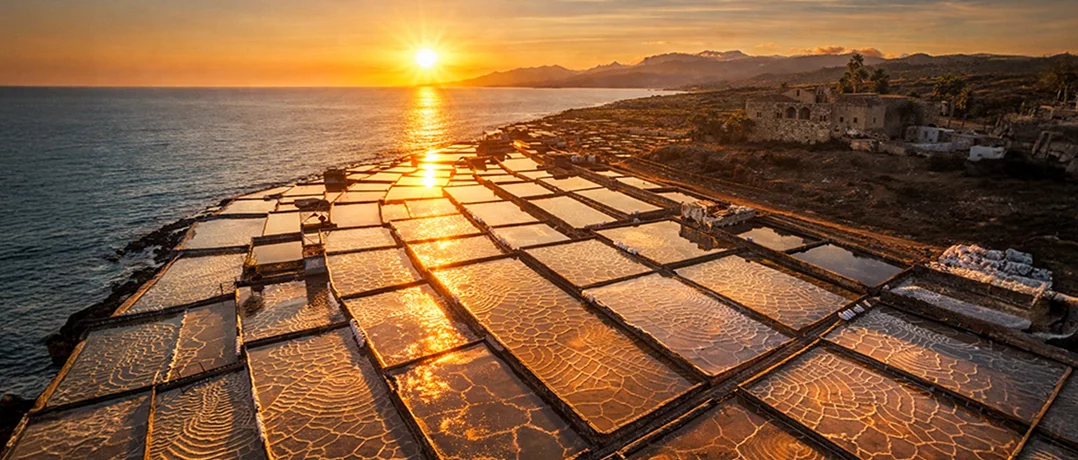
On Lebanon's northern coast, a village still harvests salt the way it has for three centuries, by hand, under the summer sun, at the edge of the Mediterranean. In Anfeh, these are the salt pans, and in summer they turn the shoreline into something improbable: a mosaic of blinding white crystals laid out like a patchwork quilt under the Levantine sun.
Anfeh is one of the last places in the Arab world where sea salt is still harvested by hand, using methods unchanged for more than three centuries. The process is as elemental as the sea itself: channel seawater into shallow terraced pools, wait for the sun and wind to do their work, then rake the salt into glistening mounds and carry it away.
The salt flats occupy the lower western edge of Anfeh's rocky peninsula, carved into a series of descending terraces that step toward the waterline. The layout is deliberate and ancient. The highest pools serve as settling basins, where seawater drawn through rock-cut channels is allowed to clarify before flowing by gravity into the evaporation pans below.
The shallow pools themselves are just centimeters deep, thin enough that the sun's heat penetrates all the way to the clay floor, maximizing evaporation. When conditions are right, with temperatures above 30°C and a steady sea breeze, crystals begin to form within two to three days. The salt that accumulates is notably pure: bright white, coarse-grained, and faintly minerally, carrying the character of the eastern Mediterranean in every crystal.
The summer harvest is, by all accounts, a village affair. From June through September, the families work the flats in the early morning and late afternoon, avoiding the harshest midday sun. The tool is simple: a long-handled wooden rake, broad and flat, used to draw the salt crystals toward the edges of each pool where they pile into low white mounds.
The salt is collected into baskets or sacks and either sold locally or carried to Tripoli's markets. Much of it ends up in the kitchens of northern Lebanon: curing olives, preserving cheese, seasoning the fish caught just offshore from the same peninsula.
Across the Mediterranean, traditional salt-making communities have largely vanished, displaced by industrial production that delivers cheaper, uniform product at scale. Cheap imported salt, widely available in Lebanese supermarkets, has eroded the economic case for artisan production. The families who work the pans do so as much from attachment to tradition as from commercial necessity, a precarious motivation in a country already under severe economic stress.
Tourism has emerged as a double-edged force. Anfeh draws visitors increasingly drawn to its antiquity and coastal charm, and the salt pans have become part of the village's identity as a heritage destination. This attention has brought recognition, and occasional revenue from visitors who purchase small bags of hand-harvested salt as souvenirs. But tourism, if poorly managed, can encroach on the shoreline, disturb the delicate hydrology of the pans, and commodify a practice that survives precisely because it has remained outside the logic of mass production.
What Anfeh holds is rarer than it might appear. The salt pans are a living system, still producing, still anchored in the economic and social fabric of a coastal community. The knowledge embedded in the work will vanish with the people who carry it, if the practice is abandoned.
There are small reasons for optimism. A quiet movement among Lebanese food producers and chefs has begun to spotlight artisan ingredients, and Anfeh's hand-harvested salt, coarser, more complex, and geographically specific in a way no industrial product can replicate, fits neatly into that story. The challenge is connecting that interest to the families at the water's edge, ensuring that recognition translates into a livelihood that keeps the rakes moving and the pans alive for another three hundred years.

