



The fall of the Byzantine Empire stands as a stark warning of how internal division and external abandonment can endanger Lebanon’s Christian community and its long-term future.
The fall of Byzantium: A timeless warning for Lebanese Christians
The fall of Byzantium: A timeless warning for Lebanese Christians
By Anthony Chamoun | May 29, 2026

Reading time: 10 min
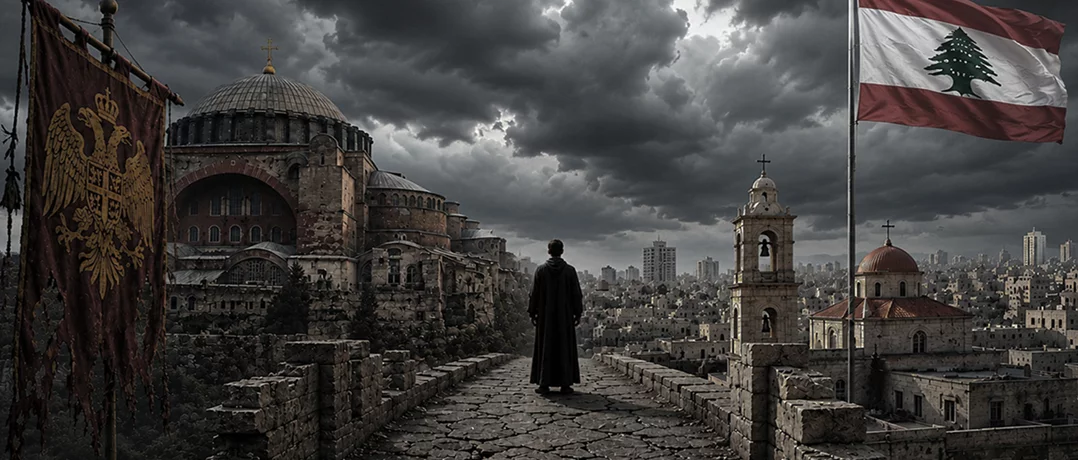
The Byzantine Empire (330-1453 C.E.) was established by Roman Emperor Constantine I, also known as “Constantine the Great,” who chose the ancient Greek colony of Byzantium as the site of a “New Rome” with an eponymous capital city, Constantinople.
After the fall of Rome in 476 C.E., the eastern half of the Roman Empire persisted for nearly a millennium until its ultimate downfall on 29 May 1453 C.E. In the evening prior to the final assault, the last Christian service was held in the Great Church of Holy Wisdom, the Hagia Sophia. Sir Steven Runciman recalled in his “The Fall of Constantinople” that
At this moment there was union in the Church of Constantinople.
This event was not merely the collapse of an empire, but marked a geopolitical and civilizational turning point for both East and West; widely regarded as the end of the Middle Ages.
Although various distinct reasons led to the empire’s demise, with weaknesses beginning to unravel from the 11th century C.E. (specifically since the Battle of Manzikert in 1071 C.E.), two consequential causes will be highlighted for the purpose of this article: the internal divisions within the empire itself and Western reluctance to lend meaningful support in time of need.
From here, a vital question arises: Do the internal divisions and external abandonment that preceded the fall of the Byzantine Empire find parallels in contemporary Lebanon, particularly in relation to the condition of its Christian population and the limits of Western support?
 The Ottoman forces breaching the walls of Constantinople in 1453 C.E., marking the collapse of the Byzantine Empire and the end of a millennium-old Christian polity.
Revisiting the fall of the Byzantine Empire on 29 May 1453 C.E.
Despite proving to have been impregnable for over a millennium, Constantinople’s formidable walls were eventually breached after a 53-day siege by the Turkish-Ottoman army, led by Sultan Mehmed II, also known as “Mehmed the Conqueror.” The causes underlying the empire’s downfall, which represented the final phase of the Byzantine-Ottoman Wars (1299-1453 C.E.), can be broadly categorized into two principal domains.
Western reluctance and abandonment:
The Great Schism of 1054 C.E. between the Roman Catholic Church and the Eastern Orthodox Church has had profound impacts on West-East relations, creating religious and political hostilities as well as mutual distrust between Rome and Constantinople that lasted for centuries. This, in and of itself, weakened the possibility of unified Christian resistance against later Muslim expansion.
The animosity was exacerbated during the Fourth Crusade (1202-1204 C.E.), which, although initially intended to recapture Jerusalem and restore Christian control over the Holy Land, ended with the Sack of Constantinople in 1204 C.E. This ultimately led to the fragmentation of the Byzantine Empire and the establishment of Latin Crusader states, initiating the period known as Frankokratia or Latinokratia.
Western European kingdoms did, at times, offer Constantinople the aid it had frequently requested. However, conditional Western support, which was insufficient, was often tied to ecclesiastical submission to Rome. Emperor John V unsuccessfully sought financial help from the West in 1369 C.E. to confront the growing Ottoman threat, but he was arrested as an insolvent debtor in Venice.
Furthermore, the aforementioned kingdoms were themselves preoccupied with their own wars and conflicts, such as the Hundred Years’ War (1337-1453 C.E.) between England and France, the Spanish Reconquista (711-1492 C.E.), and the Holy Roman Empire’s internal wars.
Therefore, while limited volunteers and assistance came from Venice, Genoa, and the Pope, Western powers generally failed to come to the Byzantine Empire’s aid in its time of dire need. Hence, the West understood the Ottoman threat far too late.
An empire and civilization fractured from within:
Prior to the collapse of the Byzantine Empire, the latter was plagued with detrimental internal strife and succession crises. A notable example is the Byzantine Civil War (1341-1347 C.E.), also known as the Second Palaiologan Civil War, after the death of Emperor Andronikos III Palaiologos. Indeed, as in earlier civil wars of the 7th and 11th centuries C.E., rival factions contended over power and influence, polarizing Byzantine society, undermining its cohesion, and resulting in substantial territorial losses. The Byzantine Civil War thus exemplifies the fragility of political power in the empire’s late period and the impact of internal conflicts on its stability and territorial integrity.
Domestic disagreements had a religious dimension as well. As Ottoman pressure increased over time, some Byzantine emperors sought military aid from Western Europe by attempting reconciliation and union between the Eastern Orthodox and Roman Catholic Churches, especially at the Council of Florence (1438-1445 C.E.). However, bitter internal divisions arose between “unionists” who supported compromise with Rome for survival and “anti-unionists” who viewed it as betrayal of Orthodox identity and even a “mortal sin,” especially after the Sack of Constantinople. This religious polarization weakened morale and national cohesion during the empire’s final decades. Indeed, some Byzantines preferred Ottoman rule over submission to the papacy, hence the famous phrase attributed to Loukas Notaras, a Byzantine Greek statesman who served as the empire’s last Megas Doux (Grand Duke):
Better the Turkish turban than the papal tiara.
Even the well-known anecdote concerning “the debate over the sex of the angels” reveals the intellectual detachment and political paralysis that prevailed in the face of existential danger; although no solid historical evidence confirms that such a debate actually occurred in the dramatic manner later portrayed.
In short, the Byzantine Empire was weakened internally long before the Ottomans breached the walls.
The consequences of the empire’s downfall:
The aftermath of the fall of the Byzantine Empire and its reverberations has been profound.
In the East, Islam dominated the region and key ancient Christian regions gradually declined politically and demographically; such as Constantinople and Nicaea which became Istanbul and İznik respectively, or even the transformation of the Hagia Sophia Church into the Grand Mosque. Moreover, Eastern Christianity lost its principal imperial and religious center. Thus, the collapse created a deep sense of political and civilizational catastrophe among Eastern Christians as they became second-class subjects within an Islamic imperial system.
In the West, the fall of Constantinople eventually forced Europe to confront a strategic danger along its border it had previously underestimated, as the Ottoman Empire (1299-1922 C.E.) continued expanding into the Balkans and Central Europe afterward.
Although the empire’s fall contributed to the European Renaissance (due to the migration of Byzantine scholars into Italy and Western Europe) and the Age of Exploration (due to the need to find alternative routes to Asia), Christianity (which managed to survive along with its traditions) never recovered its demographic and political influence in the region ever since.
 The mosaic of the Virgin Mary and the Child, Theotokos, in the apse of Hagia Sophia, one of the most iconic monuments for both Christianity and Islam, originally constructed as a Byzantine cathedral before later serving as a museum since 1934 and then being reconverted into a mosque in 2020.
Parallels between Byzantium and Lebanon’s Christian situation
Of course, when drawing parallels between Byzantium and Lebanon, we are not equating the latter’s contemporary Christian situation or religious and political influence with that of the fallen empire. However, it is important to identify similar patterns and even risks that may currently confront Lebanon’s Christian population in order to be addressed accordingly.
Western engagement and its constraints:
Since the establishment of the modern Lebanese State in 1920 and its subsequent independence in 1943, Western support for the country’s Christian population has gradually diminished, though it has not disappeared entirely. Under the pretext of promoting inclusivity or engaging the country’s “majority,” the aid that these countries have offered has remained limited, insufficient, and merely rhetorical without sustained or meaningful long-term commitment. Indeed, the West, once perceived as historical protectors of Christian communities (namely Catholics), has increasingly adopted a secularized and interest-driven approach concerning both domestic and foreign policy, with the principle of raison d’État taking precedence over ideological or religious considerations.
A striking example is the so-called 1976 “Kissinger Plan” set by Dean Brown, former United States (U.S.) envoy and representative of Secretary of State Dr. Henry Kissinger. Brown reportedly suggested to former Lebanese President Camille Chamoun that his country was considering relocating Lebanese Christians to Canada or the U.S., thereby facilitating a “Christian exodus.” Former U.S. Under Secretary of State for Political Affairs, Ambassador David Hale, noted in his “American Diplomacy Toward Lebanon” that supporting the Christians in the Lebanese War (1975-1990) would have expanded the war by drawing Israel and Syria into it and thus risked Kissinger’s strategy of step-by-step shuttle diplomacy in the region, stating that
Any sympathy felt in Washington for the Maronite cause was subordinated to an interest in containing the Lebanese war.
Even when Washington intervened militarily in favor of the Lebanese government and presidency during the so-called “Political Maronism” in 1958 and 1982, it did so primarily to fulfill its own broader geopolitical interests rather than supporting the country’s Christian population; namely countering the threat of communism and the domino theory in the Middle East through the 1957 Eisenhower Doctrine, as well as safeguarding the interests and security of its formidable regional ally, Israel. In addition, U.S. Ambassador Dwight Porter declined several of President Charles Helou’s requests for dire economic, military, and political support in response to growing pressures from the Palestinian Liberation Organization (P.L.O.) and Arab nationalists. Indeed, Ambassador David Hale noted that
U.S. attention to Lebanese security problems came too late.
Moreover, following the 1989 Taif Agreement, Syria consolidated its grip in Lebanon, undermining its sovereignty and initiating a period of political exclusion and persecution of Lebanese Christian leaders and activists. This all unfolded largely with Western acquiescence. Even France, long considered as Lebanon’s “tender mother,” has evolved from an active power to almost a bystander, with often advancing a policy inconsistent with the interests and stability of the country’s Christian population. Indeed, François-Xavier Bellamy, Vice President of the European Parliament and Vice President of France’s Les Républicains party, recently told The Beiruter in an exclusive interview that Europe has long tended to “normalize” Hezbollah’s role in Lebanon. He argued that European governments have too often regarded the group as a conventional political actor, despite its armed capabilities and its significant influence within Lebanese state institutions.
Therefore, instead of strengthening resilience of Lebanese Christians in their homeland, Western policies of reluctance and restraint to date have left the aforementioned community vulnerable to political marginalization and economic hardships. These conditions have accelerated emigration, prompting thousands of Lebanese Christians to seek opportunities abroad.
Internal fragmentation and political disunity:
Western negligence is not the sole and primary reason for the precarious position in which Lebanese Christians find themselves today. Their long-standing internal fragmentation and persistent quarrels for power and leadership have been a major contribution to the weakening of Christian political influence in Lebanon.
Lebanese Christians have long been plagued by a self-destructive dynamic: an intense competition for influence and leadership within the community. The relentless struggle for supremacy has not only fragmented the community, but rather undermined its collective role, power, and leverage within the country and its consociational political system.
The matter that we are referring to is not anew, as it finds patterns in Lebanon’s modern history. Although both Tanios Chahine and Youssef Bey Karam were considered as prominent Maronite and Lebanese nationalist figures during the 19th century in Mount Lebanon, the two were vehemently opposed to one another. They maintained profound political disagreements and rival ambitions for leadership. Such divisions later characterized Christian politics in Lebanon, culminating with the 1990 “War of Elimination” between Lebanese Army fighters supporting then head of Lebanon’s interim military government, General Michel Aoun, and the Lebanese Forces (L.F.).
In essence, the intense power struggle within the community has hindered the formulation of unified national priorities, a coherent foreign policy approach, and effective strategies to address the demographic, political, and economic challenges facing Christians in Lebanon.

A 6th-century mosaic in Ravenna, Italy, depicting Emperor Justinian I (reign 527-565 C.E.) alongside Bishop Maximianus, imperial guards, and court officials, reflecting the political and religious authority of the Byzantine Empire.
A shared responsibility between Lebanese Christians and the West
As the world marks 573 years since the fall of the Byzantine Empire, its historical legacy continues to shape both Eastern and Western Christianity. The structural vulnerabilities that once contributed to Byzantium’s decline resonate, though in a different form, within the contemporary condition of Lebanese Christians.
Addressing these challenges requires ensuring sufficient, meaningful, and sustained external support from the West. In this regard, Lebanese Christians could benefit from renewed Western attention to the plight of Eastern Christians.
However, the limitations of external support in the absence of internal cohesion must be recognized. The future of Lebanese Christians depends not only on external political trends but also on internal dynamics; most notably enhancing political cohesion and communal unity.
Hence, the lesson from the fall of Constantinople is not that history is doomed to repeat itself, but that divided societies rarely withstand prolonged geopolitical pressures, especially when foreign backing becomes uncertain and inconsistent. For as it is written in the Gospel of Mark (3:24-3:25)
Every kingdom divided against itself is brought to desolation; and every city or house divided against itself shall not stand.
-
-

-
Anthony ChamounResearcher/WriterFocusing on Political Science and International Affairs.
-
