War and displacement are devastating southern Lebanon’s agricultural sector, threatening farmers’ livelihoods and the country’s food security.




War and displacement are devastating southern Lebanon’s agricultural sector, threatening farmers’ livelihoods and the country’s food security.

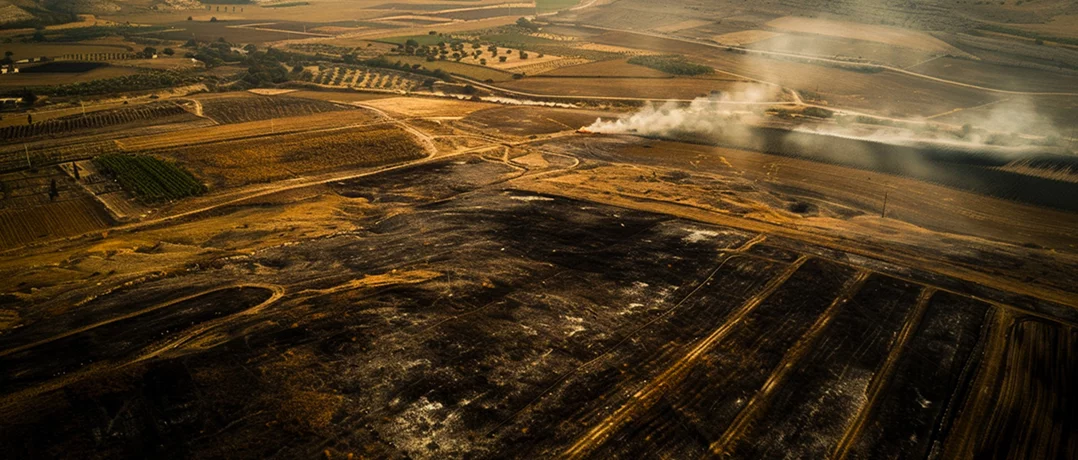
The southern Lebanese countryside has long been defined by the sight and scent of olive groves, citrus orchards, and grazing livestock. Today, much of it lies damaged, abandoned, or inaccessible. A Ministry of Agriculture report as part of the National Response Plan, puts stark numbers to what residents and aid workers have witnessed for months: an agricultural sector in crisis, with consequences that reach far beyond the south.
The numbers in the report are staggering. A total of 56,264 hectares of agricultural land across Lebanon have been affected by hostilities, with 18,559 hectares directly damaged, representing 22.5% of agricultural land in conflict-affected areas. The damage spans 64 southern towns and extends across farmland, irrigation networks, and production facilities.
Fruit trees have been affected across 11,075 hectares, while olive groves, the backbone of many southern farming families, have suffered damage over approximately 6,600 hectares. Livestock losses are equally devastating: more than 1.8 million poultry, sheep, goats, and cattle have perished, with additional losses recorded in beekeeping and fish farming.
Independent assessments add further context. A joint FAO-Ministry of Agriculture report published in April 2025 estimated total agricultural damages and losses at USD 704 million, with southern Lebanon and the Bekaa Valley identified as the hardest-hit regions. The sector’s reconstruction needs were estimated at USD 263 million, with USD 95 million prioritized for 2025-26.
Perhaps the most alarming figure in the Ministry’s report is this: 77.9% of farmers in southern Lebanon remain displaced. These are not large agribusiness operators, the report notes that small-scale farmers make up around 80% of agricultural activity in the south, meaning the crisis falls heaviest on those with the fewest resources to absorb it.
The Famine Early Warning Systems Network (FEWS NET) has flagged the destruction of the last remaining bridge over the Litani River in April 2026 as a critical blow, severing supply routes for food, fuel, and essential goods to the south and further isolating farming communities from markets and assistance. With road access limited and land inaccessible due to insecurity, even farmers who wish to return face near-insurmountable obstacles.
Southern Lebanon is not a peripheral agricultural zone, it accounts for up to 70% of the country’s citrus production and a significant share of its vegetables, olives, and bananas. Its collapse sends shockwaves through Lebanon’s already fragile food system.
The IPC’s latest analysis projects that between April and July 2026, nearly 961,000 people, 18% of Lebanon’s population, will face acute food insecurity, driven by agricultural disruption, displacement, and cuts to humanitarian assistance. The spring planting window, a critical opportunity to begin recovery, is closing fast.
Nora Ourabah Haddad, FAO’s Representative in Lebanon expressed that “compounded shocks are undermining agricultural livelihoods and impacting food security, highlighting the urgent need for emergency agricultural assistance to support farmers and prevent further deterioration,”
The Ministry of Agriculture says it is implementing a response plan in cooperation with international partners, including the World Food Program and the European Union, providing both financial and in-kind assistance to affected farmers. But the ministry itself has warned that the implications for national food security are serious, and that support measures must be accelerated.
What is unfolding in southern Lebanon is not only the destruction of farmland, but the erosion of an entire way of life. The olive groves, orchards, and grazing fields that once sustained families and local economies are becoming symbols of absence; empty land where work, routine, and community once existed.
The silence spreading across the south’s fields carries consequences far beyond rural communities. It reaches Lebanese households already struggling with rising food prices, growing insecurity, and dependence on imports. If recovery efforts fail to keep pace with the scale of destruction, the crisis will not remain confined to the south. It will reshape how the entire country eats, works, and survives.

