



How Lebanon’s heritage has survived centuries of war, empire, collapse, and destruction, becoming a story of national survival itself.
The fight to preserve Lebanon’s identity

Lebanon marks Heritage Day, a moment of reflection on a cultural landscape shaped by centuries of continuity and rupture. It is a reminder that Lebanon’s story is not only written in its present challenges, but also in the textures of its past, still visible in its streets, its villages, and the collective memory of its people.
A country built in layers
Long before there was a Lebanon, there were the cities later claimed by it. Byblos, north of Beirut, has been continuously inhabited for roughly 7,000 years; from its harbor the Phoenician alphabet spread across the Mediterranean. Tyre, founded around 2,750 BC, planted Carthage in 814 BC. Sidon’s necropolis produced the Alexander Sarcophagus, now in Istanbul.
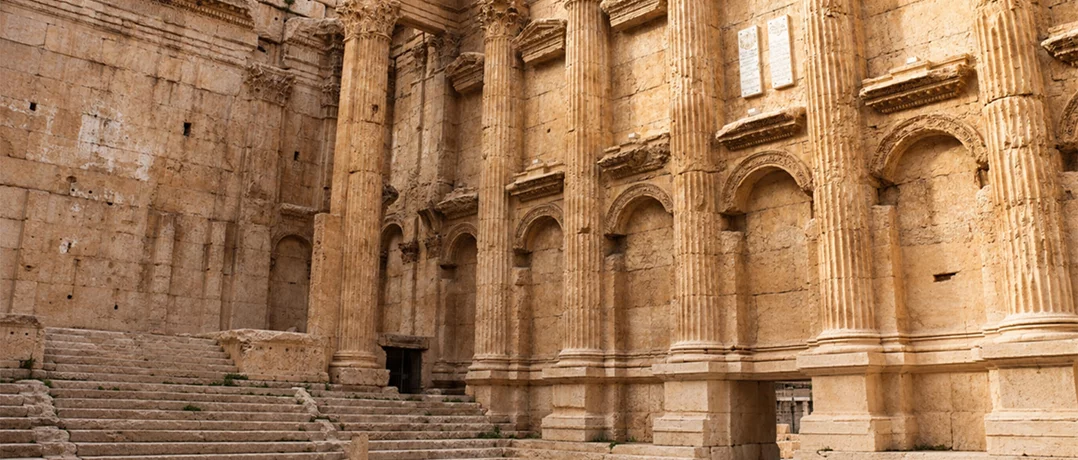
At Baalbek, the Romans built the largest temple of their empire after Rome itself: the Temple of Jupiter’s 54 Corinthian columns once stood 19.9 meters high, only six remain, and its podium contains the Trilithon, three limestone blocks roughly 19 meters long and weighing 750-800 tonnes each.
The Qadisha Valley sheltered Maronite hermits for over a millennium beside the Cedars of God, the last sacred grove of trees once felled by Solomon and the pharaohs. Tripoli’s Mamluk-era core sits beside Oscar Niemeyer’s unfinished 1962 Rachid Karami International Fair, inscribed by UNESCO in 2023.
Lebanon sits on the seam where the Mediterranean meets the Levant, and every civilization that wanted one through the other left something behind: Phoenicians, Persians, Greeks, Romans, Byzantines, Umayyads, Crusaders, Mamluks, Ottomans, French Mandate authorities.
Heritage you can taste and hear
Not all of it is stone. Lebanon ratified the UNESCO 2003 Convention for the Safeguarding of the Intangible Cultural Heritage in 2007 and, in 2014, inscribed Al-Zajal, a centuries-old form of improvised, sung poetry performed in competing teams at weddings and festivals, on UNESCO’s Representative List. The national register also tracks dabké, manakish, the soap-makers of Tripoli, and the Jezzine knife-makers whose handles are carved from horn. These travel with the diaspora, several million abroad, larger than the resident population of roughly 5.5 million, and keep the country recognizable to itself from São Paulo to Detroit.
And then, the destruction
Each wave of damage hits a particular nerve. The 1975–1990 civil war killed an estimated 120,000 people and gutted central Beirut along the Green Line, including the old souks and stretches of Ottoman and French Mandate architecture. The Solidere reconstruction that followed remains controversial.
The 2020 Beirut port explosion, 2,750 tonnes of ammonium nitrate, roughly 0.5–1.1 kilotons of TNT, one of the largest non-nuclear blasts in history, killed 218 people, injured over 7,000, displaced 300,000, and damaged more than 8,000 buildings, around 640 of historic value.
The Sursock Museum, less than a kilometre from the port, lost 70% of its building and 66 of the 132 artworks on display; restoration took nearly three years and cost about $2.5 million, funded partly by Italy through UNESCO’s Li Beirut initiative. Five years on, NGOs estimate only about 60% of damaged heritage buildings have been restored; the rest sit in limbo as international funding shifted to Ukraine and Gaza.
Then came the 2024 conflict between Israel and Hezbollah. Airstrikes destroyed a centuries-old Ottoman building and the 150-year-old Hotel Palmyra beside Baalbek, brought down part of its north gate, and struck within 50 meters of Tyre’s ruins. The Ottoman souk of Nabatieh was destroyed; the 19th-century church of St George in Derdghaya was hit while civilians sheltered inside; the 18th-century mosque in Kfar Tibnit was leveled; the historic village of Muhaibib was erased. Thirteen shrines and dozens of mosques were damaged.
UNESCO granted enhanced protection to 34 sites in November 2024, expanding the list to 73 in April 2026, nearly every major heritage landmark in the country.
The story of Lebanese heritage
Enhanced protection is a 1954 Hague Convention designation; it does not stop a missile. Lebanon’s heritage has always been protected less by paper than by the people around it, families keeping stone houses standing, parish priests maintaining mosaics, municipal staff fighting off developers. State collapse, an economic crisis that wiped out roughly 98% of the lira’s value since 2019, and accelerating emigration have hollowed out that human infrastructure.
This is what makes World Heritage Day in Lebanon feel less like a celebration than a reckoning. Preserving heritage here has never been about freezing the past. It is about refusing to let memory become another casualty.
-
-

-
The Beiruter
-
