



When foreign flags appear in Lebanon, a deeper debate emerges over sovereignty, national identity, and the state’s authority over public symbols.
The foreign flags challenging Lebanon’s sovereignty
The foreign flags challenging Lebanon’s sovereignty
By The Beiruter | October 01, 2026

Reading time: 5 min
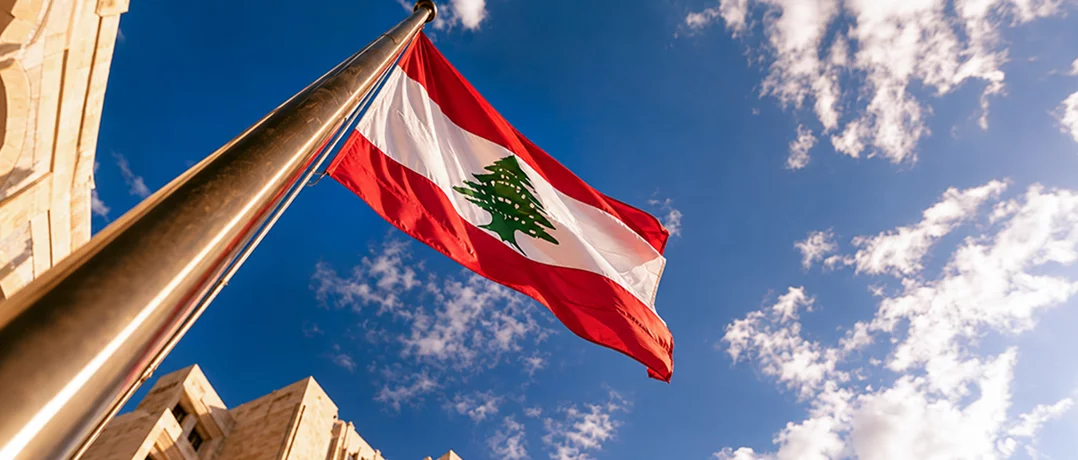
A recent dispute in the southern Lebanese town of Houmine al-Fawqa, in the Nabatiyeh district, over the raising of an Iranian flag on a private residence has reignited a broader debate over the legal status of foreign flags in Lebanon, the meaning of national symbols, and the state’s authority over public spaces.
The incident, which reached judicial authorities, resulted in a decision by the Public Prosecutor of Appeal in Nabatiyeh, Judge Najat Abu Chakra, ordering the removal of both the Iranian flag displayed on the house and a flag belonging to the Amal Movement that had been installed on municipal communal land. The decision was based on the principle that foreign flags cannot be displayed on Lebanese territory outside officially regulated contexts.
Speaking to The Beiruter, Lebanese lawyer and Head of the Change Movement Me. Elie Mahfoud said the case reflects a wider question extending beyond the specific incident: the relationship between national sovereignty, state authority, and the use of foreign symbols in Lebanon’s political environment.
A legal distinction between diplomatic use and political display
Mahfoud stressed that the presence of a foreign flag in Lebanon is not automatically a legal violation, explaining that the Lebanese state itself permits foreign flags to be displayed during official occasions, diplomatic events, and international conferences.
However, he drew a distinction between official and regulated use of foreign flags and their permanent or political display in public spaces. According to Mahfoud, a foreign flag can be considered legitimate when it appears within diplomatic or protocol frameworks, such as at embassies, during official visits by foreign leaders, or at international events where clear rules govern the placement of national symbols.
The issue becomes different, he argued, when a foreign flag is raised permanently or used as a political symbol in streets, public areas, or private properties in a way that conveys political affiliation or external influence.
Referring to the constitutional principle that Lebanon is a “sovereign, free, and independent homeland,” Mahfoud asserted that
Lebanon is a sovereign state, and the Lebanese flag is the symbol of this sovereignty.
He argued that the central question is not the existence of a foreign flag itself, but the context in which it is displayed and the message it seeks to convey.
The Lebanese flag and the question of sovereignty
For Mahfoud, the debate surrounding foreign flags is fundamentally linked to the concept of state sovereignty and the authority of national institutions.
He stressed that official protocol in Lebanon places the Lebanese flag at the center whenever it is displayed alongside foreign flags, with foreign symbols not allowed to take precedence over the national emblem.
From his perspective, the problem emerges when foreign flags move beyond diplomatic representation and become political symbols competing with the state’s own symbols. “The issue is not a foreign flag passing through Lebanon temporarily,” Mahfoud explained.
The issue is transforming a foreign flag into a political declaration of allegiance on Lebanese soil.
He argued that symbols can carry political meanings beyond their physical presence, particularly in countries where political identities and regional alliances have historically shaped public spaces.
While acknowledging that raising a foreign flag does not legally prove disloyalty or a violation of national allegiance, Mahfoud said the political implications can become significant depending on the circumstances.
He argued that when a foreign flag is displayed as part of a political identity or linked to an external project, it raises questions about the balance between domestic political expression and the authority of the Lebanese state.
According to Mahfoud, the key question is what the symbol represents: whether it reflects a temporary expression connected to a specific event, or whether it signals political alignment with a foreign state.
He warned that the repeated presence of foreign political symbols in Lebanese communities could contribute to a perception of competing loyalties and weaken the idea of a unified state.
Lebanon has one flag that represents one state.
Weak state authority and the persistence of the phenomenon
Mahfoud identified what he described as three main reasons behind the continued presence of foreign political symbols in Lebanon.
The first, he said, is the weakness of state authority. According to him, when state institutions retreat from regulating public space, political parties and other actors often fill the vacuum through symbols, slogans, and public displays of influence.
The second factor is what he described as the application of laws through “double standards.” Mahfoud argued that citizens question the credibility of state institutions when rules are enforced in some cases but not others. “The problem is no longer only the flag itself,” he said.
It becomes a question of the state’s ability to apply the law equally.
The third factor, according to Mahfoud, is political and security considerations. He argued that authorities sometimes hesitate to address certain issues because of the influence of the groups or actors associated with them (namely referring to Hezbollah). In his view, a state that applies laws only when facing weaker actors faces a challenge not only of law enforcement but of sovereignty.
A broader debate over symbols in public spaces
Mahfoud pointed to previous campaigns in which he called for the removal of political symbols and names linked to foreign figures from Lebanese public areas, including references associated with former Syrian President Hafez al-Assad and Iranian military commander Qassem Soleimani.
He argued that public spaces should not become platforms for promoting foreign figures or external political projects, regardless of their origin.
For him, the issue is not limited to one country or one political group, but concerns a broader principle regarding the relationship between Lebanon and external influences. “Lebanon is not an open space for foreign flags, nor a billboard for outside projects. Those who raise another country’s flag must remember that they are raising it on the territory of a state called Lebanon,” he said.
Lebanon is a state, and a state has one flag.
-
-

-
The Beiruter
-
