



A Sudanese migrant worker’s story reveals how war, displacement and Lebanon’s kafala system can leave migrant workers vulnerable to exploitation, insecure employment and legal uncertainty.
The fragile state of migrant workers amid displacement
The fragile state of migrant workers amid displacement
By Vanessa Kallas | August 22, 2026

Reading time: 7 min
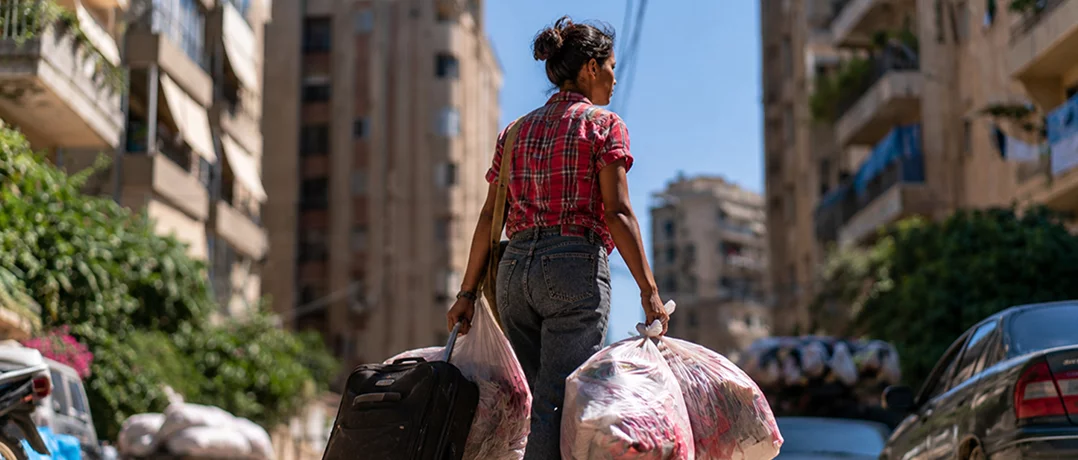
“Humanity is not a color. Humanity is not a shape. Humanity is a feeling from within.”
For Hamdan Mahmoud, a Sudanese migrant worker and poet who has spent years in Lebanon, those words come after a life marked by political persecution, precarious employment and displacement. When war erupted, Mahmoud was living with his employer in southern Lebanon, where his house was destroyed. He says his employer left him, his wife and their two-year-old son to fend for themselves, forcing the family to walk for hours to find transportation to safety.
“The walls had crumbled in our small room,” Mahmoud recalls. “I had to walk for hours with my wife and son to find a bus that would transport us to a safer zone.”
Mahmoud says his difficulties with the employer did not end with the destruction of his home. He had previously worked for months without receiving his wages and says he was sometimes required to work from morning until night, including his days off. After the fighting subsided, his employer asked him to return for the same $300 monthly salary, despite a previous agreement that it would increase to $400 after the war. Mahmoud refused. He says the employer then demanded $700 for the renewal of his residency and refused to return his belongings when Mahmoud asked to collect them, telling him they would remain confiscated until the money was paid.
“I sometimes worked for two or three months without receiving compensation,” he says. “I worked from morning until night, including on my days off.”
After his home was destroyed, Mahmoud and his family eventually found refuge at Migrant Services and Development (MSD), where they remained for nine months.
His experience reflects a broader vulnerability faced by migrant workers in Lebanon, whose employment, housing and legal residency can be closely connected to their relationship with an employer.
IOM’s latest Migrant Presence Monitoring identified 164,097 migrants across Lebanon from data collected in June and July 2025. Women accounted for 70% of the identified population, while Ethiopians represented 40%, followed by Bangladeshis at 21% and Sudanese migrants at 9%.
IOM’s 2026 Lebanon Crisis Response Plan estimates that around 165,000 migrants are at risk of exploitation, loss of legal status and exclusion from humanitarian assistance. When hostilities escalated in March 2026, more than 48,000 migrants were estimated to have been displaced.
Kafala ties residency to employment
The term “kafala” is commonly used to describe the system governing migrant workers in Lebanon, although there is no single Lebanese law formally establishing a system under that name.
“It refers to a collection of administrative rules and procedures governing the entry, employment, and residency of foreign workers,” says Lebanese lawyer Eliane Abdel Ahad.
In practice, the system can tie a migrant worker’s legal status to a particular employer, meaning that leaving a job can have consequences extending beyond the workplace.
The vulnerability is particularly pronounced among migrant domestic workers, who are excluded from Lebanon’s Labor Law under Article 7 and therefore do not receive the same statutory protections as other workers. A 2026 study published in Migration Studies estimates that around 177,000 migrant domestic workers, predominantly women, are employed in Lebanon, citing IOM 2024 data.
For workers facing abuse or exploitation, leaving an employer can become a complicated legal and administrative process.
“There is no general rule allowing a migrant worker to leave an employer and automatically retain an independent legal status,” Abdel Ahad says. “Changing employers generally requires administrative procedures involving the relevant authorities, although exceptional mechanisms can apply in specific circumstances.”
A worker may therefore have a legitimate reason to leave an employer while still facing uncertainty over how to maintain legal residency and employment.
The imbalance also extends to personal documents. Abdel Ahad says employers do not have a general legal right to retain workers’ passports because of an employment dispute, pointing to Lebanese court decisions in 2014 and 2016 that ordered employers to return passports belonging to migrant domestic workers and recognized the infringement of their freedom of movement.
The same principle applies to personal belongings. An employer does not acquire the right to confiscate a worker’s property because of a dispute over employment or wages, yet enforcing those rights can be difficult for someone without income, housing or secure legal status.
Mahmoud’s experience illustrates that gap. His dispute over wages and residency left him without work and unable to recover his belongings while he was already trying to rebuild his life after displacement.
When war exposes the gaps
The escalation of hostilities magnified vulnerabilities that already existed.
Migrant workers were living and working in areas heavily affected by fighting, including southern Lebanon, the Bekaa and Beirut’s southern suburbs. Some lost their jobs as businesses closed or employers left, while others were abandoned or found themselves without a place to stay.
Access to collective shelters was another obstacle. Humanitarian reporting during the escalation documented cases in which migrant workers and undocumented people were turned away from shelters or hesitated to approach them because of concerns about discrimination or their legal status. Some relied instead on community networks, overcrowded accommodation or informal arrangements.
For many displaced migrants, organizations such as MSD became an essential source of shelter and assistance.
Carole Daniel, a member of migrant services at MSD, says the organization was created in 2014 by migration experts and professionals from different backgrounds and has focused on legal and social assistance for migrant workers and refugees.
“We provide legal assistance and counselling for migrant domestic workers and refugees, legal representation and follow-up in courts, as well as social counselling and assistance,” Daniel says. She adds that MSD supports migrant workers across Lebanon “with no discrimination or preferences.”
Following the escalation, MSD’s collective shelter in Ghosta began receiving displaced migrants and vulnerable people from areas including Nabatiyeh, Bent Jbeil, Saida, Dahieh, Mays al-Jabal and Kafra.
Today, the shelter accommodates 29 families, totaling 87 people, including two pregnant women. Since the beginning of the war, around 250 people have passed through the shelter, while approximately 50 others could not be accommodated because of limited space and resources.
“We provide shelter, food, psychosocial support, medical care, and other basic services,” Daniel says. Residents can also receive individual psychological support and legal assistance.
MSD has also tried to help residents regain some degree of independence through training in sewing, electricity, gardening, soap making and makeup, alongside recreational activities for children.
For Mahmoud, the sewing course became a route back into employment. After spending months at the shelter, he completed the training and found work in a sewing factory, where he remained for five months before renewed fighting interrupted his employment again.
Migrants keep rebuilding
The humanitarian response has unfolded against a much wider displacement crisis. IOM’s displacement tracking recorded 430,600 internally displaced people across Lebanon as of July 8, 2026, while 732,594 people had begun returning to their communities.
Migrants make up a smaller proportion of the country’s overall displaced population, but their circumstances create particular obstacles. IOM’s 2026 response plan identifies exploitation, loss of legal status and exclusion from humanitarian assistance among the risks facing migrant communities.
For organizations assisting them, the shortage of resources remains a major concern.
“We have a waiting list because we do not have enough space to accommodate everyone who needs help,” Daniel says. The organization also faces the challenge of finding longer-term solutions for migrants who need employment, stable housing, legal support or repatriation.
The gap between emergency assistance and long-term security is particularly significant for migrant workers. A shelter can provide immediate protection, food and medical care, but leaving it still requires a worker to find employment, secure housing and address their legal status.
Abdel Ahad’s explanation of the system helps illustrate why that transition can be difficult. A worker who leaves an exploitative employer may still have to navigate administrative procedures before securing a new legal footing.
For migrant workers, rebuilding after displacement therefore requires more than finding a safe place to sleep. It requires the ability to earn wages, control personal documents and belongings, challenge exploitation and leave abusive employment without being pushed into legal and economic insecurity.
The war exposed the consequences of those vulnerabilities, but it did not create them. The structures governing migrant employment had already left many workers dependent on relationships that can affect their residency, income and access to basic security.
For Mahmoud, rebuilding has meant starting again more than once. He lost his home, saw his employment interrupted and remains unable to recover his belongings. Yet he continues to look for work, having used the skills he learned at the shelter to rebuild his livelihood.
His determination extends beyond his own future. Mahmoud wants his son to have the education and stability he was denied in Sudan.
MSD can provide temporary shelter, legal support, medical care and skills training, but Daniel’s account highlights the limits of emergency assistance when demand exceeds capacity. Around 250 people have passed through the shelter since the beginning of the war, while 50 others could not be accommodated.
For Lebanon’s migrant workers, lasting recovery will depend on whether they can move beyond emergency shelter toward secure employment, housing and legal status without remaining trapped in relationships that leave them vulnerable to exploitation.
-
-

-
Vanessa KallasJournalistCovering socio-political, environmental, and human rights issues.
-
