

France Day at USEK offered a window into how a centuries-old relationship is adapting to a new era, with education, entrepreneurship, research, and talent mobility increasingly defining cooperation between the two countries.
The future of Franco-Lebanese ties

The relationship between France and Lebanon predates the modern Lebanese state itself. French missionaries established schools throughout Mount Lebanon as early as the seventeenth century, while the nineteenth century saw France assume the role of protector of many Eastern Christian communities within the Ottoman Empire. Following the First World War, France governed Lebanon under a League of Nations mandate, helping shape many of the institutions that would later become part of the modern state.
Yet more than a century later, history alone no longer explains the endurance of that relationship.
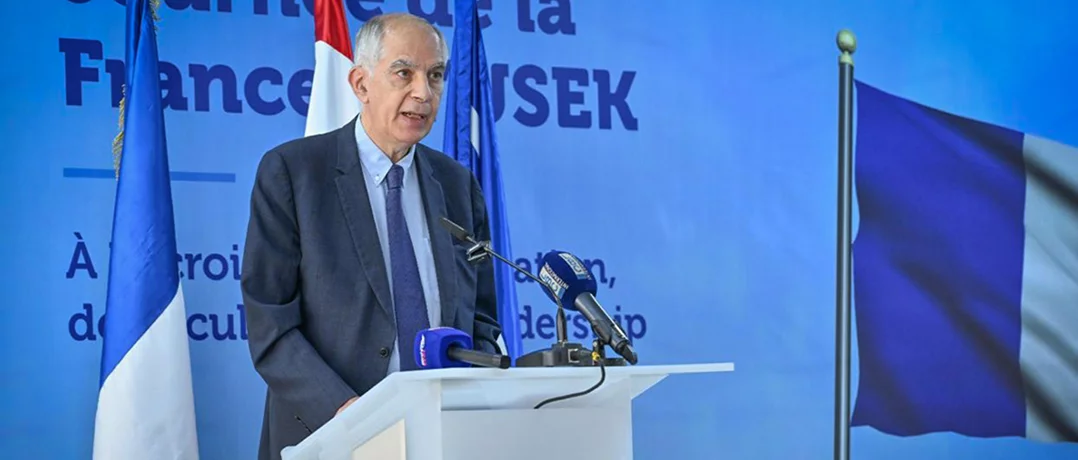
Against that backdrop, France Day at the Holy Spirit University of Kaslik (USEK) on June 11 examined a critical and timely question: how must the Franco-Lebanese relationship adapt to a period of profound technological, economic, and political change while preserving the foundations that have sustained it for centuries?
For the diplomats, university leaders, and business executives gathered in Kaslik, adaptation did not mean reinvention. Instead, conversations repeatedly returned to education, entrepreneurship, research, and mobility. From university partnerships and academic exchanges to private-sector investment, the relationship that emerged was sustained not only by historical affinity, but by the networks, institutions, and opportunities connecting the two countries.
From memory to exchange
Opening the event, USEK President Fr. Joseph Moukarzel argued that the relationship between France and Lebanon belongs to a category of ties that extend beyond political alliances or economic interests.
"There are relationships between peoples that are born of interest. Others are born of geography," he said.
And then there are rarer, deeper relationships, born of long-standing mutual recognition. The relationship between France and Lebanon belongs to this latter category.
For Fr. Moukarzel, the relationship has endured as much through schools, universities, cultural institutions, and personal connections as through official diplomacy. More than a century after the French Mandate, those connections remain visible across Lebanon, from academic partnerships and research collaborations to the steady movement of students and professionals between the two countries.
French Ambassador Hervé Magro focused on those contemporary connections. France continues to support academic cooperation through scholarship and research initiatives such as FORSA, SAFAR, and SEVE, he noted, while USEK alone maintains partnerships with more than 60 French public and private institutions.
"Our objective is not brain drain," Magro said.
Our objective is that these Lebanese talents return, transmit their knowledge, and invest their skills in rebuilding their country.
Universities at the center
If one institution sits at the center of the contemporary Franco-Lebanese relationship, it is the university. As Fr. Moukarzel put it:
Today, Lebanese universities carry an immense responsibility: preventing the fatigue of a country from becoming the fatigue of a generation
The educational ties between France and Lebanon remain extensive. According to Campus France du Liban, 3,472 Lebanese students were enrolled in French higher education during the 2024-2025 academic year, a 3 percent increase from the previous year and 17 percent higher than five years earlier. At the school level, approximately 500,000 students attend French-language institutions across Lebanon, one of the largest Francophone educational networks outside France.
Those connections have taken on added significance since the onset of Lebanon's financial crisis in 2019. As economic opportunities narrowed and public institutions struggled, universities remained among the country's most internationally connected sectors, sustaining research partnerships, academic exchanges, and pathways to professional opportunities abroad.
Yet educational cooperation is no longer understood simply as Lebanese students leaving for France. Maxence Duault, president of the France-Lebanon Chamber of Commerce and Industry and director general of ESA Business School, argued that partnerships between Lebanese and French institutions increasingly function as exchanges rather than transfers.
“Lebanon possesses genuine expertise in education, from schools to universities,” he said. “When we speak about partnerships between Lebanese and French institutions, these are not one-way relationships.”
Discussing collaborations between Lebanese and French institutions, Duault pointed to academic modules developed in Beirut that are now taught in France and to international executive education programs organized by Lebanese teams on behalf of leading French business schools.
While France remains an important destination for Lebanese students, Lebanese institutions increasingly contribute expertise, research, and educational innovation to the wider Francophone academic ecosystem.
Lebanon's competitive advantage
For many of the business leaders present, Lebanon's most valuable resource was neither geographic nor financial. It was human capital.
According to France's Ministry for Europe and Foreign Affairs, nearly 100 French companies currently operate in Lebanon across sectors ranging from telecommunications and finance to logistics, energy, retail, and agribusiness. Companies such as CMA CGM, Publicis, TotalEnergies, Saint-Gobain, and Thales continue to maintain a presence despite years of instability.
Their continued presence reflects confidence not only in the Lebanese market, but also in the Lebanese workforce. As Dualt noted, membership in the France-Lebanon Chamber of Commerce and Industry has grown from 65 companies in 2020 to nearly 175 today, a figure he cited as evidence that many firms continue to view Lebanon as a place worth investing in despite its challenges.
For Hady Nassif, president of Lebanon's committee of French Foreign Trade Advisors, the explanation is straightforward.
"Lebanon's greatest asset remains its people," he said.
Nassif described Lebanese professionals as multilingual, multicultural, and comfortable operating between different regions and professional environments. Those qualities, he argued, have made Lebanese talent valuable not only within Lebanon but across Europe, the Gulf, and beyond.
Myriam Zarife, chief executive of digital health company Dictalive, offered a more entrepreneurial perspective. Asked what had enabled the company to expand across Lebanon, France, and Switzerland, she pointed first to adaptability.
"If I had to identify the key factors behind our growth, the first would be adaptability," she said.
As Lebanese entrepreneurs, adaptation is almost part of our DNA. We constantly adapt internally, but we also adapt to different cultures, markets, and communities in order to meet their specific needs.
Her experience underscored the extent to which Lebanese entrepreneurs continue to translate local expertise into businesses that operate across multiple markets.
Francophonie as an economic asset
Language occupied a prominent place in the conversation. For decades, French in Lebanon has often been framed as a cultural inheritance, a legacy of historical ties that remains visible in schools, universities, and public life. Several speakers, however, approached the question from a different angle.
Drawing on the work of psychologist Ellen Bialystok, whose research has linked multilingualism to cognitive flexibility and problem-solving ability, Duault argued that Lebanon's long tradition of education in Arabic, French, and English provides advantages that extend well beyond culture.
“When you look at the benefits associated with multilingualism, you almost see a description of the Lebanese character,” he said.
The French language is therefore not only a cultural asset. It is a cognitive asset and a strategic advantage.
The argument carries particular relevance in Lebanon, where generations of students have been educated in Arabic, French, and English. French remains the language of instruction for mathematics and science in a substantial share of Lebanese schools, while graduates routinely enter professional environments that require them to move between multiple languages and cultural contexts.
Viewed through that lens, Francophonie is more than a matter of heritage. It functions as a source of professional capital and a competitive advantage in an economy that rewards adaptability, communication, and cross-cultural fluency.
A partnership recast
As France and Lebanon navigate a rapidly changing political, economic, and technological landscape, their centuries-old ties will need to find new expressions and new areas of cooperation. History remains part of the story. So does culture. Yet the conversations in Kaslik also pointed to the importance of the mechanisms through which those ties are sustained: universities, research partnerships, entrepreneurship, and professional networks.
Lebanon's youngest generation will therefore play an important role in determining how those connections evolve in the decades ahead.
"Get involved. Build networks. Look for opportunities. Connect with people," Zarife said, encouraging students to engage actively with the opportunities available to them.
You can create from Lebanon. You can build companies from Lebanon. You can create products and services here that serve international markets.
Her remarks pointed toward a vision of the relationship built not on nostalgia, but on cooperation. Centuries after France's arrival in Lebanon, the relationship finds expression not only through diplomacy or culture, but through classrooms, businesses, and institutions that bring people from both countries into regular contact.
If the Franco-Lebanese relationship was once anchored primarily in memory, its future may rest on its ability to remain a source of exchange, opportunity, and collaboration for both countries.
-
-

-
The Beiruter
-
