



From collapsing confidence in governments and media to growing distrust between citizens themselves, public trust is becoming one of the defining political and cultural crises of the modern era.
The global trust collapse

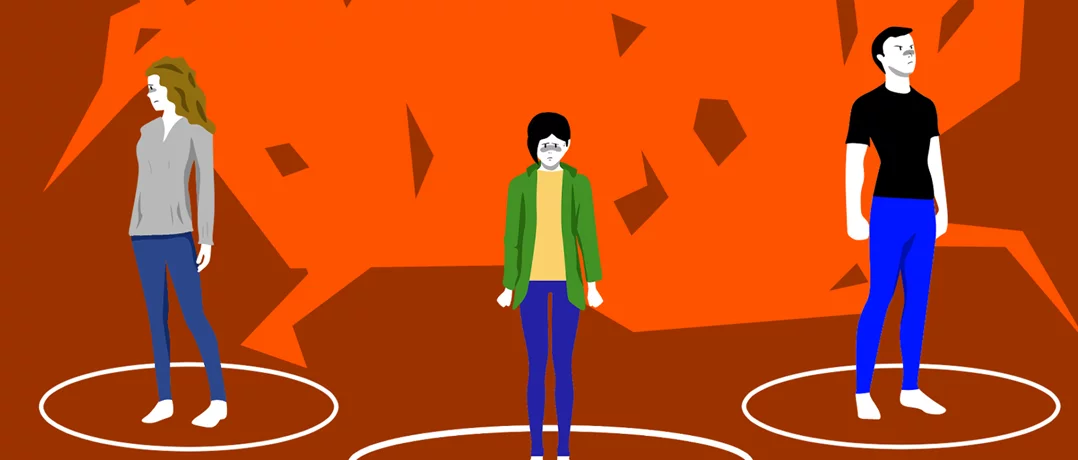
Illustration by Karim Dagher
Public trust in institutions is no longer simply declining. In many countries, it is becoming more insular, as citizens increasingly place their confidence only in those who share their political identities, social backgrounds, or cultural worldviews. As that distrust deepens, the range of people, institutions, and information sources considered credible continues to narrow, weakening the shared civic and informational foundations democratic societies depend on.
The 2026 Edelman Trust Barometer found that nearly seven in 10 people globally are unwilling to trust someone with different values, while only 39% regularly consume news from sources with opposing political perspectives. Together, the findings suggest that distrust is no longer functioning merely as dissatisfaction with institutions. It is increasingly reorganizing how people consume information, engage politically, and relate to one another.
Trust in institutions is reaching historic lows
The deterioration in institutional confidence is now visible across multiple international datasets. The Edelman Trust Barometer, which surveyed more than 37,500 people across 28 countries, found that distrust toward those with different values rises to 90% in Japan, 81% in Germany, and 76% in the United Kingdom, while the United States sits almost exactly at the global average at 70%. The report also found that 65% of respondents worry foreign actors are injecting falsehoods into national media ecosystems to inflame domestic divisions.
The report furthermore identified a widening economic divide in institutional trust. In 2012, Edelman measured a six-point trust gap between high-income and low-income respondents. By 2026, that gap had more than doubled to 15 points globally. The disparities are especially pronounced in the United States, where the gap now stands at 29 points, followed by Indonesia and Nigeria at 26 points each, France at 22, and Saudi Arabia at 21.
The deterioration is also visible in long-running polling conducted by Gallup. Its 2025 Confidence in Institutions index found that only three institutions command majority confidence among Americans, which are small business at 70%, the military at 62%, and science at 61%. Confidence in Congress, meanwhile, has fallen to just 9%, while television news stands at 11%
and newspapers at 17%, among the lowest levels recorded since the survey began.
The decline extends beyond the United States. According to Government at a Glance 2025, the latest comparative survey published by the Organisation for Economic Co-operation and Development, only 39% of people across OECD countries say they trust their national government. Just 37% believe governments are balancing the needs of current and future generations effectively. In Latin America and the Caribbean, the OECD’s first regional trust survey across 10 countries found that figure even lower at 35%.
What makes these findings particularly consequential is that trust functions as a form of civic infrastructure. Democratic systems rely on the assumption that public institutions retain at least baseline legitimacy, even amid disagreement. As that legitimacy weakens, governing becomes more difficult, compromise becomes politically risky, and public consensus becomes harder to sustain.
Shared information environments are breaking apart
The erosion of trust is also altering how people consume information. Rather than turning away from information entirely, many audiences are increasingly relying on narrower and more politically aligned sources.
The 2025 Reuters Institute for the Study of Journalism Digital News Report, which surveyed audiences across 48 markets on six continents, found that trust in news has remained stuck at just 40% globally for the third consecutive year. In the United States, only 32% of respondents said they trust most news most of the time. The report also documented growing levels of news avoidance, with substantial shares of respondents saying they sometimes or often actively avoid political news altogether.
Among younger audiences, reliance on TikTok personalities, YouTube creators, podcasts, and influencers continues to grow at the expense of traditional news organizations. As audiences sort themselves into increasingly personalized media ecosystems, societies lose common informational reference points for understanding events, evaluating facts, and resolving political disagreements.
The Reuters Institute report additionally found that countries with higher levels of political polarization consistently record weaker confidence in journalism and greater patterns of selective news consumption. Increasingly, information is judged less on factual grounds than on whether it aligns with existing political or social identities.
That dynamic reinforces itself over time. Narrower information diets deepen distrust, and deeper distrust further narrows the range of acceptable information sources.
Distrust is becoming socially isolating
One of the most striking aspects of the current decline in trust is that it now extends beyond institutions themselves, with people increasingly less willing to trust one another.
The Edelman Trust Barometer found that nearly seven in 10 respondents globally now believe people with different political or social views are difficult to trust. More than half said governments and business leaders deliberately mislead the public. Large shares of respondents also expressed concern that journalists, political leaders, and CEOs are actively contributing to societal division rather than reducing it.
This helps explain why distrust increasingly manifests not simply as political anger, but as withdrawal. People disengage from civic participation, avoid opposing viewpoints, and retreat toward smaller communities organized around shared beliefs and identities.
The consequences extend beyond politics. Lower-trust societies often experience weaker social cohesion, lower confidence in expertise, and greater difficulty implementing long-term public policy. Trust affects whether populations comply with public health guidance, believe economic messaging, cooperate with institutions, or feel invested in collective systems larger than themselves.
Many of the most influential trust studies now point toward the same conclusion. The problem is no longer only whether institutions can regain public confidence. Increasingly, it is whether societies can preserve enough shared trust to sustain a common civic reality at all.
-
-

-
The Beiruter
-
