



A Baalbek tradition, tarq preserves memory through slow, manual craftsmanship.
The gold thread that tells Baalbak’s story

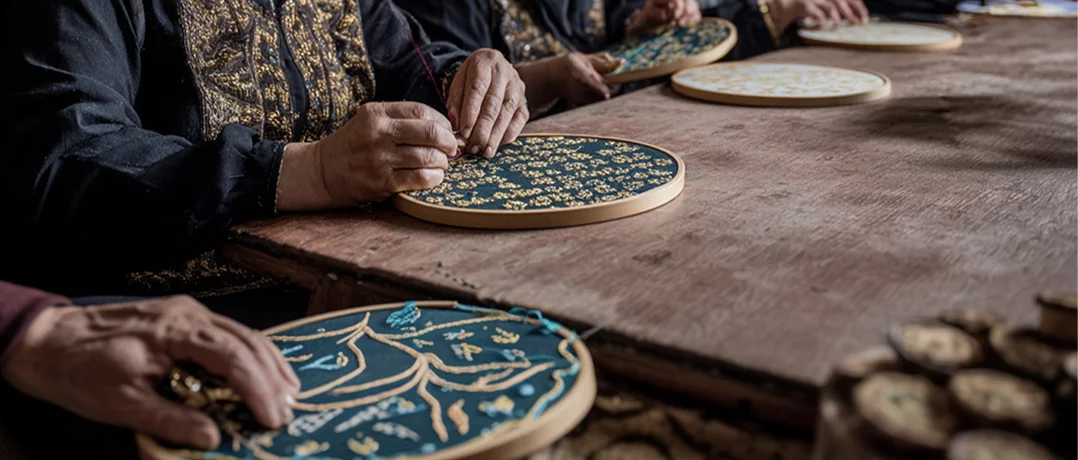
A manual craft that turns fabric into a mosaic of light, one point at a time. Practiced almost exclusively by hand, tarq is an embroidery technique that cannot be replicated by machines, making it one of Lebanon’s most delicate and endangered traditional crafts.
The technique is performed on fine fabrics such as silk, tulle, linen, and Najaf fabrics, though its most traditional base is a silk veil: thin, slightly transparent, and stretched tightly over a round wooden frame. Onto this fragile surface, artisans embroider using metallic wire made of pure gold or silver, free of polyester or synthetic alloys. The materials alone place tarq among the most precious forms of textile work.
The tools are just as specific. The needle used for tarq is unlike a standard sewing needle: it is silver-plated and features two holes. Each stitch is made independently, the needle pricks the fabric, the thread is closed in on itself, then cut. No stitch is continuous. Instead, hundreds, sometimes thousands, of tiny points come together to form the final pattern.
A mosaic of precision
The patterns created through tarq are typically geometric, inspired by oriental motifs and composed of minute square shapes that resemble a mosaic. These designs are embroidered directly onto the fabric without being drawn beforehand, relying entirely on the artisan’s memory, spatial awareness, and rhythm. It is work that demands exceptional patience and concentration.
While tulle is considered the easiest fabric to embroider due to its thinness, it is also fragile. The needle and metallic thread are wide enough to tear the fabric if mishandled. Mastering tarq therefore requires not only technical skill but years of experience. Professional embroiderers are able to work confidently on all fabrics, regardless of their delicacy.
Tarq is expensive, by necessity, not luxury. The cost of gold and silver thread is high, as is the quality of fabric required to support it. Precious wire cannot be placed on poor-quality textiles, and the time investment is significant. Creating a single veil or abaya can take days, sometimes weeks, depending on the density of the embroidery.
From ottoman Baalbek to today
The craft arrived in Baalbek during Ottoman rule, introduced by a Turkish woman who taught the technique to local women. Over time, tarq became deeply rooted in the city’s cultural fabric.
Today, as fewer women master the technique, local associations in Baalbek organize training sessions to ensure tarq is not lost. These initiatives aim to keep the knowledge alive while adapting it to contemporary realities.
In Baalbek’s wedding traditions, tarq holds a ceremonial role. On the night of the henneh, which precedes the wedding, the bride wears a tarq-embroidered abaya. As the groom’s parents arrive carrying the henneh tray, the bride prepares for the ritual dressed in the embroidered garment. When her hands and feet are finished, the house fills with song and dance before the groom’s family departs.
The bride also wears a tarq abaya on her wedding day, a symbolic garment woven into moments of transition, celebration, and continuity.
A living heritage
Tarq is a memory stitched into fabric, history carried on a veil. Each point is a gesture of patience, each pattern a quiet inheritance. In an age of speed and replication, tarq remains stubbornly slow, deliberately human. And perhaps that is its greatest value: a craft that insists on time, care, and the beauty of what cannot be rushed.
-
-

-
The Beiruter
-
